FlashRender slashes video rendering's sampling cost 25x
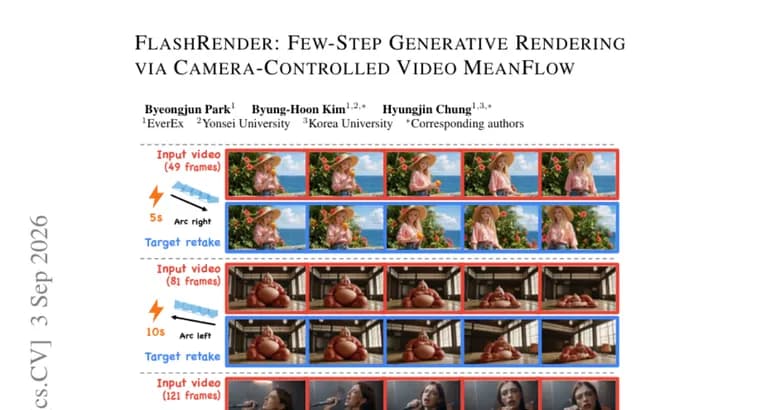
Researchers have introduced FlashRender, a few-step generative rendering framework that takes a source video and re-renders it along a different target camera trajectory in a matter of seconds. The work starts from a diagnosis: existing multi-step generative rendering models show camera control that depends on the number of sampling steps used, which the authors identify as a visible symptom of discretization error. They argue that fixing this step-dependent inconsistency substantially lowers the curvature of the model's denoising trajectory, which in turn makes it much easier to distill the process down to fewer steps. To fix the inconsistency itself, the paper introduces Representation Transformation and Alignment (RETA), a technique that aligns hidden representations of the source video with target-video features produced by a frozen visual geometry model. This bakes the geometric transformation directly into the source-video stream, so camera control stays consistent regardless of how many sampling steps are used. On top of the lower-curvature trajectory that RETA produces, the model is fine-tuned with a MeanFlow objective, which lets it handle discretization error more effectively. Finally, the authors apply on-policy flow map distillation to correct errors that accumulate when the model generates its own rollouts under a fixed, small number of sampling steps. According to the paper, extensive experiments show that RETA, the MeanFlow objective, and the on-policy distillation step are complementary: combined, they let FlashRender match multi-step baseline models on both video quality and geometric consistency at 25x lower sampling cost, and it also achieves better camera controllability than those baselines, including on camera trajectories that fall outside the training distribution.
Key facts
- FlashRender re-renders a source video along a new target camera trajectory in seconds, using a few-step generative model instead of a slow multi-step one.
- It traces camera-control problems in existing multi-step models to sampling-step-dependent discretization error, and shows that fixing this lowers denoising trajectory curvature and eases step distillation.
- RETA (Representation Transformation and Alignment) aligns hidden source-video features with target-video features from a frozen visual geometry model to keep camera control consistent across sampling steps.
- A MeanFlow fine-tuning objective plus on-policy flow map distillation are added to further reduce discretization error and correct self-rollout errors under fixed few-step sampling.
- FlashRender matches multi-step baselines on video quality and geometric consistency at 25x lower sampling cost, with better camera controllability even on out-of-distribution camera trajectories.
Why it matters
Multi-step generative rendering models have needed many sampling steps to keep camera control accurate, which is slow. The paper traces this to a specific cause, camera control that varies with the number of sampling steps, and shows that resolving it also lowers the curvature of the denoising trajectory, which is what makes aggressive step distillation feasible without the usual quality trade-off. That combination, a diagnosed cause plus a fix that unlocks distillation, is the core contribution.
Who it affects
The audience is researchers and engineers working on video generation, novel-view synthesis, and camera-controlled video editing, who need faster generative rendering pipelines that still hold up on geometric consistency. The abstract does not name the authors, an institution, or any downstream product, so it reads as a research contribution rather than an announced tool.
How to use it
The source text gives no publication venue, no code or dataset release, and no pricing or licensing information, so there is nothing yet to point to for hands-on use.
How solid is it
The authors describe the results as backed by extensive experiments comparing FlashRender to multi-step baselines on video quality, geometric consistency, and camera controllability, including on out-of-distribution camera trajectories, at 25x lower sampling cost. The abstract does not name the specific benchmarks, datasets, or baseline models used, nor does it report quantitative quality scores, so the size and rigor of that experimental comparison cannot be checked from this text alone.
Risks and caveats
All of the reported outcomes, including the 25x figure, come from the authors' own description of their experiments; without named benchmarks, baselines, or metric scores in the source, the claims cannot be independently verified from this text. No runtime figure or code release accompanies the claim that rendering takes place 'in seconds', so real-world speed and reproducibility remain open questions.