FlowBalance improves Qwen3 math reasoning over FlowRL
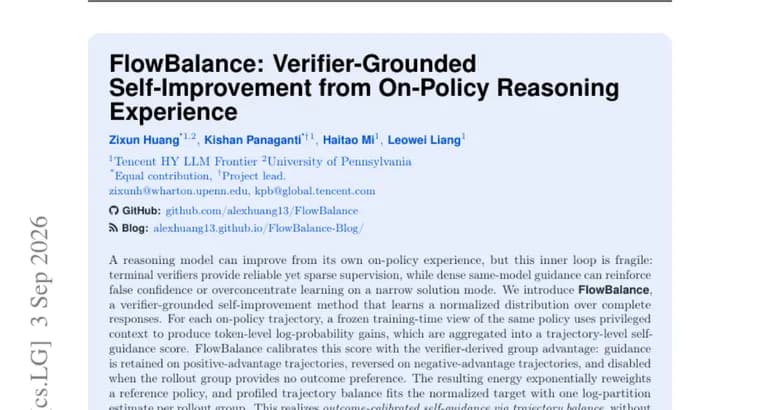
Zixun Huang and co-authors present FlowBalance, a method for letting a reasoning model improve itself from its own on-policy rollouts without drifting into overconfidence. The starting problem: terminal verifiers (checking whether a final answer is right) give reliable but sparse feedback, while denser self-generated guidance from the same model can reinforce false confidence or collapse learning onto one narrow solution style. FlowBalance addresses this by learning a normalized distribution over complete responses rather than training token by token. For each on-policy trajectory, a frozen, training-time copy of the same policy uses privileged context to compute token-level log-probability gains, which are aggregated into a single trajectory-level self-guidance score. That score is then calibrated against the verifier-derived group advantage: guidance is kept on trajectories the verifier marks as positive-advantage, reversed on negative-advantage trajectories, and switched off entirely when a rollout group gives no outcome preference either way. The resulting energy function reweights a reference policy exponentially, and the authors fit this normalized target using trajectory balance with one log-partition estimate per rollout group, which lets the method realize outcome-calibrated self-guidance without a separate token-level imitation loss. The authors also give theoretical backing: within-group contrast preservation, a minimum-change characterization in reverse KL divergence, monotonic verifier control over the target reward, and an exact correction against false-positive self-guidance on rejected responses. On mathematical reasoning benchmarks, FlowBalance improves average performance over the FlowRL baseline on both Qwen3-4B and Qwen3-8B, while also improving training speed and stability. It avoids the response-length collapse that the authors report for direct OPSD, and shows higher correct-strategy diversity in a controlled AIME24 diagnostic. The paper's text does not give the specific numeric margins by which FlowBalance beats FlowRL or OPSD, nor does it name author affiliations, a release date, or a code or dataset link.
Key facts
- FlowBalance is a verifier-grounded self-improvement method that learns a normalized distribution over complete model responses rather than training token by token.
- A frozen, training-time copy of the policy produces token-level log-probability gains, aggregated into a trajectory-level self-guidance score.
- That score is calibrated against verifier-derived group advantage: kept on positive-advantage trajectories, reversed on negative-advantage ones, and disabled when a rollout group has no outcome preference.
- FlowBalance improves average performance over the FlowRL baseline on both Qwen3-4B and Qwen3-8B on mathematical reasoning, and improves training speed and stability.
- It avoids the response-length collapse seen with direct OPSD and shows higher correct-strategy diversity on a controlled AIME24 diagnostic.
Why it matters
Letting a reasoning model learn from its own attempts is efficient but risky: a verifier that only checks the final answer gives too little signal to learn from quickly, while letting the model guide itself more densely can teach it to trust wrong reasoning that happened to land on a right-looking answer, or to collapse onto one narrow way of solving problems. FlowBalance is an attempt to get the density of self-guidance without that failure mode, by anchoring the model's own confidence signal to what the verifier actually confirms.
Who it affects
The method targets researchers and engineers building reasoning models through reinforcement-learning-style post-training, particularly on math reasoning tasks. It is demonstrated on the open Qwen3-4B and Qwen3-8B models, so it is directly relevant to teams already working with that model family or comparable open reasoning models.
How to use it
This is a research method described in a paper, not a released product. The source text gives no code repository, dataset link, or release date, so there is nothing here to install or call directly; adopting it would mean implementing the training procedure described in the paper.
How solid is it
The claims rest on a single paper's own reported comparisons against the FlowRL baseline on Qwen3-4B and Qwen3-8B, plus a controlled AIME24 diagnostic for strategy diversity, backed by theoretical results the authors state (within-group contrast preservation, a minimum-change reverse-KL characterization, monotonic verifier control of target reward, and an exact correction against false-positive self-guidance). The available text does not include the actual numeric performance gap between FlowBalance and FlowRL or OPSD, only that FlowBalance comes out ahead; independent replication and broader benchmark coverage are not addressed here.
Risks and caveats
The source text does not state the size of the reported improvements, so the practical magnitude of the gain over FlowRL or OPSD cannot be judged from what is available. No author affiliations, institutions, or funding are given, and the paper had minimal engagement on its discussion page at the time of writing, so wider scrutiny of the method has not yet had time to surface.
“guidance is retained on positive-advantage trajectories, reversed on negative-advantage trajectories, and disabled when the rollout group provides no outcome preference”
— FlowBalance paper