FlowEvo co-evolves LLM agents' workflows and reusable skills
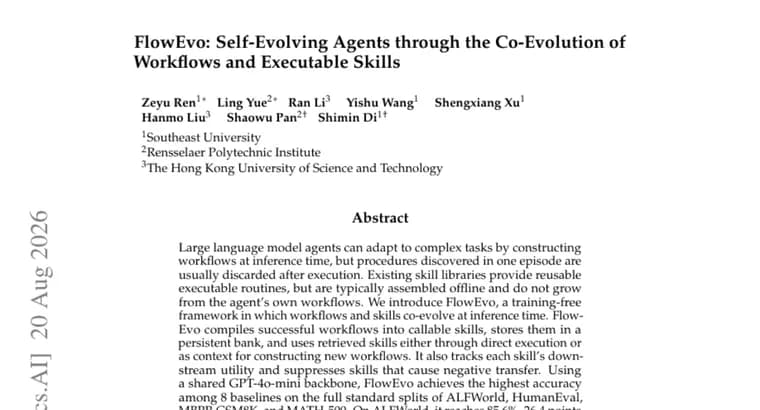
Large language model agents that build workflows on the fly to handle complex tasks usually throw those workflows away once the task is done, even the ones that worked. Reusable skill libraries exist as an alternative, holding executable routines an agent can call on later, but they are typically assembled offline ahead of time and do not grow out of what an agent discovers while actually working. The researchers introduce FlowEvo, a training-free framework in which an agent's workflows and its skills co-evolve together at inference time.
FlowEvo compiles a workflow that succeeded into a callable skill and stores it in a persistent bank. On later tasks, the agent can retrieve a stored skill and either run it directly or use it as context while building a new workflow. The bank is not allowed to grow without limit: FlowEvo tracks each skill's downstream utility and suppresses any skill found to cause negative transfer, meaning it hurts performance rather than helping it.
Using one shared GPT-4o-mini backbone, FlowEvo achieves the highest accuracy among 8 baseline methods on the full standard splits of five benchmarks: ALFWorld, HumanEval, MBPP, GSM8K, and MATH-500. On ALFWorld specifically, it reaches 85.6% accuracy, 26.4 percentage points above the strongest baseline, while using roughly one third as many tokens as that baseline. In a separate comparison across 10 base models ranging from 7B to 671B parameters, FlowEvo outperforms a method called ExpeL in 49 of 50 model-dataset comparisons.
Code for FlowEvo is available at https://github.com/DEFENSE-SEU/FlowEvo.
Key facts
- FlowEvo is a training-free framework in which an LLM agent's workflows and skills co-evolve at inference time, compiling successful workflows into callable skills stored in a persistent bank.
- The bank is curated, not just accumulated: FlowEvo tracks each skill's downstream utility and suppresses any skill that causes negative transfer.
- Using a shared GPT-4o-mini backbone, FlowEvo achieves the highest accuracy among 8 baselines on the full standard splits of ALFWorld, HumanEval, MBPP, GSM8K, and MATH-500.
- On ALFWorld it reaches 85.6% accuracy, 26.4 percentage points above the strongest baseline, using roughly one third as many tokens as that baseline.
- Across 10 base models spanning 7B to 671B parameters, FlowEvo outperforms the ExpeL baseline in 49 of 50 model-dataset comparisons; code is available on GitHub.
Why it matters
Most LLM agents that build multi-step workflows on the fly discard the workflow once the task is done, even when it worked well. Reusable skill libraries are the usual alternative, but they are typically built offline ahead of time and do not grow out of what an agent actually discovers while working. FlowEvo closes that gap: it needs no updates to the underlying model's weights, and it lets an agent's own successful workflows accumulate into a persistent, reusable skill bank as the agent keeps working. It also actively curates that bank, tracking each skill's downstream usefulness and suppressing any skill found to cause negative transfer, so the library does not simply grow without limit.
Who it affects
The benchmarks span embodied household tasks (ALFWorld), code generation (HumanEval, MBPP) and math reasoning (GSM8K, MATH-500), so the immediate audience is researchers and engineers building LLM agents for multi-step tasks like these. Because FlowEvo needs no retraining and was tested across 10 base models ranging from 7B to 671B parameters, the approach is not tied to one model size or one lab's infrastructure. It is a research contribution released with accompanying code, not a shipped commercial product.
How to use it
FlowEvo is training-free: it does not require fine-tuning or updating the backbone model's weights, so it runs on top of an existing LLM. The recipe is to let the agent operate normally, compile any workflow that succeeds into a callable skill, and store it in a persistent bank; the next time a related task comes up, the agent can retrieve a stored skill and either execute it directly or use it as context while assembling a new workflow. FlowEvo also tracks how much downstream benefit each stored skill actually provides and suppresses any that cause negative transfer rather than help. Code is available at https://github.com/DEFENSE-SEU/FlowEvo.
How solid is it
The claims rest on two sets of experiments described in the abstract: a comparison against 8 baselines on the full standard splits of five benchmarks using one shared GPT-4o-mini backbone, and a separate comparison against a method called ExpeL across 10 base models spanning 7B to 671B parameters, where FlowEvo won 49 of 50 model-dataset pairings. That is a broad sweep across benchmark domains and model sizes. The abstract does not name which specific baseline counts as 'the strongest baseline' referenced in the ALFWorld accuracy and token comparisons, does not explain how negative transfer is detected or how a skill's downstream utility is measured, and does not describe what ExpeL is beyond being the method FlowEvo is compared against. It is also not stated whether the GPT-4o-mini backbone used in the main comparison is one of, or separate from, the 10 base models used against ExpeL.
Risks and caveats
The source names its individual authors but gives no institutional affiliation, and no date for when the paper was submitted or published, which limits how easily a reader can independently trace when the work was done. The mechanism for suppressing skills that cause negative transfer is described only at a high level in the abstract: adopting FlowEvo means trusting that self-curation step, not just its benchmark numbers, on the paper's word until more detail is available.