FRED trains World Action Models to predict future video features in one step
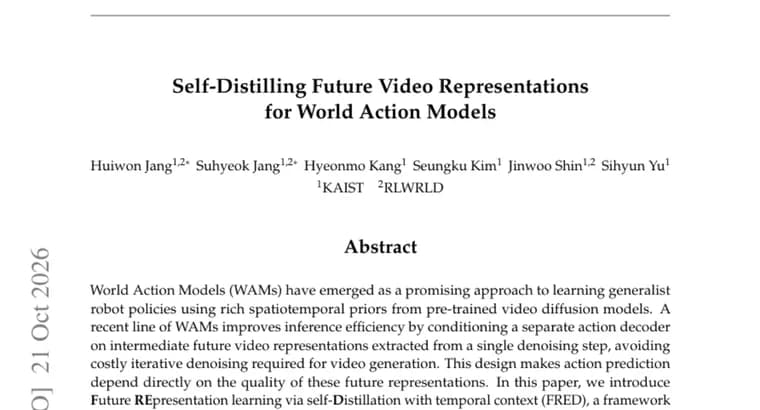
World Action Models (WAMs) are an approach to building generalist robot policies that borrows the rich spatiotemporal priors of pre-trained video diffusion models. A recent line of WAMs speeds up inference by conditioning a separate action decoder on intermediate future video representations taken from a single denoising step, which avoids the costly iterative denoising normally needed to generate video. The paper's authors point out that this design makes action prediction depend directly on how good those future representations are.
The paper introduces FRED, short for Future REpresentation learning via self-Distillation with temporal context. It is a framework that trains WAMs to improve the quality of future video representations produced from noise in a single denoising step. The core mechanism is self-distillation: the model learns to predict future representations from noise, and the targets are representations extracted from ground-truth future observations. On top of that, the video model is also conditioned on historical observations, which supply temporal context and help it predict future representations better.
The abstract reports that across diverse real-world manipulation scenarios, FRED consistently outperforms competing WAMs. The gains are described as particularly large on long-horizon tasks and on out-of-domain tasks under zero-shot environment generalization. The one concrete number comes from human-to-robot skill transfer, which FRED is said to improve substantially: on tasks absent from the robot training data and demonstrated only in human videos, FRED reaches 50.0% task success, compared with 19.4% for the best competing WAM.
Key facts
- FRED (Future REpresentation learning via self-Distillation with temporal context) trains World Action Models to produce better future video representations from noise in a single denoising step.
- It uses self-distillation, with representations extracted from ground-truth future observations as the targets, and conditions the video model on historical observations for temporal context.
- The abstract says FRED consistently outperforms competing WAMs across diverse real-world manipulation scenarios.
- Gains are described as particularly large on long-horizon and out-of-domain tasks under zero-shot environment generalization.
- On tasks demonstrated only in human videos and absent from robot training data, FRED reaches 50.0% task success versus 19.4% for the best competing WAM.
Why it matters
Single-step WAMs avoid the heavy cost of iterative video denoising, but their action decoder is only as good as the future representations it receives. FRED targets exactly that weak point by training the model to make those one-step representations better. The most striking reported result is in learning from human videos: 50.0% task success against 19.4% for the best competing WAM on tasks the robot never saw demonstrated by a robot.
Who it affects
Mainly researchers building generalist robot policies and video-diffusion-based world models, especially those working on efficient single-step inference. The human-to-robot transfer result is also relevant to anyone hoping to teach robots from human video rather than from robot demonstrations.
How to use it
This is a research paper, not a product. The method's recipe, as described, is to train a WAM with self-distillation against representations from ground-truth future observations, and to condition the video model on historical observations. No code, weights or release plans are mentioned.
How solid is it
The claims come from the paper's own abstract and cover real-world manipulation scenarios, which is more convincing than simulation alone. But the abstract gives limited detail. The number of tasks, trials, robots or environments behind the 50.0% and 19.4% figures is not stated. The competing WAMs are not named, and the abstract does not say which one scored 19.4%. For long-horizon and out-of-domain tasks only a qualitative statement of 'particularly large gains' is given.
Risks and caveats
The 50.0% versus 19.4% comparison is the only number reported, and the abstract does not say whether it is the only benchmark or the best case. No model size, compute cost, inference speed or latency figures are given, so the efficiency side of the single-step design cannot be judged from the abstract. These are self-reported results from a preprint and would need independent replication.