Future Chunk Prediction trains video models to anticipate scene evolution
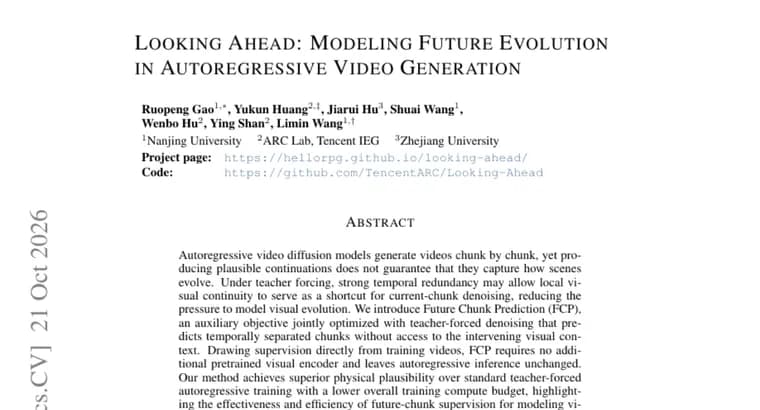
A paper listed on Hugging Face Papers introduces Future Chunk Prediction (FCP), an auxiliary training objective for autoregressive video diffusion models. These models generate video chunk by chunk. The authors' starting point is that producing plausible continuations does not guarantee a model has captured how scenes actually evolve.
They point to teacher forcing as a possible cause. Under teacher forcing, strong temporal redundancy between neighbouring chunks may let local visual continuity act as a shortcut for denoising the current chunk. That would reduce the pressure on the model to learn visual evolution.
FCP is meant to remove that shortcut. It is optimized jointly with the usual teacher-forced denoising loss, and it asks the model to predict temporally separated chunks without access to the intervening visual context. Supervision comes directly from the training videos, so no additional pretrained visual encoder is needed. Autoregressive inference is left unchanged, so the added objective affects training only.
The authors report that their method achieves superior physical plausibility over standard teacher-forced autoregressive training, with a lower overall training compute budget. They present this as evidence of the effectiveness and efficiency of future-chunk supervision for modeling visual evolution. They also say their visualizations suggest FCP fosters a more structured representation space, which may be valuable for building autoregressive world models.
The listing is an abstract only. It gives no metric names, benchmark scores, model sizes or datasets, and it does not say how large the compute saving is.
Key facts
- Future Chunk Prediction (FCP) is an auxiliary objective for autoregressive video diffusion models, optimized jointly with teacher-forced denoising.
- It predicts temporally separated chunks without access to the intervening visual context, aiming to stop models from relying on local visual continuity as a shortcut.
- FCP needs no additional pretrained visual encoder, takes its supervision from the training videos, and leaves inference unchanged.
- The authors claim better physical plausibility than standard teacher-forced training with a lower overall training compute budget.
- Visualizations suggest a more structured representation space, which the authors say may help build autoregressive world models.
Why it matters
Autoregressive video models can produce clips that look plausible without understanding how a scene develops over time. The paper targets that gap with a training change rather than a new architecture. If the claimed gains hold, better physical plausibility at lower training compute would be a useful combination. The authors also tie the idea to autoregressive world models, though only as a possibility.
Who it affects
Researchers and engineers training autoregressive video diffusion models are the direct audience, since FCP is an add-on to teacher-forced training. Anyone interested in video-based world models may also follow it. Ordinary users of video generators would see no change in how models are run, because inference is unchanged.
How to use it
The listing describes the recipe at a high level: add FCP as an auxiliary loss alongside teacher-forced denoising, with targets that are chunks separated in time from the current one and no access to the frames in between. It needs no extra pretrained visual encoder. Inference stays as it is. No code release is mentioned, so implementation details would have to come from the full paper.
How solid is it
This is the authors' own account in an abstract-only listing. The claims of superior physical plausibility and lower training compute are stated without metric names, scores, baselines beyond standard teacher-forced training, or the size of the saving. The structured-representation point rests on visualizations and is not quantified. Treat the results as unverified until the full paper and any independent replication are checked.
Risks and caveats
The teacher-forcing shortcut is the authors' hypothesis, worded with "may", not a demonstrated cause. Without named models, datasets or metrics, it is unclear how far the gains generalize. The link to world models is suggestive only. Authors and institutions are not named in the listing, which limits how much weight to place on it.
“Our method achieves superior physical plausibility over standard teacher-forced autoregressive training with a lower overall training compute budget”
— Paper abstract, Hugging Face Papers