G-CAST: governed self-training for Alibaba 1688's Yuancai shopping agent
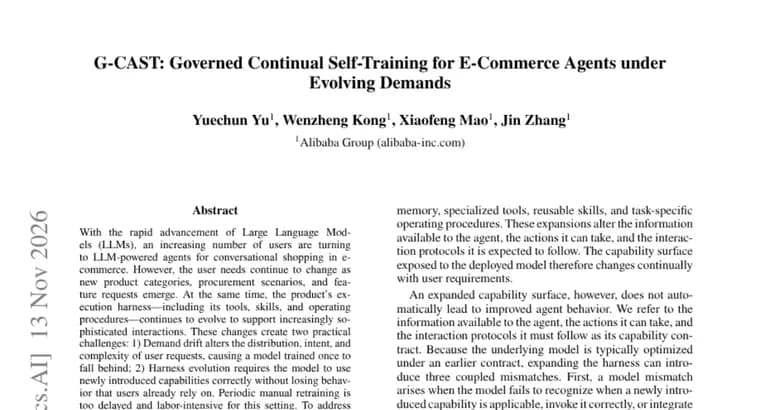
A preprint on Hugging Face Papers describes G-CAST, a governed continual self-training system for LLM-powered shopping agents. The problem it targets: more users now shop through conversational agents, but what they ask for keeps changing. New product categories, procurement scenarios and feature requests keep appearing. At the same time, the product's execution harness, meaning its tools, skills and operating procedures, keeps evolving to support more sophisticated interactions.
The authors name two practical challenges that follow. First, demand drift alters the distribution, intent and complexity of user requests, so a model trained once falls behind. Second, harness evolution requires the model to use newly introduced capabilities correctly without losing behavior that users already rely on. The authors say periodic manual retraining is too delayed and labor-intensive for this setting.
G-CAST is their answer. It converts daily production evidence, gathered under evolving demand and capability contracts, into reward-routed, entropy-prioritized training data and into governed reward evolution. Each model update is then controlled by governed checkpoint transition under cumulative evaluation. According to the authors, this lets the agent learn newly introduced behaviors without sacrificing previously accepted capabilities.
The authors report experiments on a real production e-commerce agent. They say G-CAST adapts more strongly to newly introduced demand while better preserving previously accepted behavior than a strong autonomous post-training baseline. Ablations, they add, show that both reward-routed, entropy-prioritized data orchestration and governed reward evolution are important to these gains.
G-CAST is now deployed in Yuancai (cai.1688.com), a B2B procurement agent on Alibaba's 1688 platform.
Key facts
- G-CAST is a governed continual self-training system for LLM-powered e-commerce agents, built to cope with demand drift and an evolving tool and skill harness.
- It turns daily production evidence into reward-routed, entropy-prioritized training data and governed reward evolution.
- Governed checkpoint transition under cumulative evaluation controls each model update, so new behaviors are learned without losing previously accepted capabilities.
- On a real production e-commerce agent, the authors report stronger adaptation to new demand and better preservation of accepted behavior than a strong autonomous post-training baseline.
- The system is deployed in Yuancai, a B2B procurement agent on Alibaba's 1688 platform.
Why it matters
A shopping agent is never finished. Users bring new categories and scenarios, and the product's own tools and procedures keep changing. A model trained once drifts out of step with both. The paper treats this as an operations problem and proposes continual self-training from daily production evidence, with each update gated so that behavior users already rely on is not lost. The claim is backed by a live deployment rather than only a benchmark.
Who it affects
Teams that run LLM-powered shopping or procurement agents in production, where demand shifts and the tool harness changes over time. It also concerns users of Yuancai, the B2B procurement agent on Alibaba's 1688 platform where G-CAST is now deployed.
How to use it
The abstract describes a pipeline rather than a downloadable tool. Its pieces: daily production evidence under demand and capability contracts, reward-routed and entropy-prioritized data orchestration, governed reward evolution, and checkpoint transitions approved through cumulative evaluation. The live example is Yuancai at cai.1688.com.
How solid is it
This is a research preprint, and every claim in it comes from the authors themselves. The experiments ran on a real production e-commerce agent, and ablations are reported for both main components. No numerical results (accuracy, gains, percentages) are given for the experiments. The baseline is described only as a 'strong autonomous post-training baseline'; it is not named. The size of the improvement therefore cannot be judged from the abstract.
Risks and caveats
The comparison rests on one production agent and one unnamed baseline. The base model, model size and training method details are not stated. No deployment date, traffic volume or user count for Yuancai is given. The paper also gives no timescale for the update cycle beyond 'daily production evidence'. Treat the results as the authors' own account until the full paper's numbers can be checked.
“Periodic manual retraining is too delayed and labor-intensive for this setting.”
— G-CAST paper abstract