Gambit inference algorithm boosts reasoning accuracy with thought-level beam search
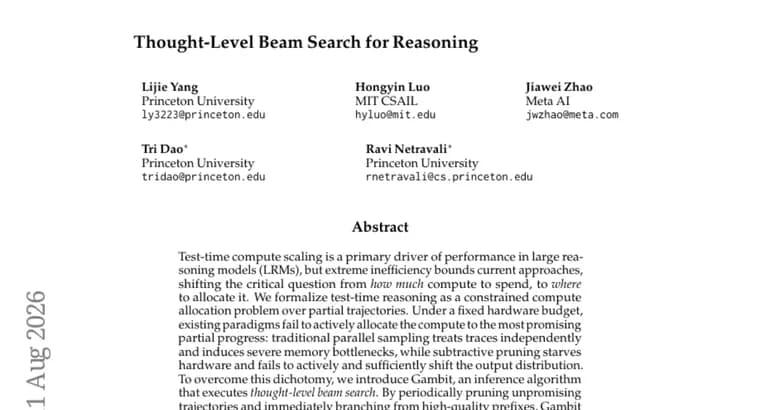
Test-time compute scaling, letting a large reasoning model think longer at inference, is a major driver of its performance, but current methods waste much of that extra compute. Researchers behind a new paper argue the real question is no longer how much compute to spend but where to spend it, and they frame test-time reasoning as a constrained compute allocation problem over partial reasoning trajectories under a fixed hardware budget. They point to two existing approaches and why each falls short: traditional parallel sampling treats reasoning traces independently, which induces severe memory bottlenecks, while subtractive pruning starves hardware and fails to sufficiently shift the output distribution toward better answers.
To address both problems, the authors introduce Gambit, an inference algorithm that performs thought-level beam search. It periodically prunes unpromising reasoning trajectories and immediately branches from high-quality prefixes, using a lightweight scorer that probes the model's hidden states to judge which partial traces are worth continuing. This lets Gambit dynamically concentrate compute on the most promising reasoning traces while keeping hardware utilization continuously high, rather than either sampling everything in parallel or simply cutting weak traces without redirecting the freed capacity.
In evaluations across multiple models and benchmarks under identical hardware constraints, the authors report that Gambit strictly dominates existing baselines. Compared with pruning baselines, it yields an absolute accuracy gain of up to 6.7% on the HMMT-24 benchmark and up to 3.3% on AIME-25. It also delivers more than double the throughput on trace completion, and reduces total token consumption by up to 68.5% relative to standard parallel sampling.
Key facts
- Gambit is an inference algorithm that performs thought-level beam search, periodically pruning weak reasoning trajectories and branching from high-quality prefixes.
- It uses a lightweight scorer that probes the model's hidden states to decide which partial reasoning traces to keep extending.
- Under identical hardware constraints, it yields up to a 6.7% absolute accuracy gain on HMMT-24 and up to 3.3% on AIME-25 over pruning baselines.
- It delivers more than 2 times higher throughput on trace completion than baselines.
- It cuts total token consumption by up to 68.5% relative to standard parallel sampling.
Why it matters
Large reasoning models get much of their performance from spending extra compute at inference time, generating and evaluating long chains of thought. The paper argues that current methods for spending that compute are severely inefficient: parallel sampling that treats each reasoning trace independently runs into memory bottlenecks, and subtractive pruning that just kills weak traces starves hardware without redirecting the freed capacity toward promising ones. Gambit reframes the problem as one of actively allocating a fixed compute budget toward the partial reasoning traces most likely to succeed, rather than treating all traces equally or only removing bad ones.
Who it affects
The work is aimed at teams building and serving large reasoning models, particularly anyone running test-time compute scaling (multiple reasoning traces per query) in production or research settings where hardware budgets are fixed. It also matters to researchers benchmarking reasoning performance on competition math problems, since the reported gains are measured on HMMT-24 and AIME-25.
How to use it
Gambit is an inference-time algorithm, not a retrained model: it operates on an existing reasoning model's generation process by periodically pruning unpromising trajectories and branching from strong prefixes, guided by a lightweight scorer that reads the model's hidden states. The abstract does not give a price, license, or release details for the method, and does not specify the pruning frequency or beam width used.
How solid is it
The authors report results from evaluations across multiple models and benchmarks, describing Gambit as strictly dominating existing baselines under identical hardware constraints. The quantified gains, the accuracy improvements on HMMT-24 and AIME-25, the throughput increase, and the token reduction, all come from the paper's own reported experiments. The abstract does not name the authors, institutions, or a publication date, nor does it name any benchmarks or models beyond HMMT-24 and AIME-25.
Risks and caveats
The headline figures are framed as "up to" gains, so they represent best-case results rather than an average across all tested conditions. The abstract gives no numeric detail on the pruning frequency, beam width, or how the hidden-state scorer is trained or calibrated, which limits independent assessment of the method. The reported accuracy improvements are also measured on two competition math benchmarks specifically, and the abstract does not describe how the approach performs on other types of reasoning tasks.