Gander releases an open real-time multimodal agent model
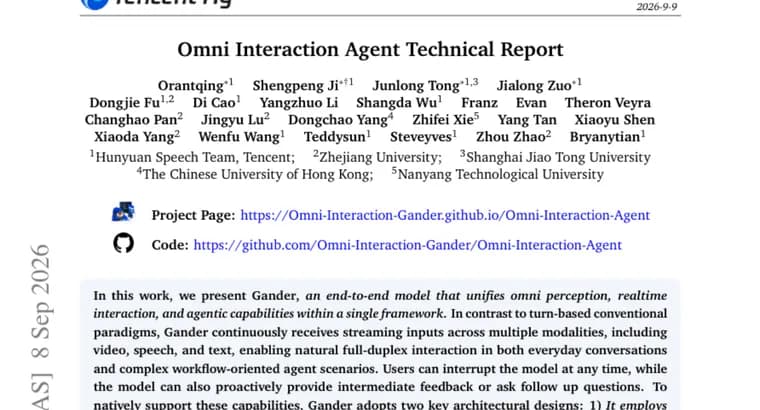
A technical report presents Gander, an end-to-end model that unifies omni perception, real-time interaction, and agentic capabilities inside a single framework. Unlike conventional turn-based systems that wait for a user to finish speaking before responding, Gander continuously receives streaming input across video, speech, and text at the same time, which lets it hold natural full-duplex conversations as well as handle complex, workflow-oriented agent tasks. A user can interrupt the model at any point, and the model can also act first, offering intermediate feedback or asking a follow-up question without being prompted.
Two architectural choices make this possible. First, Gander uses what the authors call a Cerebellum-Brain collaborative framework: the Cerebellum handles real-time interaction and everyday omni conversational ability, while the Brain takes on complex reasoning and higher-level agentic work. The two parts stay in continuous contact through tool calling and an agent orchestration runtime, rather than operating as separate stages. Second, the Cerebellum itself is built on a streaming Thinker-Talker architecture, in which both the user's input and the model's output are flattened into a single ordered token stream at the chunk level, giving the system one unified representation for low-latency, continuous interaction.
The authors evaluated Gander across four dimensions: conversational ability, omni understanding, interactive capability, and agentic intelligence. Internal human evaluations found that Gander keeps the natural, expressive spoken-dialogue quality of state-of-the-art open source models while also performing competitively on omni interaction. The report also states that Gander holds up in harder real-world conditions, including background noise, conversations with multiple participants, and backchannel communication (the short verbal or non-verbal cues, like "mm-hm," that keep a conversation flowing). The team says it is releasing Gander's models, code, and data to support further research and development.
The report does not name the authors or their institution, does not give numeric benchmark scores for any of the four evaluation dimensions, does not identify which "SOTA open source models" Gander was compared against, and does not state a release date, version number, or license terms beyond the statement that the release includes models, code, and data.
Key facts
- Gander is an end-to-end model that unifies omni perception, real-time interaction, and agentic capabilities in one framework, replacing turn-based dialogue with continuous full-duplex streaming across video, speech, and text.
- Users can interrupt Gander at any time, and the model can proactively give intermediate feedback or ask follow-up questions on its own.
- The architecture pairs a Cerebellum (real-time interaction and omni conversation) with a Brain (complex reasoning and agentic tasks), the two linked continuously through tool calling and an agent orchestration runtime.
- The Cerebellum runs a streaming Thinker-Talker design that flattens user input and model output into one ordered token stream at the chunk level for low latency.
- Gander was evaluated across four dimensions (conversational ability, omni understanding, interactive capability, agentic intelligence); internal human evaluations found it matches the spoken-dialogue naturalness of unnamed SOTA open source models while competitive on omni interaction, and the team is releasing its models, code, and data.
Why it matters
Most voice and multimodal assistants still work in turns: the system waits for the user to stop, then replies. Gander is built around continuous, simultaneous streaming instead, so it can be interrupted mid-response and can also speak up first with feedback or a question. That shift, plus splitting the system into a fast Cerebellum for conversation and a slower Brain for reasoning and agent tasks, is the report's core architectural argument for why a single model can handle both natural chat and complex agentic work without switching modes.
Who it affects
Developers building voice assistants, multimodal agents, or real-time interactive systems are the direct audience, since Gander is released as an open model with code and data rather than a closed API. Researchers working on streaming architectures or agent orchestration get a concrete design (the Cerebellum-Brain split, the chunk-level token stream) to study or build on.
How to use it
The report states that Gander's models, code, and data are being released for further research and development, but it gives no license terms, no pricing, no access instructions, and no version number, so what exactly can be reused and under what conditions is not specified in the text.
How solid is it
The performance claims rest on internal human evaluations across four dimensions the authors chose themselves, not on published benchmark scores. The comparison point, "SOTA open source models," is not named, and no numeric results are given for any of the four evaluation dimensions, so the claims of matching or competing with existing systems cannot be checked against public data from this report alone.
Risks and caveats
The report discloses no author names or institutional affiliation, no release date, no numeric benchmark results, and no license terms beyond the general statement that models, code, and data will be released. Robustness claims for noisy, multi-party, and backchannel-heavy scenarios are asserted but not backed by reported figures in the text.
“Internal human evaluations demonstrate that Gander maintains the natural and expressive spoken dialogue capabilities of SOTA open source models while achieving competitive performance in omni interaction.”
— Gander technical report