Gavel routes agent skills by reading a frozen LLM's own signals
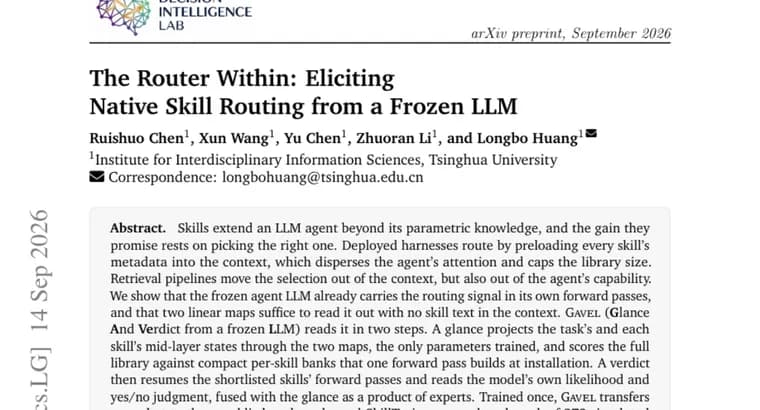
Skills let an LLM agent work beyond its built-in knowledge, but only if the agent picks the right one, and the two routing approaches in common use both come with a cost. Deployed harnesses preload every skill's metadata into the model's context, which spreads the agent's attention thin and puts a hard cap on how large a skill library can grow. Retrieval pipelines sidestep that context limit by selecting skills externally, but that moves the decision out of the agent's own capability and into a separate system.
A new paper argues there is a third option: a frozen agent LLM already carries the routing signal it needs inside its own forward passes, and only two trained linear maps are enough to read that signal out, with no skill text ever loaded into context. The resulting method, Gavel (Glance And Verdict from a frozen LLM), works in two steps. A glance step projects the mid-layer hidden states of the task and of every skill through the two trained maps, then scores the full library against compact per-skill representations, or banks, that a single forward pass builds when a skill is installed. A verdict step then reruns the forward pass only for the shortlisted skills, reads the model's own likelihood and yes/no judgment on each, and fuses that with the glance score as a product of experts.
Gavel is trained once and transfers zero-shot to three public benchmarks plus SkillTraj, a new benchmark of 372 simulated agent trajectories that the paper introduces alongside the method. On the Qwen3-32B backbone, it outperforms progressive-disclosure and retrieve-and-rerank pipelines that add 1.2 billion to 16 billion external parameters, by up to 13.4 points on written tasks and by up to 21.9 points when the need for a skill arises mid-rollout, partway through the agent's run. The paper also reports that routing accuracy improves as the underlying backbone model improves, and that in a bash-agent harness the same 32B model, routed by Gavel, triggers the correct skill on the Skill-Use benchmark more often than far larger frontier models running in Codex.
Key facts
- Gavel is a routing method that reads the skill-selection signal a frozen LLM agent already carries in its own forward passes, using two trained linear maps as its only new parameters and no skill text loaded into context.
- It works in two steps: a glance that scores the whole skill library against per-skill 'banks' built with one forward pass at installation, then a verdict that reruns only the shortlisted skills and fuses the model's own likelihood and yes/no judgment with the glance score.
- Trained once, Gavel transfers zero-shot to three public benchmarks plus SkillTraj, the paper's own new benchmark of 372 simulated agent trajectories.
- On Qwen3-32B, Gavel outperforms progressive-disclosure and retrieve-and-rerank pipelines that add 1.2 billion to 16 billion external parameters, by up to 13.4 points on written tasks and up to 21.9 points when the need for a skill arises mid-rollout.
- In a bash-agent harness, the same 32B backbone routed by Gavel triggers the correct skill on the Skill-Use benchmark more often than far larger frontier models running in Codex.
Why it matters
Agent harnesses with pluggable skills face a tradeoff: list every skill's metadata in the context and the agent's attention thins out as the library grows, with a hard ceiling on how many skills fit at all; hand the choice to a separate retrieval system instead, and the agent stops making that decision itself. This paper reports that a frozen agent LLM already holds what it needs to route correctly inside its own forward passes, recoverable with two trained linear maps and without ever putting a skill's text in the context. That turns routing into something extracted from computation the model already performs, rather than something bought with context budget or an added external model.
Who it affects
The paper speaks to anyone building or operating an agent harness with a skill or tool library large enough that describing every option in context stops working: its own comparison points are progressive-disclosure and retrieve-and-rerank pipelines that add 1.2 billion to 16 billion external parameters just to route. It matters most where the routing decision needs to stay inside the same frozen backbone the agent already runs rather than adding a second model to maintain, and for cases where the needed skill only becomes clear partway through a task: the paper reports a wider gap over existing pipelines there, 21.9 points versus 13.4 points on written tasks.
How to use it
Gavel adds a skill to the library with one forward pass at installation time, which builds that skill's compact bank representation; the two trained linear maps used at query time are the only parameters Gavel learns. Routing itself runs in two passes: a cheap glance over the whole library, then a verdict step that reruns only the shortlisted skills. The paper does not say whether Gavel's code, trained weights, or the SkillTraj benchmark will be released, so outside groups cannot yet reproduce the setup or point it at their own skill libraries.
How solid is it
The headline numbers come from one paper's own experiments: Gavel is trained once and evaluated zero-shot on three public benchmarks it does not name, plus SkillTraj, a 372-trajectory benchmark the same paper introduces alongside the method. The reported gains, up to 13.4 points on written tasks and up to 21.9 points when a skill's need emerges mid-rollout, are best cases within that comparison rather than averages, and the paper does not state what metric those point gains are measured in. The concrete numbers are reported for a single backbone, Qwen3-32B, though the paper adds that routing accuracy improves as the backbone model improves; the bash-agent harness result, that the same 32B model beats far larger frontier models on the Skill-Use benchmark, does not name which frontier models were compared.
Risks and caveats
The text does not name the paper's authors or their institution, or give a publication or submission date, so there is no outside attribution to check the claims against. The reported gains are against progressive-disclosure and retrieve-and-rerank pipelines specifically. Because the improvement figures are described as 'up to,' they are the largest gaps the paper found rather than a typical one, and the unnamed metric behind them makes the numbers hard to compare against other published work.
“We show that the frozen agent LLM already carries the routing signal in its own forward passes, and that two linear maps suffice to read it out with no skill text in the context.”
— the Gavel paper