Google and HHMI Janelia map the complete male fruit fly brain
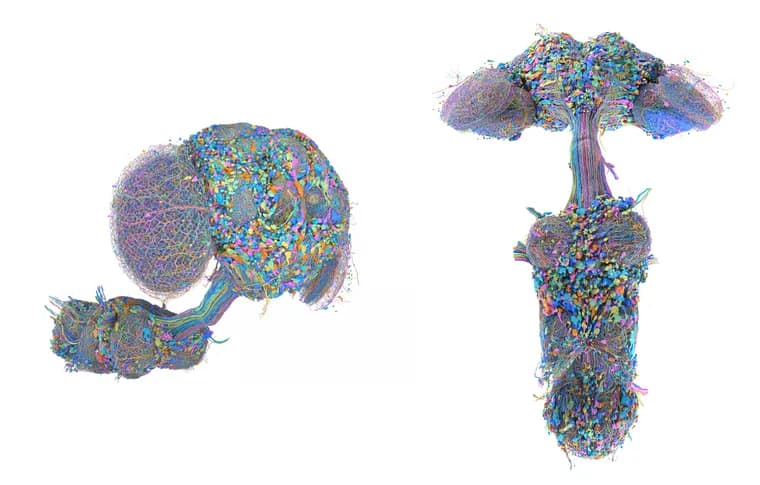
Google Research and the Howard Hughes Medical Institute's (HHMI) Janelia Research Campus have published a complete wiring diagram, or connectome, of the male fruit fly's brain and central nervous system. The paper, "Sexual dimorphism in the complete connectome of the Drosophila male central nervous system," appeared in the journal Cell on September 3, 2026. Google describes it as the result of a decade-long partnership between its Connectomics team and HHMI Janelia, which led the project. The map covers more than 166,000 neurons and 125 million synaptic connections, which Google calls the largest brain map by number of neurons to date. It includes not just the brain but the ventral nerve cord, the fly's analogue of the spinal cord, so the resource extends beyond the brain into how it controls the body. Every neuron has been annotated and checked, or proofread, by a team of human experts at HHMI Janelia, and the full dataset can be viewed, explored and downloaded through Neuroglancer, the open source visualization tool Google built for large, multidimensional scientific datasets.
Drosophila melanogaster, the common fruit fly, has anchored genetics research behind multiple Nobel Prizes, valued for consistent, stereotyped behavior and a short life cycle. Google and its collaborators are betting the same qualities will make it useful for neuroscience too, since mapping the 86 billion neurons of a human brain is not yet possible and mapping a much smaller nervous system in full is a way to start learning general principles of how brains work. Google says the new male connectome complements both an existing female fruit fly brain map and a separate, more recently released complete female fruit fly brain and nerve cord map, so researchers now have matched male and female resources: differences between the sexes' neurons can be compared directly, useful for studying courtship and aggression, while brain regions that look alike in both sexes let researchers start studying variation between individual flies. The work also builds on Google's own earlier connectomics efforts on the fly's other sex: an initial, fully automated female fruit fly brain reconstruction in 2019, then by 2020 a human-verified map of half a female fruit fly brain, a record at the time, covering 25,000 neurons and 21 million connections.
Building a connectome starts with slicing a preserved brain into millions of ultra-thin sections, imaging each one under an electron microscope, and using AI to reconstruct the 3D structure from the resulting flat images. Google's tools for this include flood-filling networks, convolutional neural networks that start at a single pixel and expand outward to trace every pixel belonging to the same object. The team's current reconstruction system, called PATHFINDER, recently improved its speed and accuracy after incorporating synthetic neurons into its training data. Even so, Google says verifying and annotating the resulting shapes still takes years of human effort per brain, the bottleneck the team is trying to shrink so future brain-mapping projects fit within realistic budgets and timelines.
Alongside the male fly connectome, three companion papers published the same day already put it to use, studying the neuroscience of visual systems, taste and social behavior, though the source does not name these papers' individual authors or institutions. Google also frames the fly work as a step toward vertebrates, animals with a spinal cord that are anatomically, evolutionarily and functionally closer to humans. In a study led by Columbia University and published this week in Nature, Google's team helped map a portion of the elephantnose fish's hindbrain involved in signal processing; the paper, "Connectome analysis of a cerebellum-like circuit for sensory prediction," is described as the first demonstration of combining a static connectome with other data to study neural plasticity and learning, producing what Google calls the most complete mechanistic model of learning in a vertebrate brain to date. A forthcoming paper with Harvard on the larval zebrafish brain is billed as the first whole-brain vertebrate dataset to combine neural structure with molecular cell type across an entire brain; the source gives no release date for it, and Google has separately put out a preliminary dataset pairing neural activity with structure in the same zebrafish brain.
Google frames the male fly connectome as a foundational resource for future neuroscience, biology, pharmacology and medicine, pointing to understanding conditions such as Alzheimer's, depression or schizophrenia, and, someday, new treatments, better brain health and support for brain repair. Those are stated as long-term hopes, not results already achieved. Mapping a full human brain, at 86 billion neurons, remains out of reach for now; Google's own nearer-term plans, described only as upcoming, are a fully proofread map of the zebrafish brain and mapping a portion of the mouse brain, with no timeline given for either.
Key facts
- The connectome catalogs more than 166,000 neurons and 125 million synaptic connections in the male fruit fly's brain and ventral nerve cord, which Google calls the largest brain map by number of neurons published to date.
- The paper, "Sexual dimorphism in the complete connectome of the Drosophila male central nervous system," appeared in Cell on September 3, 2026, the product of a decade-long partnership between Google's Connectomics team and HHMI Janelia Research Campus, which led the project.
- Every neuron was annotated and proofread by human experts at HHMI Janelia, and the dataset can be viewed, explored and downloaded through Neuroglancer, Google's open source tool for large, multidimensional datasets.
- The male connectome complements an existing female fruit fly brain map and a separately released, more recent female fruit fly brain and nerve cord map, building on a 2020 human-verified half-brain map of 25,000 neurons and 21 million connections, letting researchers compare the sexes and study variation between individuals.
- Three companion papers published the same day already apply the male connectome to research on visual systems, taste and social behavior, and Google says its AI reconstruction methods, including the PATHFINDER system, are extending to vertebrates, including a Columbia-led, Nature-published study of an elephantnose fish's hindbrain and an upcoming Harvard collaboration mapping the larval zebrafish brain.
Why it matters
Fruit flies have anchored genetics research behind multiple Nobel Prizes, and Google and HHMI Janelia are betting the same short life cycle and stereotyped behavior that made Drosophila useful for genetics will make it just as useful for neuroscience. Mapping a full human brain, at 86 billion neurons, is not yet possible, so a complete map of a much smaller nervous system gives researchers a tractable model for how perception, reaction and behavior work at the level of individual neurons and synapses. Because a matched female connectome already exists, having both sexes fully mapped lets scientists compare neurons directly in the brain regions where males and females differ, useful for studying courtship and aggression, and lets them start measuring variability between individual flies in regions that look the same across sexes. It is also a proof point for the underlying AI reconstruction methods: the same flood-filling network and PATHFINDER techniques used here are what Google says it is now extending toward vertebrate brains.
Who it affects
Directly, this is a resource for Drosophila researchers in genetics and neuroscience, who gain a complete, human-verified wiring diagram to test hypotheses about specific circuits rather than working from partial maps. It also matters to the connectomics field itself: the reconstruction techniques built for this project, including the PATHFINDER system and its use of synthetic training neurons, are the same methods Google says it is applying to vertebrate brains, including fish and mice. Further out, Google frames this as relevant to understanding human conditions such as Alzheimer's, depression or schizophrenia, and says it hopes such work will someday lead to new treatments, better brain health and support for brain repair, though these are stated as long-term hopes rather than outcomes of this study.
How to use it
The full connectome is public: Google says it can be viewed, explored and downloaded through Neuroglancer, the open source visualization tool Google built for large, multidimensional datasets. The source names no price or license terms for the data itself, describing access only as viewing, exploring and downloading through that tool.
How solid is it
The underlying paper appeared in Cell, a peer-reviewed journal, and Google describes it as the product of a decade-long partnership with HHMI Janelia, which led the project; every neuron in the map was also proofread by human experts at HHMI Janelia rather than left as raw AI output. The companion vertebrate study on the elephantnose fish, led by Columbia University, appeared this week in Nature, another peer-reviewed venue. One nuance worth flagging: the post's opening line calls the male connectome simply "the largest brain map to date," but its own body text narrows that claim specifically to the largest brain map by number of neurons, a qualifier that matters because it leaves open how the map compares on other measures. The account itself is Google's own telling of its and its partners' work, posted to the company's research blog rather than published by an independent outlet, though the underlying science sits behind the peer-reviewed Cell and Nature papers it describes.
Risks and caveats
The medical framing here, understanding conditions such as Alzheimer's, depression or schizophrenia, and someday finding new treatments, improving brain health and supporting brain repair, is presented in the source as a long-term hope, not a claim of any result demonstrated by this study. Google itself says mapping a full human brain, at 86 billion neurons, remains out of reach, and the fly connectome is offered as a step toward general principles rather than a human-relevant map on its own. Several details are left unspecified: the source names no individual authors or institutions for the three companion papers, gives no neuron or synapse counts for the elephantnose fish or zebrafish datasets, and sets no timeline for the still-upcoming zebrafish whole-brain map or the planned mapping of a portion of the mouse brain. Google also notes that verifying and annotating a reconstructed brain still takes years of human effort per project, a bottleneck that limits how quickly the approach can scale to larger or more numerous brains.
“With over 166,000 neurons and 125 million synaptic connections, this is the largest brain map by number of neurons to date.”
— Michał Januszewski and Viren Jain, Research Scientists, Google Research