Google announces CC, an experimental AI agent for families
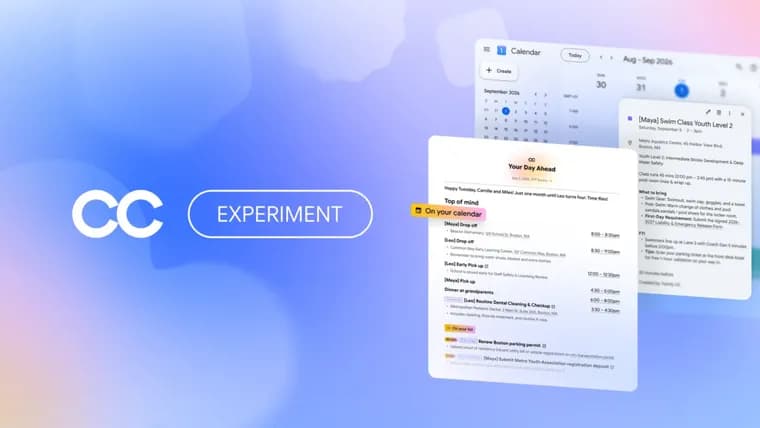
Google has introduced CC, a new experimental project from Google Labs that turns the personal-data customization already built into Gemini into a shared resource for an entire family. CC is an evolution of something Google announced in 2025; that earlier version eventually became Gemini's Daily Brief, which mines the data in a user's Google account to surface daily action items and suggestions. The new CC keeps that same goal but is designed to serve up to six users in a family at once, rather than one person alone.
Google says CC runs on its own Google account, so each family member decides individually whether and how to interact with it. Access to personal data is opt-in on a per-source basis: CC only sees emails from a connected user if that user explicitly shares them, though people can designate certain addresses, such as school scheduling emails, as always available to the agent. Family members can also feed CC content directly by sending it email or a Google Chat message, or by dropping invitations, documents and other files into a shared Google Drive folder that the agent monitors.
Day to day, CC's main function mirrors Daily Brief: every morning, all registered users receive a shared "Your Day Ahead" email that pulls together the day's events and updates on previously assigned tasks. Beyond that digest, CC can add items to shared calendars, send reminders about important tasks, and generate documents from a user's instructions that then become accessible to every other CC user in the family.
Key facts
- Google announced CC, an experimental Google Labs AI agent that evolves a 2025 Google project whose earlier version became Gemini's Daily Brief.
- CC is designed as a shared resource for up to six users in one family, with its own dedicated Google account.
- It only reads a connected user's emails when that user explicitly shares them, though specific addresses (for example, school scheduling emails) can be marked as always available.
- Content can also reach CC via email, Google Chat, or a shared Google Drive folder it monitors for invitations and documents.
- Each morning it sends all registered family members a shared "Your Day Ahead" email, and it can add shared calendar items, reminders, and documents accessible to the whole family.
Why it matters
Google's own models are not clearly ahead on capability right now, but the company is leaning on an asset rivals cannot easily match: how much personal data it already holds on users deep in its ecosystem. Gemini already uses that data for one person; CC extends the same kind of customization from an individual account to a whole family sharing tasks, calendars and documents. It is a small, incremental step, evolving a 2025 feature into Daily Brief and now into a multi-user version, rather than a new capability.
Who it affects
Households already inside the Google ecosystem, specifically up to six family members who would each get their own relationship with the shared agent. Because CC runs on its own Google account and each person chooses what to share with it, adoption depends on every participating family member opting in individually rather than one person setting it up for everyone.
How to use it
Family members can reach CC through several channels: sharing specific email addresses (such as school scheduling mail) as always visible to it, sending it messages directly by email or Google Chat, or dropping files into a shared Google Drive folder it watches. Once set up, CC sends a daily shared "Your Day Ahead" summary, adds items to shared calendars, issues reminders, and drafts documents that every family member using CC can then access. The source gives no launch date, availability timeline, or pricing and account-tier information for CC.
How solid is it
The report comes from a single outlet, Ars Technica, describing a Google Labs experiment; every capability described is attributed generally to Google's own statements rather than to a named executive or spokesperson, and no individual is quoted. The piece situates CC in a clear lineage (a 2025 predecessor that became Daily Brief), which supports the account, but beyond that context there is little independent detail to check the claims against.
Risks and caveats
The pitch rests on family members trusting a shared AI agent with email, calendar and document access, and Google's answer to the obvious privacy question is that emails are visible only when "explicitly shared." The source does not explain what mechanism enforces that boundary, nor what "CC" stands for, nor how the six-person limit or any account tiering works in practice. As a product move, it reads as Google iterating on an existing feature for a new use case rather than a shift with wider industry implications.