Google's generative UI lets teachers build STEM simulations
Google Research, led by research scientist Gal Elidan and product manager Yael Haramaty, has announced a research experiment that applies generative UI (GenUI), AI models that construct interfaces on the fly instead of using pre-coded ones, to classroom simulations. The system lets a teacher describe a topic and get a custom, interactive, guided simulation tailored to their curriculum and students, built with what the team calls pedagogical guardrails rather than a generic content generator.
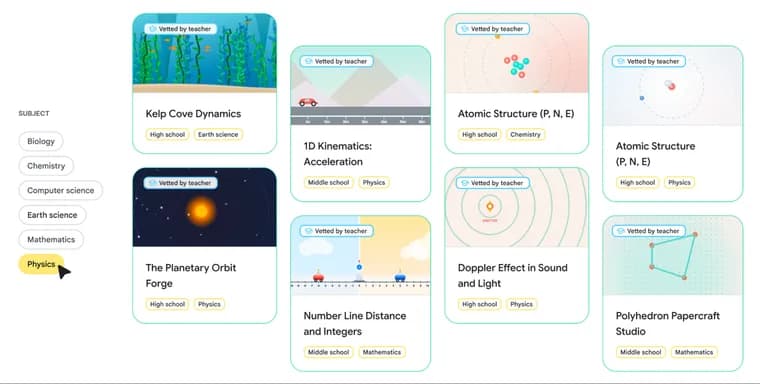
Alongside the research, Google released a sample library of more than 30 AI-generated learning interactives in English, covering STEM subjects including physics, chemistry, biology and math, aimed mainly at middle and high school. Every interactive in the library has been reviewed and vetted by teachers before publication; topics already covered include Kepler's Laws of Planetary Motion, data visualization and projectile motion.
Technically, each simulation is produced through a self-correcting generation loop: the system iterates against a set of quality criteria covering pedagogy (do the difficulty levels progress correctly and match the learning objectives), mechanics (do the controls work, can the level actually be solved) and visual design (no distracting redundant elements). Part of that checking is agentic: an automated evaluator opens a Chrome instance and interacts with the simulation as a user would, including adversarial moves such as pushing a control to an extreme value, to test whether it still holds up. Google says this iterative checking takes longer to generate a final interactive but produces closer adherence to the quality criteria.
The team backs the approach with two studies. STEM teachers in the UK evaluated a collection of the interactives and rated them overall good or excellent, with physics and chemistry the subjects most amenable to simulation creation; Google says the full methodology and results sit in a separate tech report. Separately, 12 teachers in the US each requested three different custom interactives for their own classrooms, and rated the results at an average of 8 out of 10. One high school science teacher said dynamic generation solves a problem static, off-the-shelf simulations could not: "I've never been able to differentiate any of the simulations because it's just, you get what you get." A middle school science teacher praised how closely the generated design matched their own instructional goals, and both groups pointed to the built-in tiered hints and worked solutions as mirroring the step-by-step support they give students individually.
The work builds on LearnLM, Google's family of generative AI models for education released in 2024, and on the 2025 Learn Your Way experiment that reimagined the textbook with generative AI. Google frames the active-learning premise with education theorist John Dewey, who argued in 1916 that students should be given something to do, psychologist Jean Piaget's work on how learners construct knowledge, and the modern ICAP framework, which the post says shows interactive behaviors produce deeper schema construction and longer retention than passive listening or reading.
Google is now moving to a pilot with Google for Education: schools using Google Workspace for Education can sign up so their teachers can request simulations for any custom STEM concept matched to their curriculum, learning goals and grade level. Each newly generated interactive is sent back to the requesting teacher for review, and only after that teacher validates and approves it can it be added to the public library. Google also plans separate UX research and field studies to measure learning gains and student engagement from using the interactives in real classrooms, work it describes as still ahead rather than done.
Key facts
- Google Research released a public sample library of more than 30 AI-generated, teacher-reviewed STEM learning interactives (physics, chemistry, biology, math) for middle and high school.
- The system uses generative UI (GenUI) with a self-correcting generation loop, including an agentic evaluator that opens a Chrome instance to test each simulation, checking pedagogy, mechanics and visual design.
- In a US study, 12 teachers each requested three custom interactives and rated the results an average of 8 out of 10.
- UK STEM teachers who evaluated a set of interactives rated them overall good or excellent, with physics and chemistry the most amenable subjects; full results sit in a separate tech report.
- Schools using Google Workspace for Education can join the Google for Education Pilot Program to request custom simulations, which are added to the public library only after the requesting teacher validates and approves them.
Why it matters
Interactive, hands-on digital learning has stayed rare because it is expensive to build and hard to tailor to a specific class, so most teachers are stuck with generic, static simulations. Google is pitching generative UI, AI that builds an interface on demand rather than running a pre-coded one, as a way to make custom interactive practice as easy to produce as a worksheet. The framing leans on established learning-science arguments, from John Dewey's 1916 case for active learning and Jean Piaget's work on how learners build knowledge to the modern ICAP framework, that active engagement teaches better than passive reading or watching, and the work builds directly on Google's own LearnLM models (2024) and the 2025 Learn Your Way experiment.
Who it affects
STEM teachers, mainly at the middle and high school level, and the schools they work at that use Google Workspace for Education. The stated subjects are physics, chemistry, biology and math; the UK evaluation found physics and chemistry the easiest to turn into simulations. Google frames the tool as something built for and gated by teachers rather than for students directly: teachers request topics, review outputs, and approve what becomes public.
How to use it
A sample library of 30-plus ready-made, teacher-approved learning interactives is already public. To get a custom simulation, a school using Google Workspace for Education signs up for the Google for Education Pilot Program; a teacher can then request a simulation for any STEM concept matched to their curriculum, learning goals and grade level. The system generates it, sends it back to that teacher for review, and only publishes it to the shared library once the teacher validates and approves it. No price or subscription tier is mentioned in the announcement.
How solid is it
The evidence so far is two small internal studies rather than independent research. UK STEM teachers rated a set of interactives good or excellent overall, but the source gives no count of how many teachers took part, only that the full method and numbers are in a separate tech report. In the US, 12 teachers each generated three interactives and rated them 8 out of 10 on average, a modest sample self-selected from Google's own trusted tester pool. Each interactive does go through an automated self-correcting loop, including an agentic check that drives the simulation in a browser and tries adversarial inputs, before any teacher sees it, which is a real quality gate but one Google designed and runs itself.
Risks and caveats
Google has not yet measured whether the interactives improve learning: the post explicitly lists studies on learning gains and student engagement as future work, not results in hand. No launch date is given for the wider pilot, and the UK evaluation's teacher count and detailed methodology are withheld from this post pending the separate tech report. The library and pilot both depend on a teacher reviewing every AI-generated interactive before it reaches students, so how the system performs once that review step is stretched across many more requests is untested here.
“I've never been able to differentiate any of the simulations because it's just, you get what you get.”
— a high school science teacher, quoted by Google Research