Google brings Gemini Personal Intelligence to Android Auto and Google built-in cars
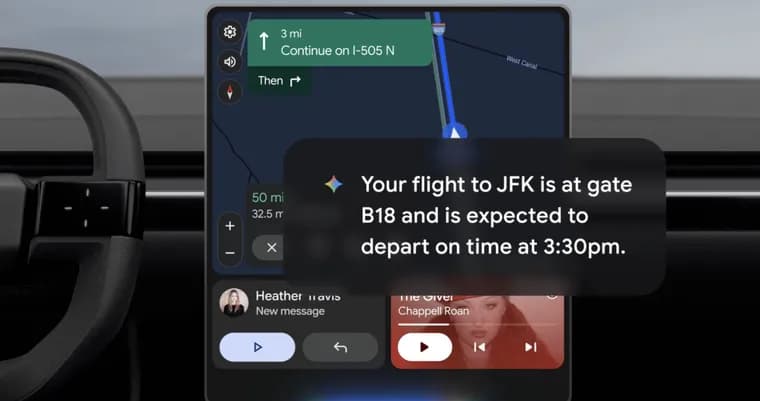
Google is bringing Personal Intelligence to Gemini in Android Auto and in cars with Google built-in. With the update, the assistant can tap into the user's information across Google apps, including Gmail, Calendar, Maps, Photos, YouTube and Search, while they drive.
Google gives several examples. A driver heading to the airport can ask Gemini about their flight status: the assistant pulls the flight details from a confirmation message in Gmail and uses them to look up the status. Instead of entering directions by hand, a driver can say "take me to my doctor's appointment". Another example prompt is "find the car wash from the photo I took last week and navigate there."
The background: Google brought Gemini to Android Auto last year, then rolled it out to cars with Google built-in in April. Several carmakers, including Ford, GM, Honda, Nissan, Volvo and Polestar, have shipped newer cars with Google built-in, which adds support for native Android apps.
The feature is opt-in. Google says it will connect a user's apps to Gemini only if they enable the Personal Intelligence setting. It will also share personalized responses only if the phone is connected to the car. Google says: "If you don't use Personal Intelligence, everything in the car still works: You can use navigation, listen to music, make calls, and ask questions, but the answers won't be tailored to you."
Personal Intelligence is rolling out to Android Auto today. Support for cars with Google built-in is due in the coming months, with no firmer date given.
Key facts
- Personal Intelligence lets Gemini in Android Auto and cars with Google built-in use data from Gmail, Calendar, Maps, Photos, YouTube and Search.
- It is rolling out to Android Auto today; cars with Google built-in get it in the coming months.
- Google's examples: checking flight status from a Gmail confirmation, "take me to my doctor's appointment", and finding a car wash from a recent photo and navigating there.
- The feature works only if the user enables the Personal Intelligence setting, and personalized responses are shared only when the phone is connected to the car.
- Without it, navigation, music, calls and questions still work, but answers are not tailored to the user.
Why it matters
This extends Gemini in the car from general answers to answers built on the user's own data. Google brought Gemini to Android Auto last year and to cars with Google built-in in April; Personal Intelligence is the next step. The examples show the aim: fewer manual steps, such as looking up an appointment or a flight confirmation, while driving.
Who it affects
Android Auto users get the feature first, as it is rolling out today. Drivers of cars with Google built-in have to wait for the coming months. Carmakers that have shipped such cars include Ford, GM, Honda, Nissan, Volvo and Polestar, though the source does not say which of them will get Personal Intelligence.
How to use it
Enable the Personal Intelligence setting; Google says it connects apps to Gemini only then. Keep the phone connected to the car, since personalized responses are shared only in that case. Then ask in plain language, for example about a flight, an appointment, or a place from a photo. If you leave the setting off, navigation, music, calls and questions still work, with answers that are not tailored to you.
How solid is it
The account rests on Google's own description of the update as reported by The Verge. The examples are Google's illustrations of what the assistant can do, not independent tests. Android Auto availability is stated as today; for cars with Google built-in the only timing is "the coming months".
Risks and caveats
The feature gives Gemini access to email, calendar, photos and search data inside the car, so the opt-in setting is the main control. The source gives no details on how the data is processed or on privacy safeguards beyond that setting and the phone-connection requirement. It also names no regions, languages or tiers for the rollout, and no firm date for cars with Google built-in.
“If you don’t use Personal Intelligence, everything in the car still works: You can use navigation, listen to music, make calls, and ask questions, but the answers won’t be tailored to you”