Google DeepMind launches Gemini Robotics 2 for whole body control
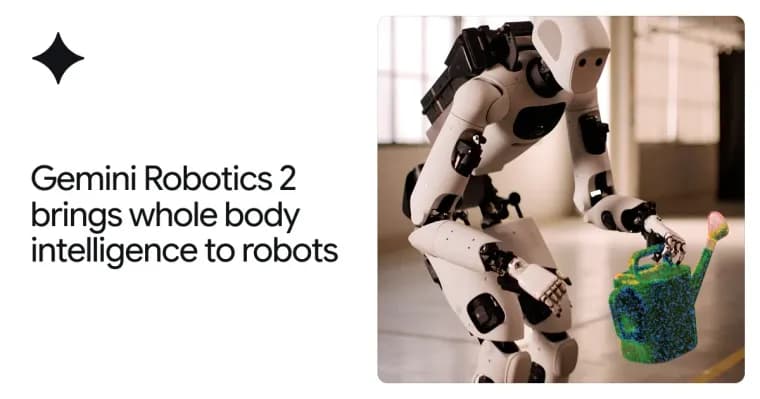
Google DeepMind has introduced Gemini Robotics 2, a new generation of models built to give robots whole-body control, finer manipulation skills and the ability to work as a team, following up on the original Gemini Robotics release. The update comes as three separate models. Gemini Robotics 2 is the company's most advanced vision-language-action (VLA) model, converting camera and language input directly into motor commands; it can drive full humanoid robots from feet to fingertips as well as bi-arm robots, and adds a new level of dexterous manipulation on both hands and grippers. Gemini Robotics ER 2 is the embodied-reasoning model, a vision-language model that acts as the robot's high-level planner: it talks to humans, reads the physical scene, and breaks a task into steps that can run for several minutes and involve hundreds of decisions. Gemini Robotics On-Device 2 is the efficient VLA meant to run locally on the robot itself, without a network connection.
On whole-body control, Google DeepMind showed the system operating Apptronik's Apollo 2 humanoid: told to "put the watering can into the green bin in the bottom shelf," Apollo walked to the table, picked up the watering can, crossed to the shelving, and placed it in the right spot. Earlier Gemini Robotics models only handled table-top, upper-body tasks; this is described as the first time the model controls an entire humanoid body, including walking and balance, though DeepMind says movement speed still needs work.
On dexterity, the model now drives the five-fingered, 22 degree-of-freedom SharpaWave hand fitted to Apollo 2 for delicate actions such as tying knots or sealing a ziplock bag, and separately operates standard two-fingered parallel grippers on a Franka Duo platform for tasks like tight packing.
On reasoning and teamwork, Gemini Robotics ER 2 now tracks when a multi-step task begins and ends and can pinpoint the moment key events happen inside a long sequence, and Google DeepMind is introducing multi-robot collaboration, letting different robot types communicate and split a workflow that one robot could not finish alone.
Gemini Robotics On-Device 2 inherits the "motion transfer" technique from Gemini Robotics 1.5 and is built to be natively multi-embodiment: DeepMind says it can adapt to a new bi-arm robot body in a few hours of adaptation time, typically with fewer than 200 examples, even across bodies with very different shapes, sensors and degrees of freedom, shown on the Dexmate, SO101 and Trossen platforms.
On safety, DeepMind is introducing ASIMOV-Agentic, a new benchmark for agentic safety orchestration that measures whether the embodied reasoning agent refuses unsafe tool calls from the VLA and whether it can judge a task impossible and ask a human to step in. The company says Gemini Robotics ER 2 is its safest robotics model to date on safety-constraint-following and human-proximity benchmarks, better able to detect a nearby person, trigger a safety stop, and halt the robot if someone gets too close.
On availability, Gemini Robotics ER 2 is live on Google AI Studio and in private preview on the Gemini Enterprise Agent Platform; the Gemini Robotics 2 VLA model and the On-Device model are available only to early-access partners, not to the public. The blog post gives no pricing, no launch date, and no benchmark scores for ASIMOV-Agentic or for improvement over the prior Gemini Robotics 1.5 generation.
Key facts
- Gemini Robotics 2 ships as three models: a VLA model for full humanoid and bi-arm control, the ER 2 embodied-reasoning model, and an On-Device 2 VLA for local, offline operation.
- Demonstrated on Apptronik's Apollo 2 humanoid, the model walked to a table, picked up a watering can and placed it in a bin on command, the first time DeepMind's models have controlled a whole humanoid body rather than just the upper body.
- The model can drive the five-fingered, 22 degree-of-freedom SharpaWave hand on Apollo 2 for tasks like tying knots and sealing ziplock bags, and separately runs two-fingered grippers on a Franka Duo platform.
- On-Device 2 can adapt to a new bi-arm robot body in a few hours with typically fewer than 200 examples, shown working across the Dexmate, SO101 and Trossen platforms.
- Gemini Robotics ER 2 is live on Google AI Studio and in private preview on the Gemini Enterprise Agent Platform; the VLA and On-Device models remain limited to early-access partners, with no pricing or public launch date disclosed.
Why it matters
This is Google DeepMind's first robotics model that controls an entire humanoid body, from feet to fingertips, rather than just the upper body for table-top tasks, and its first time coordinating multiple robots on one workflow. Together with fast on-device adaptation to new robot bodies, it pushes DeepMind's robotics effort from narrow, pre-programmed tasks toward general-purpose physical AI, which the company frames as a milestone on the path to embodied AGI.
Who it affects
Robot makers and integrators building humanoids or bi-arm platforms, since the On-Device model is designed to transfer to new robot bodies with only a few hours of data. It also affects Apptronik, whose Apollo 2 humanoid served as the whole-body and dexterity demo platform, and users of Franka Duo, Dexmate, SO101 and Trossen hardware, which appeared in the dexterity and adaptation demonstrations.
How to use it
Gemini Robotics ER 2, the reasoning model, is available now on Google AI Studio and in private preview on the Gemini Enterprise Agent Platform. The Gemini Robotics 2 vision-language-action model and the On-Device 2 model are restricted to early-access partners; Google DeepMind has not disclosed pricing, licensing terms or a public release date for either.
How solid is it
The claims come directly from Google DeepMind's own blog post and are backed by named demonstrations: a specific instruction executed by a named humanoid (Apollo 2), a named hand (SharpaWave, 22 degrees of freedom), a named gripper platform (Franka Duo) and three named embodiments used to show fast adaptation (Dexmate, SO101, Trossen). No independent benchmark scores are given for the new ASIMOV-Agentic safety benchmark, and DeepMind provides no quantitative comparison against its prior Gemini Robotics 1.5 generation, so the scale of the improvement is not independently verifiable from this post.
Risks and caveats
Google DeepMind itself notes that robot movement speed still needs work despite the new whole-body control. The most capable models are not generally available: the VLA and On-Device models are limited to early-access partners, so the demonstrated capabilities cannot yet be independently tested by outside developers. No pricing, safety benchmark scores, or release timeline for general availability are disclosed in the source material.
“While our robots have more to advance in movement speed, this is an important step towards the skills needed to complete more complex, real-world tasks that require whole-body coordination.”
— Google DeepMind, Gemini Robotics 2 blog post