Google DeepMind ships Gemini Robotics ER 2 with video-based task tracking and multi-robot teamwork
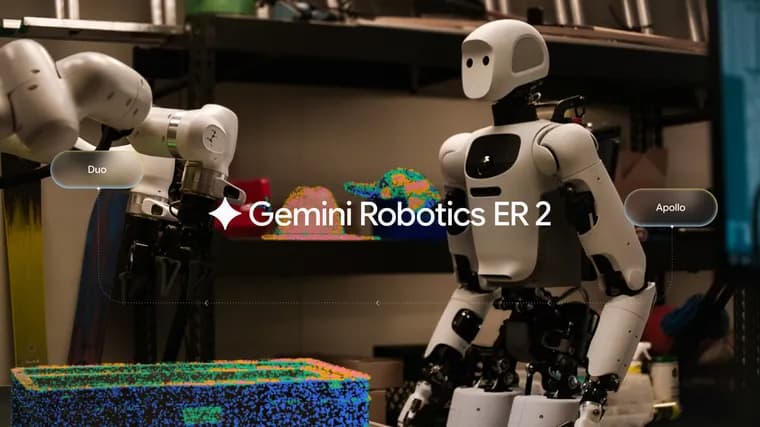
Google DeepMind has launched Gemini Robotics ER 2, its newest embodied-reasoning model for robotics, positioned as a high-level brain that lets a robot talk with people, understand its physical surroundings, and plan multi-step tasks, then hand off the actual movement to a separate lower-level vision-language-action model. The model can call tools directly, including Google Search or any function a developer defines, and it is built to keep reasoning while the robot is still acting rather than pausing to think between steps. It is now available to developers through the Gemini API and Google AI Studio, and is in private preview on the Gemini Enterprise Agent Platform.
Compared with the prior version, Gemini Robotics ER 1.6, the new model watches continuous video rather than single snapshots, so a robot can track its own progress, notice when something has gone wrong, and decide when to move to the next step. Google DeepMind reports two new evaluation results for this: 57.4% accuracy on progress classification, where each video frame is sorted into one of five completion bands (0-20%, 20-40%, 40-60%, 60-80%, 80-100%), and 91.3% accuracy with a 0.96 second mean absolute distance on moment-finding, the task of spotting the exact frame where a critical event happens, such as when to stop pouring coffee into a cup. The company says the model matches much larger model categories on this precision while running at a fraction of the compute cost and four times the execution speed.
The model also gets a multi-robot collaboration feature, letting different types of machines, for instance a wheeled rover suited to flat indoor floors and a humanoid better suited to uneven terrain, share a common understanding of a task and hand work off to each other. Google DeepMind points to a demonstration pairing Apptronik's Apollo 2 humanoid with a Franka F3 Duo arm. Separately, the company built a demo with Boston Dynamics in which Gemini Robotics ER 2 orchestrates the Spot robot's navigation and manipulator APIs so it fetches an object, such as a bag of popcorn, on a spoken command; the code for this is posted on GitHub.
On tool orchestration generally, Google DeepMind says the model consistently outperforms ER 1.6 across three control modes it tested: real robot control, simulated robot control, and a human operator tele-operating the robot remotely. On spatial reasoning, the company cites gains on three benchmarks: detecting success or failure from raw video rather than static images, so it can catch spills, slips or misalignments mid-task; reading a wider range of instruments, extended from circular dials and sight glasses to digital displays, linear scales, rulers and liquid thermometers, tested across 10 instrument types; and improved visual question answering. On safety, the company calls this its safest model yet, citing gains on Safety Instruction Following and Human Proximity benchmarks, and reports that the model successfully halts a humanoid robot when a person comes near and resumes only once the area is clear. Alongside the release, Google DeepMind says it is introducing a new benchmark for testing whether a foundation model can act as a safe orchestrator for vision-language-action systems, covering its ability to enforce safety constraints, monitor the environment, judge physical feasibility, and ask a human for clarification when needed; details are in a separate safety technical report.
The post does not name a specific launch date beyond "today," does not name an individual author or spokesperson, gives no pricing for API access, and does not disclose the actual accuracy or speed figures for the "previous generation models and competing frontier models" it says it outperforms, only that it does.
Key facts
- Gemini Robotics ER 2 is Google DeepMind's new embodied-reasoning model for robots, available via the Gemini API and Google AI Studio, with private preview on the Gemini Enterprise Agent Platform.
- It hits 57.4% accuracy on progress classification (five completion bands per video frame) and 91.3% accuracy with 0.96 second mean absolute distance on moment-finding, the latter at 4x the execution speed of much larger model categories and a fraction of the compute cost.
- It adds multi-robot collaboration, demonstrated with Apptronik's Apollo 2 humanoid working alongside a Franka F3 Duo arm.
- A Boston Dynamics demo has the model orchestrating Spot's navigation and manipulator APIs to fetch objects on a spoken command, with code posted on GitHub.
- Google DeepMind calls it its safest model yet, saying it halts a humanoid robot when a person is nearby and resumes only once the area clears, and it introduces a new benchmark for safe VLA orchestration.
Why it matters
Physical robots have long struggled with a specific gap: reasoning fast and precisely enough about the physical world in real time to know exactly when a step is finished and what to do next. Gemini Robotics ER 2 targets that gap directly by watching continuous video instead of single frames, letting a robot track its own progress, self-correct, and decide when to switch tasks without restarting a whole workflow. Layered on top is multi-robot collaboration, letting machines built for different jobs, a rover for flat floors, a humanoid for rough terrain, share a task through a common semantic understanding rather than working in isolation.
Who it affects
Developers building physical AI applications get access now through the Gemini API and Google AI Studio, with the Gemini Enterprise Agent Platform integration in private preview for enterprise customers. Robotics partners are directly involved in the launch: Boston Dynamics supplied the Spot robot for the fetch-task demo, and Apptronik's Apollo 2 humanoid is shown collaborating with a Franka F3 Duo arm. The model itself does not drive motors; it hands that off to a separate lower-level vision-language-action model, so any team already running a VLA system is the practical audience.
How to use it
Gemini Robotics ER 2 is publicly available to developers through the Gemini API and Google AI Studio today, with the Gemini Enterprise Agent Platform integration limited to private preview. Developers declare low-level control interfaces, such as VLA models or navigation APIs, as callable tools, then stream multimodal video, audio or text into the model, which integrates with the Gemini Live API's bidirectional streaming endpoint for latency-sensitive orchestration. Example code, including the Boston Dynamics Spot demo, is published on GitHub. No pricing or licensing terms for API access are given in the announcement.
How solid is it
The claims rest on Google DeepMind's own benchmark figures rather than independent testing: 57.4% accuracy on progress classification, 91.3% accuracy and 0.96 second mean absolute distance on moment-finding, and stated gains over the prior ER 1.6 model across tool orchestration, spatial reasoning (success/failure detection, instrument reading across 10 types, visual question answering), and safety benchmarks. The company says the model matches much larger model categories on moment-finding precision while running at a fraction of the compute cost and four times the speed, but it does not publish the comparison figures for the "previous generation models and competing frontier models" it says it beats, only the claim that it does.
Risks and caveats
All performance numbers and comparisons come from Google DeepMind's own announcement, with no third-party benchmark cited. The post gives no calendar date for the launch beyond "today," names no individual author or presenter, and discloses no pricing for API access. The Gemini Enterprise Agent Platform integration is private preview only, with no stated timeline for wider availability. Safety claims, including the described ability to halt a humanoid robot near a person and resume once clear, are based on the company's own testing against its own newly introduced safety benchmark, not an external audit.