Google Labs Playground builds games from prompts; Wired's test finds 'AI slop'
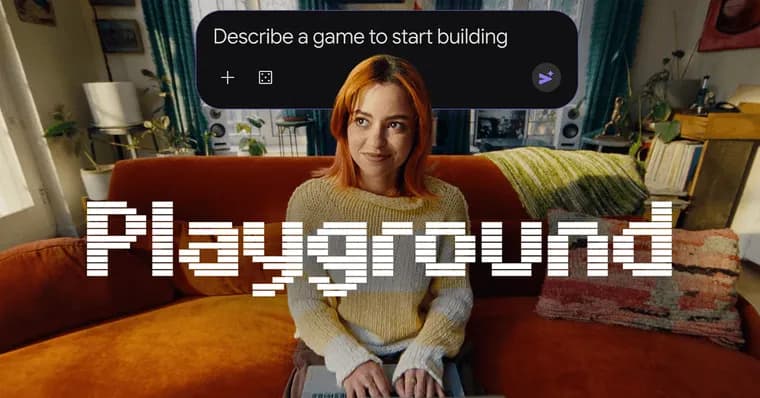
Playground, which Google launched this week according to Wired, is part of Google Labs, the company's landing page for AI experiments that have not yet become an app or official service. It works similarly to Horizon Create, the game generation service Meta announced in September. Wired describes it as vibe coding for video games: you describe in plain language, in a chatbot-like interface, what kind of game you want, and Playground builds a working in-browser version. You can then add instructions to tweak the design. Photos, videos or models can be uploaded as references; otherwise the visuals and designs are all AI-generated. Anyone can sign in with a Google account and play the user-generated games.
The Wired writer, who says they have little to no game development or coding skill, built three playable, stable, and 'not even remotely good' games in one day. The first, Pork Drop, came from the prompt 'Tetris but with cute pigs instead of blocks.' The first result was a farm-themed Tetris with pig faces on every block. After the follow-up 'Each block is a pig', contorted into the shape of the Tetris blocks, it became a clean, playable version, though the occasional block looked like a T-posed pig with its legs spread-eagle. The AI suggested the title Piggy Stacker; the writer kept their own.
The second, Dinner Darling, came from a colleague, Jay Dayrit, who answered the question of what game to make with 'Gay dinner party.' With no follow-up requests, Playground produced a 2D flash-style game with Bitmoji-like art. You play Julian, a stressed host of a fancy dinner party, preparing bruschettas and espresso martinis for increasingly angry guests against countdown timers. The writer failed miserably and saw a 'PARTY CATASTROPHE' game-over screen. The game says nothing about anyone's sexuality, and Dayrit joked that losing proved the writer was straight. Another colleague, Reece Rogers, was less impressed and noted there was no vegan or dairy-free option.
The third, Neon Don, took the most work and is the most played, with seven unique players as of publication. It began as a 'cyberpunk-style rhythm game' about a 'very divorced' ex-cop fighting rogue agents and corrupt politicians; it started as a Beat Saber-type title and was reshaped into a top-down, arcade-like shooter in the style of Hotline Miami, with synth wave music. The writer also tried to push the content bounds with this game, and Playground added its own details to the enemy descriptions, such as 'bulky, wide builds with prominent beer bellies straining against their tight tactical shirts and cargo pants.' The writer then added level scaling, boss generation and enemy variety step by step, flagged mobility bugs that were fixed (sometimes with new problems introduced), and asked for a text-based snark system so the hero quips like 'Keep shooting! Brenda took everything else away!'
The limits showed up quickly. After a certain point Google throttles usage, and every new game and iteration uses more of the allowance. The writer's Neon Don updates are due on October 14, when the allowance refreshes. A 'Backflip' button came out named 'Doge flip' and could not be changed until credits recharge. The writer admits to leaning on vibe-based edits like 'Make Don taller' or 'more divorced', and says some of the top games on the platform are much better. The verdict: Playground is fun, somewhat intuitive and gives tangible results in real time, and people will probably make interesting things with it, but the limitations keep it from being truly useful. Browsing the platform, different genres end up with almost identical menus and music, and it soon becomes clear it is AI slop all the way down.
Key facts
- Google Labs' Playground, launched this week per Wired, generates working in-browser games from plain-language prompts and lets users refine them with follow-up instructions.
- The Wired writer built three games in one day: Pork Drop (pig Tetris), Dinner Darling (a dinner-party game) and Neon Don (a top-down shooter), the last with seven unique players as of publication.
- Usage is throttled after a certain point and each new game or iteration uses more of the allowance; the writer's updates wait for the refresh on October 14.
- Different genres end up with almost identical menus and music, and the writer's verdict is that it is 'AI slop all the way down'.
- Playground works similarly to Meta's Horizon Create, which Meta announced in September.
Why it matters
Playground is Google's version of prompt-to-game generation, a space where Meta announced Horizon Create in September. It applies the vibe coding idea to video games: describe what you want in a chat box and get something playable in the browser in minutes. It sits in Google Labs, which holds AI experiments that have not yet become an app or official service. The Wired test is an early reading of how far that idea gets a non-developer.
Who it affects
The pitch is aimed at people with little or no game development or coding skill; the writer calls the process straightforward, conversational and responsive and says it suits 'dummies like me'. Anyone with a Google account can sign in and play the user-generated games. A real game developer, the writer imagines, would know what to say to sharpen features and make a game more fun or playable.
How to use it
Describe the game in plain language in the chat interface and hit Build, then add instructions to tweak the design. Photos, videos or models can be uploaded as reference assets; otherwise visuals and designs are AI-generated. The writer added features a little at a time, dictating level scaling, boss generation and enemy variety, and also leaned on vibe-based edits like 'Make Don taller'. Plan around the allowance: Google throttles usage after a certain point, and every new game and iteration uses more of it.
How solid is it
This is a single first-hand account by one Wired writer, based on three games made in one day, not a benchmark or a broad evaluation. The games were playable and stable, but the writer calls them not remotely good. The article is a light, personal review. No statement from Google is quoted, and the source does not name the AI model that powers Playground. Seven unique players on the most-played game is a tiny sample of how the public reacts.
Risks and caveats
Throttling is the main practical limit: the writer's games still have many issues that cannot be fixed until usage credits recharge, and the writer is not willing to pay for more. The AI can also drift from what you asked for; it renamed a 'Backflip' button 'Doge flip', and fixes sometimes introduced other problems. The writer also reports an unmistakable sameness across the platform, with near-identical menus, music, combat options and style choices. The writer tested content bounds with Neon Don, but the source does not say what moderation limits Playground enforced.
“Playground is fun for a bit. But soon it becomes pretty clear it’s AI slop all the way down.”
— Wired