Google Research open-sources MilleMiglia, a middle-mile logistics benchmark generator
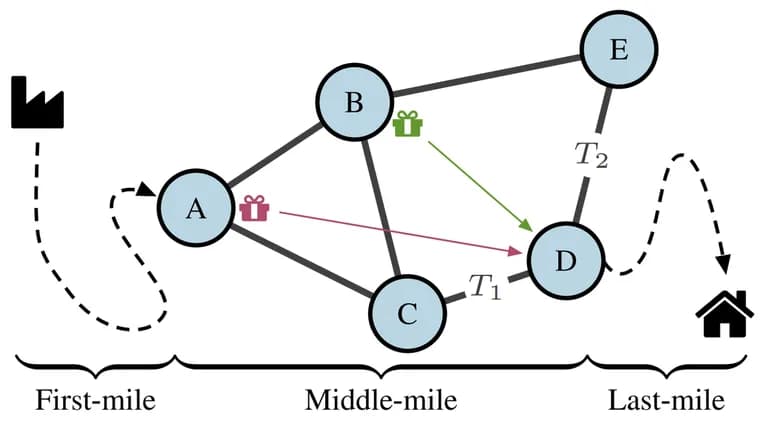
Google Research has released MilleMiglia, an open-source C++ instance generator that produces realistic, privacy-preserving synthetic benchmark data for middle-mile logistics optimization. The work comes out of an ongoing collaboration between Google and academic partners at UniBrescia and ENPC Paris, and it accompanies a paper titled "A Novel Instance Generator for Simulating Middle-Mile Logistics Networks." Source code, documentation and a sample instance are on GitHub.
Logistics research has traditionally concentrated on the first mile (moving goods from producers to initial consolidation points) and the last mile (delivering to the consumer), both usually modeled as variants of the vehicle routing problem (VRP). The middle mile, the bulk movement of goods between distribution centers at a regional or continental scale, gets far less academic attention despite accounting for a large share of total logistics spending. The post attributes this gap to a lack of public, high-quality data: most logistics companies treat their network topology and demand volumes as sensitive proprietary information.
The post frames the middle mile as structurally different from first- and last-mile delivery. Where a single truck carries a shipment from origin to destination in those stages, a middle-mile shipment behaves like a relay race: it can pass through several vehicles across a continental network, sometimes over a week, getting unloaded, sorted and consolidated at intermediate distribution centers along the way. A shipment has to reach each center inside a specific time window to catch its scheduled outgoing truck; missing that window means waiting for the next cycle and a resulting delay. Google's illustrative example has goods leaving a manufacturer in Groningen for a regional center in Utrecht, then Antwerp, then Paris, before last-mile delivery to a customer in Versailles, with the connection in Antwerp missed because the next truck to Paris was already full.
Because of this structure, the authors argue that existing VRP solvers, including tools like OR-Tools or Google Maps Platform Route Optimization, cannot apply to the middle mile: the problem needs a multi-commodity flow model over a space-time graph, tracking fixed vehicle schedules, distribution-center throughput limits and multi-day synchronization constraints that standard VRP formulations do not capture. MilleMiglia encodes all of this in a single Protocol Buffers file per generated instance, so the resulting datasets stay compact and can be consumed by solvers written in different languages. To build realistic but non-sensitive synthetic networks, it draws on statistical distributions that interpolate between publicly available industry information and privately disclosed data; it can also generate large synthetic datasets for training machine learning models.
The research was primarily conducted by Aymane Lotfi during his Student Researcher tenure at Google and by Matteo Petris, now at ENPC Paris, with Thibaut Cuvelier and Bruno De Backer credited for contributions and Claudia Archetti, now at UniBrescia, credited for leadership and support. Google positions MilleMiglia as a first step toward a standardized middle-mile benchmarking suite comparable to CVRPLIB for the VRP community, and says it hopes to launch a community challenge on middle-mile problems to draw more academic and industrial solver-developer interest. Separately, the team says it is working on a specialized solver and API built for middle-mile operational problems, though the post gives no timeline for that work.
Key facts
- Google Research, with academic partners at UniBrescia and ENPC Paris, open-sourced MilleMiglia, a C++ instance generator producing realistic, privacy-preserving synthetic benchmark data for middle-mile logistics.
- The middle mile (bulk movement between regional distribution centers) has drawn far less academic attention than first- and last-mile delivery, largely because logistics companies keep their network topology and demand data proprietary.
- MilleMiglia models the problem as a multi-commodity flow on a space-time graph, capturing fixed vehicle schedules, throughput limits and multi-day synchronization constraints that standard VRP solvers like OR-Tools cannot handle; each instance is stored as a single Protocol Buffers file.
- The team, including Aymane Lotfi, Matteo Petris, Thibaut Cuvelier, Bruno De Backer and Claudia Archetti, calls it a first step toward a standardized benchmarking suite comparable to CVRPLIB and hopes to launch a community challenge on middle-mile problems.
- Google says it is separately developing a specialized solver and API for middle-mile operations, building on the instance generator, with no timeline given.
Why it matters
Middle-mile logistics, the segment that moves goods in bulk between regional or continental distribution centers, covers the longest distance in a shipment's journey and a large share of total logistics cost, yet operational research has focused on the first and last mile instead. The post attributes the imbalance to a lack of public data: logistics companies guard their network topology and demand volumes as proprietary, so researchers have had nothing standardized to test optimization methods against. MilleMiglia is meant to close that gap by generating realistic synthetic instances that behave like real middle-mile networks without exposing any company's actual data.
Who it affects
The tool targets operations-research academics and students working on logistics optimization, and industrial solver developers building routing and network-optimization software. Indirectly, it affects logistics and e-commerce companies, retailers, automotive parts networks and time-sensitive shippers such as pharmaceutical distributors, all of which depend on the middle-mile networks the generator is meant to help optimize.
How to use it
The source code, documentation and a sample instance are published on GitHub. MilleMiglia is written in C++ and uses Protocol Buffers, so each generated instance is stored compactly in a single file that solvers written in different programming languages can consume. It can produce a range of instance types and also generate large synthetic datasets for training machine learning models. The post does not state a version number or license for the repository.
How solid is it
The release is described in a Google Research blog post co-written by two of the project's engineers and accompanies a paper, "A Novel Instance Generator for Simulating Middle-Mile Logistics Networks," produced with academic partners at UniBrescia and ENPC Paris. The post does not give a publication venue or date for that paper beyond its title, and reports no benchmark or performance results, such as solve times or solver comparisons, for the instances MilleMiglia produces.
Risks and caveats
The post does not state how many instances MilleMiglia generates or how large they are, and it reports no benchmark or performance comparisons against the tool. No release version number or license is given for the GitHub repository, and no timeline is provided for the specialized middle-mile solver and API the team says it is separately building. The underlying paper is named but not dated or placed in a publication venue.