Google Research proposes a sleep phase for LLMs to retain new knowledge
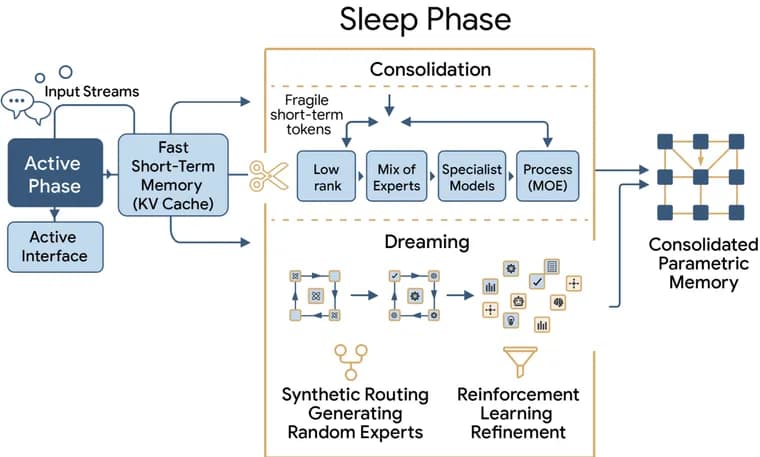
On October 27, 2026, Ali Behrouz and Vahab Mirrokni of Google Research published a blog post introducing a "sleep framework" for continual learning in large language models.
The problem they start from: once deployed, LLMs stay largely static, with a fixed knowledge cutoff. Updating the model with new data tends to trigger catastrophic forgetting, where learning new tasks badly degrades earlier ones. Relying only on in-context learning (ICL) keeps knowledge just as long as the context window lasts; when the session ends, the information is gone.
The proposed answer is inspired by how the human brain stabilizes memory during rest. The model gets a continuous periodic lifecycle that alternates between active interaction and offline memory consolidation, which turns fragile short-term context into stable long-term parameters. The authors say this lets LLMs acquire new facts, retain long-context knowledge up to 10M tokens, and improve complex reasoning.
The authors stress that the neuroscience vocabulary ("sleep", "dreaming", "self-improvement") is borrowed. The framework runs entirely within a fixed model architecture and human-defined training rules. During the offline sleep phase, the model unlocks pre-allocated Mixture-of-Experts (MoE) memory blocks and updates its numerical weights using self-generated practice examples. This automated post-training cycle is meant to help a deployed model absorb new facts and sharpen its reasoning while its core codebase and design stay unchanged.
Sleep has two stages, memory consolidation and dreaming. The post grounds them in a theory. For consolidation, the analysis treats knowledge seeding as a structured, low-rank compression problem: the model does not copy every detail of its short-term traces, but picks a compact set of directions that best preserve its own on-policy behavior and the semantic qualities the learning objective rewards. On-policy distillation aligns consolidation with the trajectories the model will actually produce at inference time, a semantic reward prioritizes meaning and task-relevant behavior over matching token probabilities, and parameter expansion supplies the capacity to write these memories without overwriting what was consolidated earlier. For dreaming, random expert activation and reward-based sample selection are said to improve the geometry of learning: injecting different MoEs broadens the gradient directions explored during synthetic generation, and gradient-based filtering keeps the synthetic experiences that carry the most useful signal. The authors say this gives a more balanced optimization landscape with better-conditioned gradients, and that dreaming is more than self-generated data augmentation.
Results reported in the post:
Continual translation in unseen languages (Manchu and Kalamang): the sleep framework kept a near-zero performance drop across multi-stage evaluations, while the baselines ICL, Cartridges and supervised fine-tuning (SFT) suffered severe catastrophic forgetting during sequential learning.
Long context on BABILong: the sleep method showed near-perfect scaling up to 10M tokens and outperformed baselines named as GPT-4 and Titans, by compressing long-context information into parametric memory during sleep-time consolidation.
Factual knowledge on SQuAD and continued pre-training (CPT): 48.9% on single-task and 46.2% on CPT evaluations, ahead of the base model, SFT and Self-Adapting Language Models (SEAL), without degrading existing model representations. The post does not name the metric.
Math reasoning: the sleep-enhanced base model scored 79.2% on AIME 24, 69.0% on AIME 25 and 46.1% on HMMT 25, outperforming SFT, group relative policy optimization (GRPO) and on-policy self-distillation (OPSD). The authors read this as showing that pairing memory consolidation with imitation learning drives better reasoning.
The authors conclude that the paradigm "provides a path toward autonomous, continually learning AI systems". The research was conducted by Ali Behrouz (Google and Cornell University), Farnoosh Hashemi (Cornell University), Adel Javanmard (Google and University of Southern California) and Vahab Mirrokni.
Key facts
- Google Research's sleep framework has a deployed LLM alternate between active interaction and an offline phase that consolidates short-term context into long-term parameters, then self-improves in a "dreaming" stage.
- In the sleep phase the model unlocks pre-allocated Mixture-of-Experts memory blocks and updates its weights on self-generated practice examples, within a fixed architecture and human-defined training rules.
- On BABILong the method is reported to scale near-perfectly up to 10M tokens, ahead of baselines named as GPT-4 and Titans.
- On SQuAD and CPT it scored 48.9% and 46.2%; on AIME 24, AIME 25 and HMMT 25 the sleep-enhanced base model scored 79.2%, 69.0% and 46.1%.
- In continual translation into Manchu and Kalamang, the authors report a near-zero performance drop, while ICL, Cartridges and SFT suffered severe catastrophic forgetting.
Why it matters
Deployed LLMs are frozen at a knowledge cutoff, and the two usual fixes both fall short: continual weight updates cause catastrophic forgetting, and in-context learning forgets when the session ends. This post proposes a third route, a periodic offline phase that moves what the model learned in context into its parameters. If it holds up, it points toward models that keep learning after deployment. The authors frame it as a path toward autonomous, continually learning AI systems, not as a finished capability.
Who it affects
Mainly researchers working on continual learning, long-context memory and post-training of LLMs, since the post compares against ICL, Cartridges, SFT, SEAL, Titans, GRPO and OPSD. It is also relevant to anyone building systems that need a model to absorb new facts or languages after deployment. The framework relies on Mixture-of-Experts memory blocks, so it is described in the context of MoE models.
How to use it
The post offers no code, model, product or release. It is a research description, and the text does not state that the framework is deployed in or planned for any Google product. No compute cost, duration or frequency of the sleep phase is given, and no paper title or link is given in the text. For practitioners the usable part is the recipe in outline: reserve MoE memory blocks, run an offline consolidation stage using on-policy distillation with a semantic reward and parameter expansion, then a dreaming stage with random expert activation and gradient-based filtering of synthetic samples.
How solid is it
This is an official Google Research blog post by the researchers themselves, and the results are the authors' own claims. Benchmarks cover translation, BABILong, SQuAD/CPT and math (AIME 24/25, HMMT 25). The text gives no paper title, arXiv link, venue or peer-review status. The metric behind 48.9% and 46.2% is not named, no baseline numbers are listed for any comparison, and the size or identity of the base models is not stated. The Manchu and Kalamang result is described only as a "near-zero performance drop", with no figures.
Risks and caveats
The post discusses no limitations or failure cases. Without baseline numbers, the size of the gains cannot be judged from the text. The "sleep" and "dreaming" terms are analogies; the authors say the system is ordinary weight updating within a fixed architecture. The theory is presented as explaining why the two stages support continual learning, but the post only summarizes it. Costs of repeated offline updates and whether forgetting is truly avoided over long deployments are not covered.
“Our sleep paradigm provides a path toward autonomous, continually learning AI systems.”
— Ali Behrouz and Vahab Mirrokni, Google Research blog post