Hy-Nomas: 8B video world model takes free-form text and camera control
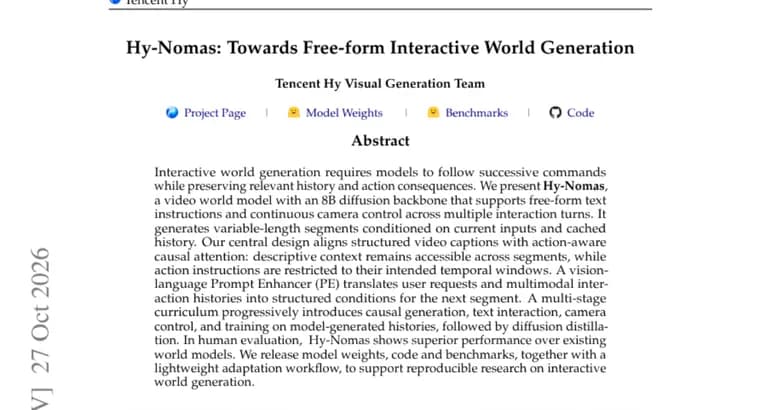
The authors present Hy-Nomas, a video world model for interactive world generation. Their starting point is that such a system must follow successive commands while preserving relevant history and the consequences of earlier actions.
The model has an 8B diffusion backbone. It supports free-form text instructions and continuous camera control across multiple interaction turns, and it generates variable-length segments conditioned on the current inputs and cached history.
The central design aligns structured video captions with action-aware causal attention. Descriptive context stays accessible across segments, while action instructions are restricted to their intended temporal windows. A vision-language Prompt Enhancer (PE) sits in front of the generator: it translates user requests and multimodal interaction histories into structured conditions for the next segment.
Training follows a multi-stage curriculum. It introduces causal generation first, then text interaction, then camera control, then training on model-generated histories, and finishes with diffusion distillation.
In human evaluation, the authors say Hy-Nomas shows superior performance over existing world models. To support reproducible research on interactive world generation, they release model weights, code and benchmarks, together with a lightweight adaptation workflow.
Key facts
- Hy-Nomas is a video world model with an 8B diffusion backbone for interactive world generation.
- It accepts free-form text instructions and continuous camera control across multiple interaction turns, generating variable-length segments from current inputs and cached history.
- Structured video captions are aligned with action-aware causal attention, so descriptive context persists across segments while actions stay within their intended temporal windows.
- A vision-language Prompt Enhancer turns user requests and multimodal histories into structured conditions for the next segment.
- The authors report superior human-evaluation performance over existing world models and release weights, code, benchmarks and a lightweight adaptation workflow.
Why it matters
Interactive world generation asks a model to obey a chain of commands while remembering what came before and what earlier actions changed. Hy-Nomas tackles this with text instructions and camera control combined in one multi-turn model, and with a design that keeps scene description available across segments while confining each action to its own time window. The release of weights, code and benchmarks makes it a candidate baseline for others working on the same problem.
Who it affects
Researchers building interactive video and world models are the direct audience, since the authors frame the release as support for reproducible research. Teams that want to adapt a world model to their own setting may look at the lightweight adaptation workflow that ships with it.
How to use it
The authors release model weights, code and benchmarks, together with a lightweight adaptation workflow. A user supplies free-form text instructions and camera control over successive turns, and the model produces the next segment from those inputs and the cached history. The Prompt Enhancer converts requests and interaction histories into the structured conditions the generator uses.
How solid is it
This is the authors' own description of their work, and the evidence given is a human evaluation in which Hy-Nomas shows superior performance over existing world models. No scores, win rates or rater counts are given, and the compared models are not named, so the size of the advantage cannot be judged from the source. The release of weights, code and benchmarks should allow outside checking.
Risks and caveats
The superiority claim rests on human evaluation with no quantitative detail in the source. The source gives no inference speed, hardware requirements, resolution or segment length, so practical cost and output quality are unknown from this text. No license or repository link is given either.