Google's 4 Neon takes first place on the Models Engineering Index
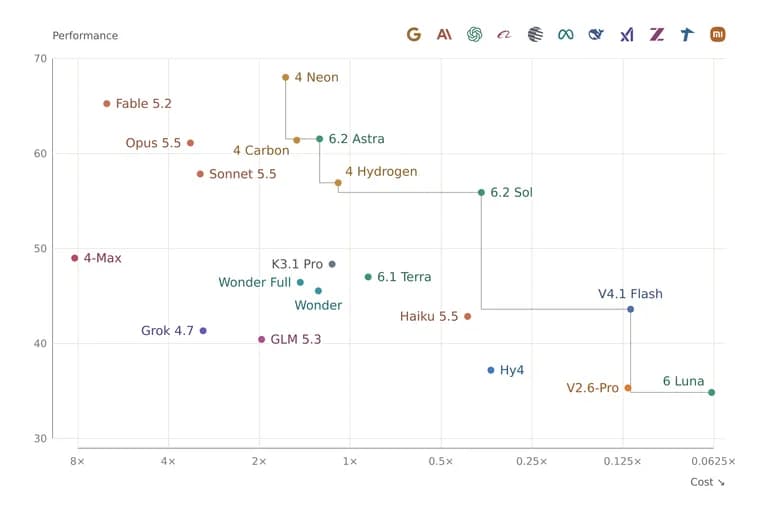
The Models Engineering Index (Mei) is a web leaderboard that ranks language models on practical engineering tasks by combining published benchmark results into a single score per model. In its current table, Google's model listed as "4 Neon" is in first place with an index of 68.0. Anthropic's Fable 5.2 is second at 65.3, OpenAI's 6.2 Astra third at 61.5, Google's 4 Carbon fourth at 61.4 and Anthropic's Opus 5.5 fifth at 61.1.
The table also shows cost and token use for each model, both relative to a typical model set at 1×. 4 Neon comes in at 1.6× cost and 0.83× tokens. Fable 5.2 sits at 6.4× cost and 2.1× tokens, so on this measure it is about four times as expensive as 4 Neon (6.4 divided by 1.6) while scoring 2.7 index points lower. 6.2 Astra is at 1.3× cost and 0.29× tokens; 4 Carbon at 1.5× and 0.89×; Opus 5.5 at 3.4× and 1.9×. Further down, the table lists Sonnet 5.5 (Anthropic, 57.8), 4 Hydrogen (Google, 56.9), 6.2 Sol (OpenAI, 55.9), 4-Max (Alibaba, 49.0) and K3.1 Pro (Moonshot, 48.4) among the top ten, and runs to 20 models, ending with 6 Luna (OpenAI, 34.9). These rows come from a summarised rendering of the page rather than a verbatim copy.
The method works like this. Each benchmark's scores are standardised, then every model's index is estimated by fitting a model effect and a benchmark effect together. The point is that a model is not rewarded for sitting only on easier benchmarks, or penalised for missing some. The result is rescaled so the listed models average 50 with a standard deviation of 10. Cost and token use are fitted the same way, on a log scale, and shown relative to the typical model. The data comes from Cognition, Cursor, the Laude Institute and Vals AI, and the project's source is on GitHub.
Most of the page's own text is a list of limits. It says the index is far from perfect and that work is underway to improve it. Models are tested on different subsets of benchmarks, so some scores rest on far less evidence than others. There are no error bars, so small gaps are not meaningful. Scores are relative to the models listed, so adding or removing models shifts them. Benchmarks are weighted equally regardless of size or reliability. Cost is the reported cost of each benchmark run, so it reflects prices at the time and each benchmark's setup, not what a model costs on your workload. Results are reproduced as published, not independently verified, and may be affected by contamination or tuning to the benchmarks. The page ends by saying benchmarks are only a proxy for real engineering work.
Key facts
- Google's 4 Neon ranks first on the Models Engineering Index with 68.0, ahead of Anthropic's Fable 5.2 at 65.3, a gap of 2.7 points.
- The index is scaled so the listed models average 50 with a standard deviation of 10; OpenAI's 6.2 Astra (61.5), Google's 4 Carbon (61.4) and Anthropic's Opus 5.5 (61.1) follow.
- 4 Neon costs 1.6× and uses 0.83× the tokens of the typical model; Fable 5.2 is at 6.4× cost and 2.1× tokens.
- Data comes from Cognition, Cursor, the Laude Institute and Vals AI, combined by fitting model and benchmark effects together.
- The page says there are no error bars, results are not independently verified, and small gaps are not meaningful.
Why it matters
Leaderboards that fold many benchmarks into one number are what many people reach for when comparing models. This one puts Google's 4 Neon on top and also shows cost and token use beside the score. On those figures 4 Neon pairs the highest index with a cost of 1.6× the typical model, while the second-placed Fable 5.2 costs 6.4×. The method is designed so a model is not helped or hurt by which benchmarks it happened to be tested on.
Who it affects
Teams choosing a model for engineering work, and the labs listed: Google, Anthropic, OpenAI, Alibaba, Moonshot, Meta, DeepSeek, xAI, Z.ai, Tencent and Xiaomi all appear in the table. Google holds three of the top seven places (4 Neon, 4 Carbon, 4 Hydrogen) and Anthropic three of the top six (Fable 5.2, Opus 5.5, Sonnet 5.5).
How to use it
Treat the index as a rough shortlist tool, not a verdict. Read the score together with the cost and token columns, but remember the page says cost is the reported cost of each benchmark run, not what a model costs on your own workload. The project's source is on GitHub.
How solid is it
Moderate at best, by the page's own account. Results are reproduced as published and not independently verified. Models are tested on different subsets of benchmarks, so some scores rest on much less evidence than others. There are no error bars, so the 2.7-point lead of 4 Neon over Fable 5.2 cannot be called significant from the source. The leaderboard rows come from a summarised rendering of the page, so the table is less certain than the methodology text.
Risks and caveats
Scores are relative to the models listed, so adding or removing models shifts them. Benchmarks are weighted equally regardless of size or reliability. Results may be affected by contamination or tuning to the benchmarks, and the page states that benchmarks are only a proxy for real engineering work. The source text names the model as "4 Neon" from Google; no longer name for the model appears in the retrieved text.
“This index is far from perfect, and work is underway to improve it.”
— Models Engineering Index page