Google's Willow qubits win a quantum game 98.3% of the time
Google Quantum AI researchers Shashwat Kumar and Rodrigo Cortiñas describe, in a Google Research blog post dated November 19, 2026, a paper in Science titled "Quantum-classical separation in bounded-resource tasks arising from measurement contextuality." The team demonstrates and measures quantum contextuality on its superconducting quantum processors. The work was carried out by the Google Quantum AI team together with academic collaborators.
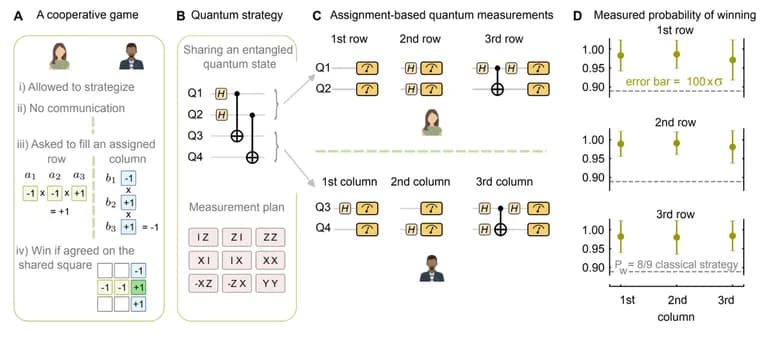
The post starts with a puzzle. Fill a 3x3 grid with +1 or -1 so that every row multiplies to +1 and every column multiplies to -1. It cannot be done: rows force an even number of -1s in total, columns force an odd number. Turned into a game, Alice gets a row and Bob gets a column, they cannot talk, and they win if they put the same number in the cell where their row and column cross. Any plan made in advance is a pre-written table, so classical players win at best 8 out of 9 rounds, or 88.89%. With quantum resources they can in principle win every round, although the impossible grid is still not filled in.
The reason is contextuality, which the authors call arguably the strangest feature of quantum mechanics. It is the testable statement that you cannot assign fixed, pre-existing values to everything you might measure: a result can depend on which compatible measurements are made alongside it. The authors add that a growing body of theory suggests contextuality, rather than entanglement, is the deeper resource behind certain quantum algorithms. Until recently it had been shown almost exclusively in small systems of a few particles, and whether it survives in many-body systems was open.
Experiment 1, the magic square game, ran on the Willow processor. Alice and Bob each hold two qubits, sharing two entangled Bell pairs, and measure them with preset settings for their row or column. Across all nine versions of the game, each played 100,000 times, the qubits won 98.30% (0.9830 ± 0.0001), losing roughly one round in sixty. The authors call the gap over the classical 88.89% meaningful and statistically significant.
Experiment 2 measured how contextual the machine is, using a Bell-Kochen-Specker inequality that bundles correlations into one number, χ = R1 + R2 + R3 - C1 - C2 - C3. Any universe with predetermined outcomes must obey χ ≤ 4; quantum mechanics permits up to 6. The inequality is state-independent, so it describes the machine rather than a carefully chosen input state. Measuring it needs every row and column measured one after another on the same two qubits without disturbing them, which the team did with an extra helper (ancilla) qubit. They ran 540 measurements in a row, repeated 1,000 times, and got χ = 5.590 ± 0.008: well past the classical bound of 4 and only 7% from the quantum limit.
Experiment 3 asked whether contextuality survives at scale. In the GHZ parity game, N players share one entangled GHZ state, each gets a one-bit question and gives a one-bit answer, and they win if the parity of all answers matches a rule set by the questions. Random guessing wins half the time; the best classical plan wins 75% for three players, shrinking toward 50% as players are added. An ideal shared GHZ state wins every time. The team played with up to 71 players, one per qubit. Noise keeps the result below 100% and grows with each added qubit, so the lead narrows, but it stays above the classical bound throughout. The team also verified genuine entanglement across 45 qubits.
Experiment 4 used a hidden linear function task. A 2018 theorem proved that finding a hidden linear function can be done by a constant-depth quantum circuit but by no constant-depth classical circuit; the authors say the advantage traces back to contextuality. They report the algorithm had never been run at scale on real hardware. They ran it on grids of up to 105 qubits, with success probabilities above one-half, using the shallow-circuit recipe the theory prescribes.
The tasks also worked as a diagnostic. Because they demand that many qubits agree simultaneously and exactly, they surfaced subtle coherent errors that rotate a quantum state slightly off-target, which conventional random-circuit benchmarks tend to average away. The authors propose contextuality as a benchmark with a ceiling set by physics (χ = 6, a win probability of 1, a perfect contextual fraction), so the distance between what a machine achieves and what nature permits becomes a score. They say this is relevant to applications such as molecule simulation for chemistry and materials science, because it measures how well a processor runs structured algorithms where subtle errors cannot hide. They also note that theory links contextuality to the magic states error-corrected quantum computers need, which the team recently prepared using magic state cultivation.
Key facts
- On the Willow processor, qubits won the magic square game 98.30% of the time (0.9830 ± 0.0001) over nine versions played 100,000 times each; the best classical strategy wins at most 88.89%.
- The state-independent contextuality quantity measured χ = 5.590 ± 0.008, above the classical bound of 4 and 7% below the quantum maximum of 6, from 540 measurements repeated 1,000 times.
- In the GHZ parity game with up to 71 players (one per qubit), results stayed above the classical bound, though noise narrows the lead as qubits are added; entanglement was verified across 45 qubits.
- Hidden-linear-function instances were solved on grids of up to 105 qubits with success probabilities above one-half, the first run of that algorithm at scale on real hardware according to the authors.
- The tasks exposed coherent errors that random-circuit benchmarks tend to average away, and the authors propose them as a benchmark with a physics-set ceiling.
Why it matters
Contextuality has been demonstrated almost exclusively in systems of a few particles, and whether it survives in many-body machines was an open question. Google's team answers it with measurements up to 105 qubits. The authors also point to theory suggesting contextuality, more than entanglement, is the resource that lets certain quantum algorithms beat classical ones. They say the hidden-linear-function algorithm had never before been run at scale on real hardware.
Who it affects
Quantum hardware builders and researchers who need ways to test processors, and physicists interested in what gives quantum computers their edge. The authors tie the benchmark to applications such as simulating molecules for chemistry and materials science, and to the magic states needed by error-corrected quantum computers.
How to use it
The authors propose the games and the χ inequality as a hardware benchmark. Unlike classical bars that get easier to clear, the ceiling is fixed by physics (χ = 6, win probability 1, a perfect contextual fraction), so the gap between a machine's score and that ceiling is an objective measure that discriminates more precisely as processors improve. The post describes the method as measuring a processor's ability to run structured algorithms, and says the tasks caught coherent errors that random-circuit tests miss.
How solid is it
The work is published in Science, with specific figures and uncertainties: 0.9830 ± 0.0001 on 100,000 plays per game version and χ = 5.590 ± 0.008. The post is written by two of the Google Quantum AI researchers and describes their own results. It gives no numeric win rate for the 71-player GHZ run, only that it stays above the classical bound, and no figure for the 105-qubit hidden-linear-function runs beyond success probabilities above one-half.
Risks and caveats
Noise grows with each added qubit, so the quantum lead in the GHZ game narrows as players are added, and results stay below the ideal 100%. The 105-qubit runs reach success probabilities only above one-half. The quantum strategy does not fill in the impossible grid; it only lets players win more often than any pre-written table. The post gives no timescale or commercial application, and the chemistry and materials point concerns the benchmark's relevance, not a demonstrated result.
“Their answers are not looked up in a hidden table written in advance; the table does not exist.”
— Shashwat Kumar and Rodrigo Cortiñas, Google Quantum AI, Google Research