Google's PhotoScan predicts insulin resistance risk from phone photos
Insulin resistance is a major but often undiagnosed driver of metabolic disease: it typically precedes a type 2 diabetes diagnosis by years, and a HOMA-IR score above 2.9 is considered insulin resistant based on epidemiological reviews. The clinical gold standard for measuring the body composition that underlies this risk, DXA (Dual-Energy X-Ray Absorptiometry) scanning, is precise but expensive, requires specialized equipment, and exposes patients to radiation, so it is not practical for routine screening.
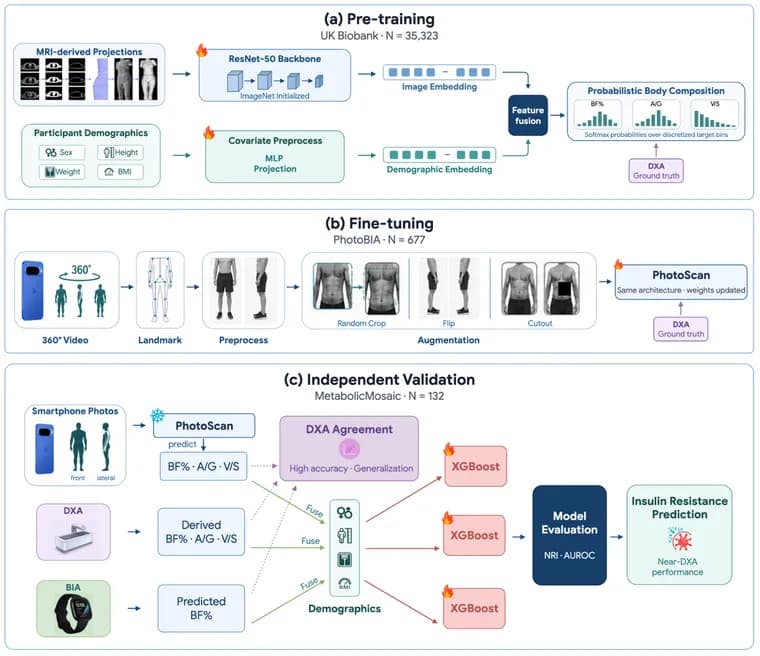
In an August 17, 2026 blog post, Google Research scientists Cassie Zhou and Ahmed Metwally introduced PhotoScan, an investigational deep learning framework that estimates three body composition metrics from standard 2D smartphone photos: body fat percentage (BF%), the Android-to-Gynoid fat ratio (A/G, trunk fat versus hip and thigh fat), and the Visceral-to-Subcutaneous fat ratio (V/S, internal organ fat versus fat under the skin). The model was pre-trained on more than 35,000 participant records from the UK Biobank, then fine-tuned on a separate cohort of 677 adults.
On the PhotoBIA cohort, evaluated with 5-fold cross-validation, the fine-tuned PhotoScan model reached an average mean absolute error (MAE) of 2.15 for BF% prediction, versus 2.91 MAE for a smartwatch-based bioelectrical impedance analysis (BIA) model. Averaged MAE for A/G was 0.107 and for V/S was 0.094. On an independent validation cohort, MetabolicMosaic, results were comparable: 2.13 MAE for BF%, 0.085 for A/G, and 0.085 for V/S. The researchers attribute the smaller A/G and V/S prediction error on MetabolicMosaic to that cohort having more female records (67%, versus 57% in PhotoBIA), since women generally have lower absolute A/G and V/S ratios, which narrows the variance the model has to predict.
The team then tested how well different data combinations predict insulin resistance itself, using a gradient boosting classifier on the MetabolicMosaic cohort, balanced by BMI and insulin-resistance status. A baseline model using only demographics (age, sex, BMI) reached an AUROC of 0.692. Adding PhotoScan's body composition features raised the AUROC to 0.760 and the Net Reclassification Index (NRI) to 0.593, close to the performance of adding gold-standard DXA data itself, which topped out at an AUROC of 0.773 and an NRI of 0.748. By contrast, adding smartwatch BIA data to the demographic baseline produced no improvement in AUROC or NRI, since BIA only estimates BF% and misses the A/G and V/S ratios that carried most of the predictive value in the PhotoScan model.
Google Research frames PhotoScan as a research prototype, not a deployed product, and says it points toward scalable, non-invasive screening for insulin resistance risk. The team's stated next step is combining body composition estimation with other data, including continuous wearable signals, glucose dynamics, and clinical blood biomarkers.
Key facts
- PhotoScan is pre-trained on over 35,000 UK Biobank records and fine-tuned on 677 adults to estimate body fat percentage, A/G ratio, and V/S ratio from ordinary 2D smartphone photos.
- On the PhotoBIA cohort, PhotoScan's BF% prediction reached an MAE of 2.15, beating a smartwatch BIA sensor's MAE of 2.91; A/G and V/S MAEs were 0.107 and 0.094.
- Adding PhotoScan features to a demographic baseline raised insulin-resistance-classification AUROC from 0.692 to 0.760 (NRI 0.593), close to gold-standard DXA's 0.773 AUROC (NRI 0.748).
- Adding smartwatch BIA data to the same baseline produced no AUROC or NRI improvement, since BIA cannot estimate the A/G and V/S ratios that drove most of PhotoScan's predictive value.
- Google Research describes PhotoScan as a research prototype, not a shipped product, with no pricing, regulatory clearance, or consumer app timeline disclosed; next steps involve combining it with wearable, glucose and blood biomarker data.
Why it matters
Insulin resistance quietly damages vascular and liver health years before it shows up in a standard fasting blood sugar test, but the gold-standard way to assess the body composition behind it, DXA scanning, is too expensive, radiation-exposing and infrastructure-heavy for routine screening. PhotoScan is Google Research's attempt to close that gap: by extracting the same kind of body composition signal from an ordinary smartphone photo, it pushes a demographic-only risk model's AUROC from 0.692 to 0.760, nearly matching what adding a real DXA scan achieves (0.773).
Who it affects
The work targets cardiometabolic researchers and, eventually, anyone who could benefit from earlier, cheaper insulin-resistance screening than DXA scanning allows. The results described come entirely from two research cohorts, PhotoBIA (used for fine-tuning and cross-validation) and MetabolicMosaic (used for independent validation), rather than from any public or clinical deployment.
How to use it
PhotoScan is not available as a product or app. Google Research's post gives no price, no release timeline, and no mention of regulatory review or clearance. The described next step is research, not deployment: combining PhotoScan's body composition estimates with continuous wearable data, glucose dynamics, and clinical blood biomarkers.
How solid is it
The model was pre-trained on more than 35,000 UK Biobank records and fine-tuned on 677 adults, then evaluated with 5-fold cross-validation on the PhotoBIA cohort and checked again on an independent cohort, MetabolicMosaic, where BF%, A/G and V/S errors stayed close to the fine-tuning results (2.13, 0.085 and 0.085 MAE respectively). That consistency across two cohorts is a meaningful internal validation signal, though the claims come from a company blog post by the researchers themselves, with no indication of peer review or testing outside these two research cohorts.
Risks and caveats
The post does not mention any FDA or other regulatory review of PhotoScan, nor any pricing or product timeline, nor the specific neural network architecture used. Demographic detail is limited: the only breakdown given is the female proportion of each validation cohort (67% for MetabolicMosaic versus 57% for PhotoBIA), which the authors say already affects A/G and V/S accuracy, and no age, country or ethnicity breakdown is provided for either cohort or the UK Biobank pre-training set. Google Research explicitly calls PhotoScan a research prototype, not a validated diagnostic tool.