GPT-Policy teaches robots new tasks from video, no retraining needed
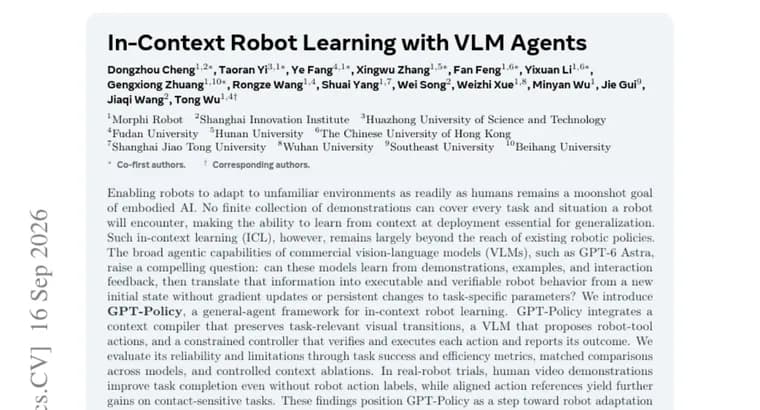
Researchers have introduced GPT-Policy, a framework that gives robots in-context learning: the ability to adapt to a new task from demonstrations, examples and interaction feedback the moment it is deployed, rather than through additional training. The motivation is that no fixed set of demonstrations collected in advance can cover every task and situation a robot will meet in the world, so the paper argues that learning from context at deployment is essential if robots are to generalize the way humans do. The paper frames this as a question raised by today's commercial vision-language models, citing GPT-6 Astra as an example of the kind of general-purpose VLM whose broad capabilities might be turned into physical robot behavior, though the paper does not state that GPT-6 Astra is the model used inside GPT-Policy's own experiments. GPT-Policy itself has three parts: a context compiler that keeps only the visual transitions relevant to the task at hand, a vision-language model that proposes which robot-tool actions to take, and a constrained controller that checks each proposed action, executes it, and reports back what happened. This loop lets the system act on a new starting state without gradient updates or any lasting change to task-specific parameters. The authors tested the framework's reliability and its limits using task success and efficiency metrics, matched comparisons across different models, and controlled experiments that varied how much context the system was given. In real-robot trials, showing the system human video demonstrations improved task completion even when those videos came with no robot action labels attached; when aligned action references were added on top, the gains grew further specifically on tasks that are sensitive to physical contact. The paper presents these results as an early step toward robots that adapt through in-context learning, offering empirical grounding for turning a VLM's general-purpose abilities into physical behavior while also mapping out what still stands in the way of using this reliably in real deployments.
Key facts
- GPT-Policy lets a robot learn a new task from demonstrations, examples and feedback at deployment time, with no gradient updates or lasting changes to task-specific parameters.
- The framework has three components: a context compiler for task-relevant visual transitions, a VLM that proposes robot-tool actions, and a constrained controller that verifies, executes and reports on each action.
- In real-robot trials, human video demonstrations improved task completion even without any robot action labels attached to them.
- Adding aligned action references on top of the video demonstrations produced further gains specifically on tasks sensitive to physical contact.
- The paper cites commercial VLMs such as GPT-6 Astra only as motivation for the research question; it does not say GPT-6 Astra was the model used inside GPT-Policy's own experiments.
Why it matters
Robot policies today are largely trained on a fixed library of demonstrations, and that library can never cover every task or situation a robot will actually run into. The paper's starting premise is that closing this gap requires robots that can learn from context the moment they are deployed, the way a person can pick up an unfamiliar task from a few examples, rather than requiring the robot to be retrained. GPT-Policy is presented as a concrete attempt to bring that kind of in-context learning, already familiar from large language models, into physical robot control.
Who it affects
The work targets robotics and embodied-AI researchers building general-purpose robot policies, and by extension anyone trying to deploy robots into environments and tasks that cannot all be anticipated and demonstrated ahead of time. It also speaks to teams building or evaluating commercial vision-language models, since the paper's core question is whether the broad agentic capabilities already claimed for those models can be translated into verified physical action.
How to use it
GPT-Policy is a research framework, not a released product: the paper gives no code or model release, no availability details, and no timeline for real-world deployment. Its architecture, an action-proposing VLM paired with a constrained controller that verifies and executes each step, points to a design pattern other groups could adopt, but the paper stops short of specifying a robot platform, task set, or number of trials that would let someone reproduce the setup directly.
How solid is it
The evaluation covers task success and efficiency metrics, matched comparisons across models, and controlled ablations of how much context the system receives, which is a methodologically serious setup for this kind of claim. That said, the abstract text gives no numeric results: no success rates, percentages, benchmark scores or baseline comparisons are stated, so the size of the improvement from human video demonstrations and aligned action references cannot be judged from what is available here.
Risks and caveats
The paper does not name the authors, their institutions, or any specific robot platform or task set in its own text, and it does not confirm that GPT-6 Astra, the commercial VLM it cites as motivation, is actually the model used inside GPT-Policy's experiments. Readers should treat the framework as an early, narrowly validated step: the authors themselves frame the results as clarifying what still has to be overcome before this kind of in-context learning can be deployed reliably, not as a solved problem.