Grant Sanderson argues math needs credit for explanation, not proof alone
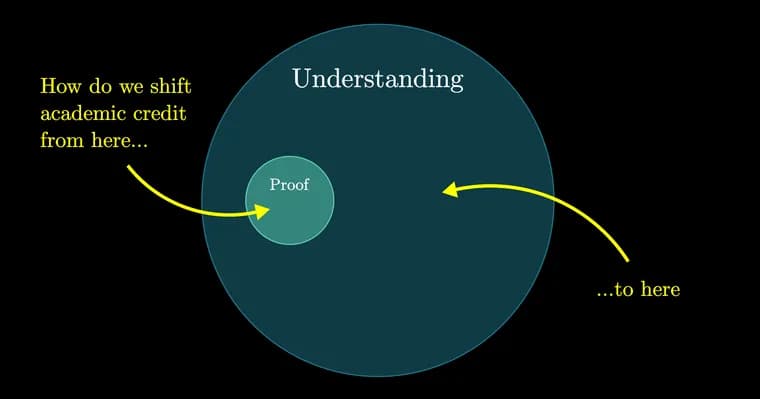
Grant Sanderson, who has built a non-traditional career in math making videos about the subject, argues in a guest post on Terence Tao's blog that the field needs a formally recognized alternative credential to the proof. His starting point is a sentiment he says is spreading through mathematics: proofs and problem solving have always been proxies for the real goal, advancing human understanding, and that proxy breaks down once proofs can be generated without anyone understanding them. He proposes defining a "motivated explanation": work whose primary aim is to answer "how would you think of that?" rather than to establish that a claim is true. He contrasts the two forms directly. A proof puts definitions first and proceeds by strict logical implication. A motivated explanation puts definitions in the middle, is allowed to start from an idea that is not quite right and needs correcting, and can draw on what Michael Nielsen calls "discovery fiction,": a narrative that starts with a simple, wrong solution, shows where it breaks, and fixes it. Sanderson flags his own bias up front: his income and career sit outside academia, so he has nothing personally at stake in what credit the field hands out, and he is not talking about popularization, since the work he means can require deep expertise to follow.
To show this already has a track record, he points to Part IV of the Princeton Companion to Mathematics, which covers over two dozen active research fields, each written up by an expert for clarity. Its editor, Timothy Gowers, told the Numberphile Podcast with Brady Haran that he spent roughly half his working time for about five years on it, and said he probably would not have been offered the job without the freedom a Fields Medal gave him. Sanderson calls it a shame that a Fields Medal should be a precondition for feeling justified in that kind of work. He then turns to Bill Thurston's essay "On Proof and Progress in Mathematics," which reframes the field's goal as advancing human understanding rather than accumulating verified statements. Thurston cites the controversy over Appel and Haken's computer-assisted proof of the four-color map theorem as evidence that mathematicians wanted to understand the proof, not just know the theorem was true, and describes people who print out a table of the first 10,000 primes only to discover raw output was never what they actually wanted. Thurston listed his own "non-credit-producing" work, including revising his notes into a book, developing new communication formats through the Geometry Center such as the "Not Knot" video, and directing MSRI. Sanderson singles out one Geometry Center product, the film Outside In, which visualized Thurston's construction for sphere eversion: where an original existence proof (Smale's) took the idea from zero to one, the film took it from one to millions of viewers. He also cites Timothy Chow's paper "A beginner's guide to forcing," which coins the term "open exposition problem" as the exposition-side counterpart to an open research problem.
Sanderson connects this to AI directly. In April, Liam Price solved Erdos Problem 1196, the asymptotic primitive sets conjecture, through his interaction with GPT-5.4 Pro. Unlike earlier Erdos problems solved with AI help, mathematicians had considered this one both important and hard to crack. The proof reached Nat Sothanaphan and Jared Lichtman, who worked to interpret what approach the AI had actually taken, since a technically valid proof existed but had not yet advanced anyone's understanding. Sanderson's reading is that every AI-generated proof is, at the moment it appears, "born an unsolved exposition problem," and that the field should expect a flood of these in the next few years. He floats an extreme version of his proposal: an institution formally naming important AI-generated results that are not yet understood, similar in spirit to the Millennium Prize Problems but for exposition rather than proof. He is explicit that this cannot work like proof verification: there is no yes-or-no test, no "Lean for motivated explanations," only a practical, verifiable-enough sense that an idea's origin has been made clear.
Key facts
- Grant Sanderson, in a guest post on Terence Tao's blog, proposes that mathematics give academic credit for "motivated explanations" of results on a par with credit for generating proofs.
- Princeton Companion to Mathematics editor Timothy Gowers told the Numberphile Podcast he spent roughly half his working time for about five years on the book, which covers over two dozen fields.
- Sanderson cites Bill Thurston's essay "On Proof and Progress in Mathematics" and the Appel-Haken four-color theorem controversy as evidence mathematicians want understanding, not just verified truth.
- Timothy Chow's paper "A beginner's guide to forcing" coined "open exposition problem" as a counterpart to the familiar "open research problem."
- In April, Liam Price solved Erdos Problem 1196 through interaction with GPT-5.4 Pro; Sanderson calls every AI-generated proof "born an unsolved exposition problem" and expects a flood of them.
Why it matters
The piece responds to a specific anxiety in the math community: once AI systems can generate valid proofs, the traditional signal of mathematical contribution, a new proof, stops reliably indicating that anyone understands anything. If the field keeps rewarding proof generation above all else, outsiders can reasonably conclude that AI is making mathematicians obsolete. Sanderson's proposal is an attempt to name and formalize the other half of the job, so the credit system reflects what practitioners already value.
Who it affects
Practicing mathematicians and the institutions that allocate credit to them: tenure and hiring committees, funding bodies, and prize committees like the one behind the Fields Medal, which Sanderson notes already gives winners the freedom to take on projects like editing the Princeton Companion. It also affects math communicators whose work sits outside traditional research credit, and, going forward, anyone who has to interpret an AI-generated proof, as Nat Sothanaphan and Jared Lichtman did with Liam Price's GPT-5.4 Pro-assisted solution to Erdos Problem 1196.
How to use it
There is no tool or product here, only a call to change incentives. Sanderson's concrete asks are that the field define "motivated explanation" clearly, treat solving an "open exposition problem" (Timothy Chow's term) as comparable in status to solving an open research problem, and consider an organized effort, on the model of the Millennium Prize Problems, to designate which AI-generated proofs most need a human explanation of why they work.
How solid is it
This is an argumentative essay, not a study, and Sanderson flags his own conflict of interest: his career and income are built on producing math videos outside academia, so he benefits personally if explanation work gains status. He backs the argument with named, checkable examples rather than abstractions, Gowers's own account of the Princeton Companion, Thurston's published essay, Chow's paper, and the specific Erdos Problem 1196 episode, but the proposal itself (a new credit category, possibly an exposition-problem prize) is his personal case, not something already adopted.
Risks and caveats
Sanderson concedes the core limitation himself: a proof can be checked as true or false, a motivated explanation cannot, and "there will never be Lean for motivated explanations," so any credit system built on it stays inherently more subjective and open to dispute over whose explanation counts. The available text also breaks off before describing what Sothanaphan and Lichtman actually concluded about GPT-5.4 Pro's approach to Erdos Problem 1196, and it does not record how the mathematics community has responded to Sanderson's proposal itself.
“There will never be Lean for motivated explanations.”
— Grant Sanderson