HarnessEval-W judges world models with sub-agents, not a single score
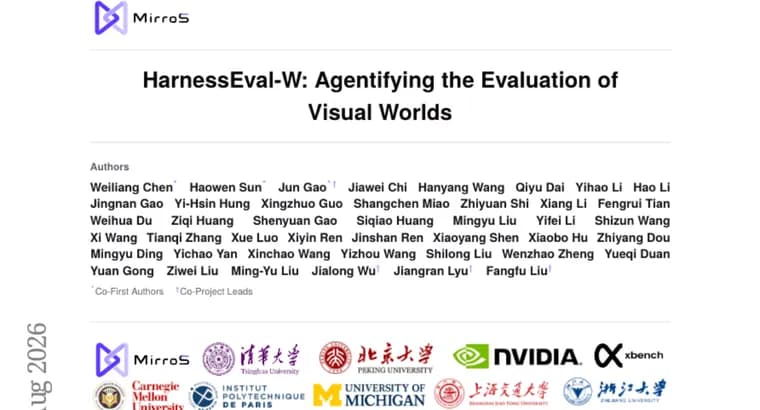
Researchers introduce HarnessEval-W, a benchmark for AI world models that replaces a single scalar score with a full reasoning trail behind every judgment. The motivation: judging a world model's rollout means checking whether physics, causality, and world state evolve correctly, something humans can spot but that existing benchmarks only measure with brute-force metrics, leaving no chain of reasoning that can be examined or verified afterward.
HarnessEval-W borrows the harness paradigm already used to evaluate large language models and applies it to world models. Instead of scoring a rollout against a fixed rubric, the system interprets the context of each evaluation case, breaks the evaluation question into smaller, measurable subproblems, and spawns specialized sub-agents to work each subproblem, giving each one tailored context and diagnostic tools. A parent agent then reviews the evidence the sub-agents gather and summarizes it into a final verdict, producing what the researchers call a transparent evidence tree whose complete reasoning chain justifies the result.
The team ran HarnessEval-W over 18 representative world models across 330 evaluation cases. They report that its judgments closely align with human preferences while also producing verifiable, fine-grained diagnoses for every generated rollout. The full pipeline is being open-sourced as a live benchmark, and the researchers invite the wider community to extend it with new skills and evaluation cases as world models continue to evolve.
Key facts
- HarnessEval-W applies the LLM-ecosystem harness paradigm to evaluating world models, replacing a single brute-force score with a hierarchy of reasoning sub-agents.
- Each evaluation case is decomposed into measurable subproblems, with specialized sub-agents given tailored context and diagnostic tools to reason over their own piece.
- A parent agent validates the sub-agents' gathered evidence and summarizes it into a final verdict, producing a transparent evidence tree for every judgment.
- The benchmark was applied to 18 representative world models over 330 evaluation cases, and the researchers report its judgments closely align with human preferences.
- The full pipeline is being open-sourced as a live benchmark, with the researchers inviting the community to contribute new skills and evaluation cases.
Why it matters
World model benchmarks have relied on brute-force metrics that output a number without showing why a rollout passed or failed. HarnessEval-W's pitch is that a trustworthy evaluation needs the reasoning behind the score, not just the score, especially for judgments about whether physics, causality, and world state evolved correctly in a generated rollout. Borrowing the harness paradigm from LLM evaluation into the world model space is the novel move here.
Who it affects
Teams building or benchmarking world models get a way to see not just how a model scored but why, through the evidence tree each evaluation produces. The open-sourced pipeline also invites outside contributors to add evaluation skills and cases, so the benchmark's coverage is not fixed to what the original researchers built.
How to use it
The researchers describe HarnessEval-W as a live, open-source benchmark rather than a one-off paper result, meant to be extended with new skills and evaluation cases as world models evolve. The source text gives no release timeline, licence terms, or access details beyond the open-source framing itself.
How solid is it
The pipeline was tested against 18 representative world models over 330 evaluation cases, and the researchers report its verdicts closely align with human preferences. The source text does not give a numeric accuracy, agreement score, or error rate to quantify that alignment, nor does it name any specific existing benchmark or metric it was compared against.
Risks and caveats
The source text names no authors or institutional affiliations, so provenance cannot be verified beyond the paper itself. It also does not explain how the 18 world models were selected or when the pipeline was or will be publicly released. As with any hierarchical multi-agent evaluator, the parent agent's summary is only as reliable as the sub-agents' individual diagnoses feeding into it, a limitation the source text does not itself address.
“no existing benchmark automates this capability: metrics are computed brute-force, leaving no reasoning chain that can be examined or verified”
— HarnessEval-W paper