Hermes Agent with Qwen 3.8 Flash Next on a Mac Studio: a first local AI diary
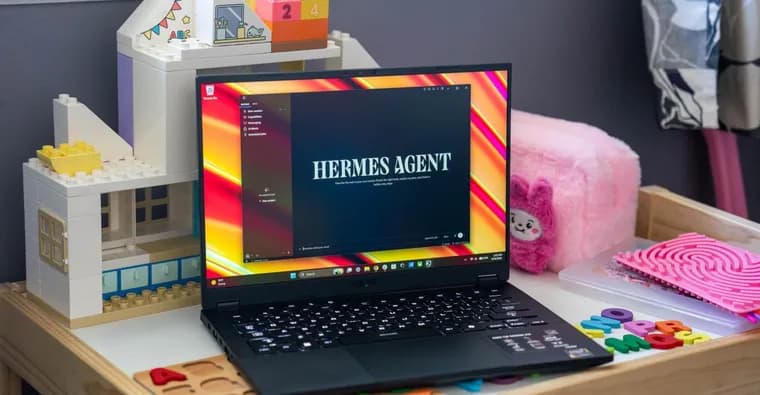
The Verge has started a posted diary on running AI locally. The author says he is not an AI expert and has so far hesitated to use AI regularly because handing his most personal data to cloud services bothered him. Local models now make it possible to try, and the question he sets out to answer is whether the tech is useful enough to justify spending heavily on a computer or laptop with a lot of RAM. He frames the piece as part of his ongoing testing of the M5 Ultra Mac Studio, alongside experiments on other Mac and Windows systems.
He began by installing Hermes Agent, an open-source, self-hosted AI agent desktop app that runs on macOS, Windows and Linux and is free if you stick to local LLMs. The Mac Studio has 256GB of unified memory, so nearly any model would fit. Since running locally means no token costs, he went big: in Hermes' onboarding interface and model picker he chose Qwen 3.8 Flash Next, a 125-billion parameter model of around 105GB. He also made the setup controllable from his phone through a Telegram bot. Then came what he calls his usual nemesis with AI, the empty text box: "What do I do with this thing?"
His first project, following YouTube advice, was a daily morning briefing run as a cron job: it scans his email and calendar, flags anything needing attention and gives a short weather report. He admits it is not very useful and that you obviously do not need a $12,000 computer to build it. It kept failing until he realised macOS could not be asleep when the job fired at 7:30am. It now runs reliably, though he needs to think of more information for it to pull.
A more useful job was his Steam library of over 400 games. Steam does not categorise games automatically, so he asked, "Can you reorganize my Steam library?" Hermes could see most games through the installed Steam client and proposed organisation options. He chose genre-based sorting while keeping his own categories such as favorites, co-op titles, party games and games to play with his wife. For that, he had to register a Steam web API key and give it to Hermes. Once it had access, sorting took a few minutes, and he revoked the key right afterwards. He says it did a fine job overall.
He also had Hermes crunch numbers from financial records and build a spec comparison spreadsheet for a new laptop that is under embargo. Both are tasks he will not trust to a cloud service, and keeping them on his own machine was, in his words, the difference between using the tool or not.
The biggest effort is a script to automate laptop benchmarks. He runs all the benchmarks manually, a dozen or so tests, three times over, averaged for each laptop, which is very time-consuming. Walking Hermes through the procedures and getting it to produce vibe-coded Python scripts has been an endeavor, and the work remains in progress.
His early conclusion is mixed. He hopes this is the tip of the iceberg, but says even powerful local models are not a magical assistant that can do anything, and the daily briefing already broke multiple times. He treats Hermes as a tool, not a digital friend, and does not say please or thank you. He plans to try much smaller Qwen models on an M6 Mac Mini, an M5 MacBook Air, an Asus TUF Gaming A14 with an AMD Strix Halo processor and, eventually, RTX Spark machines.
Key facts
- The author installed the open-source Hermes Agent on an M5 Ultra Mac Studio with 256GB of unified memory and picked Qwen 3.8 Flash Next, a 125-billion parameter model of around 105GB.
- Tasks tried: a 7:30am daily briefing, sorting a library of over 400 Steam games in a few minutes, financial data analysis and a laptop spec spreadsheet; the benchmark-automation script is still a work in progress.
- Keeping sensitive and embargoed material on the local machine was what made the author willing to use the tool at all.
- Results are mixed: the daily briefing broke multiple times, and the author says even powerful local models are not a magical assistant.
- Smaller Qwen models on an M6 Mac Mini, M5 MacBook Air, Asus TUF Gaming A14 and eventually RTX Spark are planned for later entries.
Why it matters
The piece captures the pitch behind the current push for local AI: an assistant that answers only to you rather than to OpenAI, Google, Microsoft or Anthropic. The author notes that Apple is selling its new Mac desktops partly on local AI strength and that a line of RTX Spark Windows machines with up to 128GB of RAM, aimed at agentic AI, is landing imminently. His motive is privacy, and his open question is whether the usefulness justifies paying for a machine or laptop with lots of RAM.
Who it affects
Mostly people who are curious about local AI but wary of uploading personal or sensitive data to cloud services, and those weighing a high-memory Mac or Windows machine. The author describes himself as a non-expert, so the account speaks to newcomers rather than specialists. His comparison of cost, memory and privacy also touches buyers considering the new Apple and RTX Spark hardware.
How to use it
Hermes is a free desktop app on macOS, Windows and Linux if you stick to local LLMs, with a simple onboarding interface and model picker. The author connected it to a Telegram bot to control it from his phone. His advice by example: start small with a cron job such as a daily briefing, and make sure the machine is not asleep when the job fires. For actions like sorting a Steam library the agent needs permissions, in this case a Steam web API key that he handed over and revoked afterwards. With 256GB of unified memory he could run a 125-billion parameter model; he plans to test much smaller ones too.
How solid is it
This is one person's anecdotal diary, not a benchmark or a review. No performance measurements such as tokens per second, benchmark scores or speed comparisons are given for any model or machine. There is no final verdict on whether local AI is worth the hardware cost; the author says it is early days and the diary continues. The Steam sorting is described as a fine job overall, with no accuracy or error rate given. The smaller models and other machines are planned, not yet tested.
Risks and caveats
A local agent needs permissions over your machine to act, so the author handed over an API key and revoked it right after. Reliability is uneven: the daily briefing failed at first because of macOS sleep and has broken multiple times since, and the benchmark script is unfinished. The author says local models do not make a magical assistant, and that the sheer number of available models makes things overwhelming. He also points to the cost angle: the daily briefing does not require a $12,000 computer, and he keeps his own approach cautious and vigilant.
“even these powerful local models don’t make for a magical assistant that can do anything”
— Author of The Verge's local AI diary