Hello Robot CTO Charlie Kemp on building assistive Stretch robots
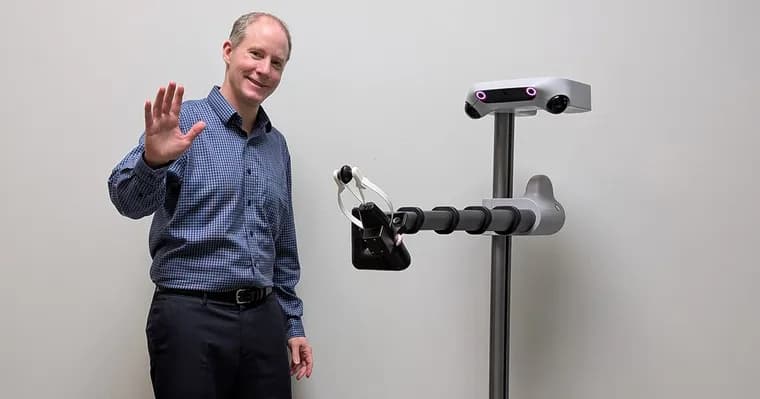
Robots Guide ran an installment of its "A Day in the Life of a Roboticist" series with Charlie Kemp, cofounder and chief technology officer of Hello Robot. The piece is a Q&A in which Kemp answers in the first person. He develops mobile manipulators, meaning mobile robots with arms, to help people in homes and workplaces, with a focus on robots that physically assist older adults and people with disabilities.
Kemp says he loves the community that uses Stretch robots as research and development platforms, and that Hello Robot works on assistive robots for older adults and people with severe mobility impairments. His argument for the work: finding human assistance is becoming more difficult, in part because societies are aging, and robots have the potential to improve quality of life and give people more independence.
On what a good day looks like, he says the best ones centre on the people using the robot rather than the robot itself. Keith, Henry and Jane Evans, and hundreds of people who have worked with robots from Hello Robot and his academic lab have changed his view of robotics. Sometimes what matters in someone's life is scratching an itch or picking up a dropped object. Sometimes autonomy is not the answer, because the person wants more control. Those answers, he says, are not found by programming alone in a room; you have to get out into the world with an open mind.
His own path began at MIT, where he became interested in AI as an undergraduate. Prof. Rod Brooks had just started the Cog project, which used humanoid robots to investigate embodied intelligence. Kemp joined Brooks's lab and worked on the humanoid Domo with Dr. Aaron Edsinger, now his Hello Robot cofounder. In 2006 the two won the best paper award at the IEEE-RAS International Conference on Humanoid Robotics for a system that let Domo help a person put objects on a shelf. That work led to his interest in assistive robotics and helped him win a faculty position at Georgia Tech. Kemp and Edsinger now lead Hello Robot, which they founded to create non-humanoid robots.
His favourite project is Robots for Humanity. In 2010, Henry Evans saw a demonstration of Kemp's academic lab research on CNN, which began a collaboration that continues as part of Henry's Robots for Humanity effort. Henry has severe quadriplegia, and he and Jane Evans are, in Kemp's words, inspirational pioneers in assistive robotics. With them and others, his former lab at Georgia Tech, the Healthcare Robotics Lab, made progress toward mobile manipulators that can meaningfully benefit people with disabilities in daily life. Building a home robot for Henry and Jane was the main inspiration for the prototype that led Kemp and Edsinger to found Hello Robot. Henry and Jane have used each generation of Stretch, which has influenced later designs, especially Stretch 4.
Kemp's advice to newcomers has two parts. First, online videos make it easy to feel robotics is solved, but there is a vast difference between a demo video and a robot being productive in the real world. The world is extraordinarily good at breaking robotic systems in ways that surprise roboticists, and there is still an enormous amount to build, learn and discover. Anyone starting a career, he says, should not feel behind. Second, you do not have to focus on robotics technology to work in robotics: the most impactful future applications will likely depend on technologists working with experts in specific application areas. His example is Dr. Vy Nguyễn, Hello Robot's clinical research lead, who started in robotics while earning her doctorate in occupational therapy and whose expertise has helped shape the company's assistive work.
He also describes what he finds rewarding: seeing software come to life in the physical world, and the chance to influence a young field. He once imagined technological progress followed an inevitable path, but now believes many futures are possible. His surprise at Hello Robot has been how physical assistance can help people connect emotionally. His example: Henry Evans used Stretch to present a rose to Jane. The motions were relatively simple, but the gesture was emotionally powerful. His academic lab's earlier work covered physical assistance with feeding, hygiene and dressing.
Key facts
- Charlie Kemp is cofounder and CTO of Hello Robot, which builds Stretch, a mobile manipulator (a mobile robot with an arm) for homes and workplaces.
- Kemp and Aaron Edsinger won the best paper award at the IEEE-RAS International Conference on Humanoid Robotics in 2006 for a system that let the humanoid Domo help a person put objects on a shelf.
- Henry Evans, who has severe quadriplegia, saw Kemp's lab research in 2010; a home robot for Henry and Jane Evans inspired the prototype that led to Hello Robot, and their use of each Stretch generation shaped later designs, especially Stretch 4.
- Kemp's warning to newcomers: there is a vast difference between a demo video and a robot being productive in the real world.
- He says the most impactful future robot applications will likely need roboticists working with domain experts, such as Hello Robot's clinical research lead Dr. Vy Nguyễn, an occupational therapist by training.
Why it matters
This is a profile, not an announcement, but it states the philosophy behind a company building assistive robots. Kemp ties the work to a concrete pressure: finding human assistance is becoming harder in part because societies are aging, and robots could help people live more independently. His other themes are that autonomy is not always what users want, since some want more control, and that the real challenges show up only when you work with the people who will use the robot. He also describes how the line from humanoid research at MIT to non-humanoid Stretch robots ran through work with Henry and Jane Evans.
Who it affects
Older adults and people with disabilities are the intended beneficiaries of the assistive robots Kemp describes. Researchers who use Stretch as a research and development platform are another group he mentions. Students and early-career people get direct advice: Kemp says this is not a moment to feel behind, and that people with expertise outside robotics technology, such as occupational therapy, can contribute importantly.
How to use it
There is no product to adopt here. The practical takeaways are Kemp's advice. Spend time with the people who would use a robot rather than only programming it, and expect real-world use to reveal opportunities and surprises you did not anticipate. Treat demo videos with caution. If you are entering the field, consider pairing technical work with an application area, as Dr. Vy Nguyễn did when she moved from occupational therapy into robotics.
How solid is it
The material is Kemp's own first-person account, published by Robots Guide, so the biographical details and opinions are his testimony. The source gives no price, specifications, sales figures, funding or customer counts for Hello Robot or Stretch, and no technical details or release date for Stretch 4. The statement about hundreds of people working with Hello Robot and lab robots is loose, not a precise count. The interviewer is not named.
Risks and caveats
Kemp speaks as a cofounder and CTO of the company, so his praise for the Stretch community and for Hello Robot's work is not independent. His claims about the potential of robots to improve quality of life are framed as potential, not demonstrated results; the source offers no data on outcomes. The rose anecdote is an illustration of emotional impact, not a measured finding. Kemp himself cautions that the real world breaks robotic systems in surprising ways and that much remains to be built and discovered.
“Working at Hello Robot is a rewarding experience. I love the community using Stretch robots as research and development platforms.”
— Charlie Kemp, cofounder and chief technology officer of Hello Robot