Irkutsk lab worker reportedly dies of plague, nearly 200 under observation
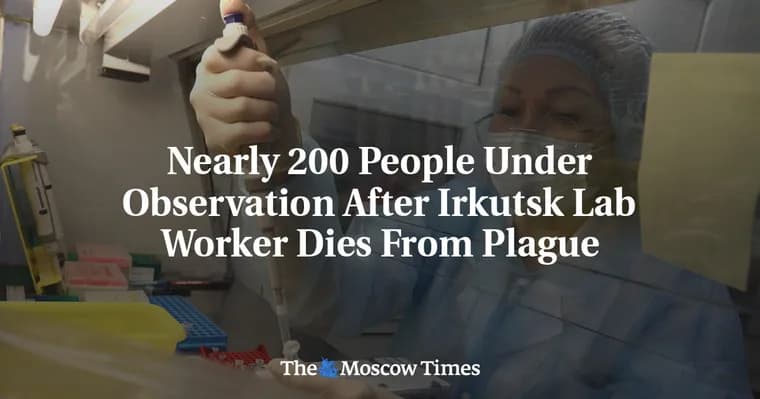
Health authorities in Siberia's Irkutsk region have placed nearly 200 people under medical observation after a laboratory worker died from plague, according to media reports and a statement by a regional leader on Friday, The Moscow Times reports.
The confirmation came from outside the region. Alexei Tsydenov, head of the neighboring republic of Buryatia, said the woman had died from an unspecified form of plague. Irkutsk officials had previously described the illness only as a "particularly dangerous infection." Citing information from Rospotrebnadzor, Russia's consumer safety watchdog, and Buryatia's government, Tsydenov said the woman had not visited his republic and that her infection was unrelated to the region. He wrote on social media that there are no plague outbreaks in the republic, including in areas bordering Mongolia.
The exiled news outlet Lyudi Baikala (People of Baikal) and the pro-Kremlin broadcaster REN TV identified the woman as Daria Sh., a 27- or 28-year-old employee of the Irkutsk anti-plague institute. According to those reports, she told medical staff she had accidentally broken a test tube containing live bacteria while collecting samples for testing. She was hospitalized on Tuesday with symptoms of severe pneumonia in Shelekhov, a town near the regional capital of Irkutsk, was placed on a ventilator, and died on Thursday.
The response has been broad. The Shelekhov district hospital was placed under quarantine pending an assessment by a special commission. At least 197 people who may have had contact with the woman were reportedly placed under medical isolation, more than 100 of them in hospital wards. Authorities canceled planned public events in Irkutsk, and law enforcement reportedly opened a criminal investigation into potential health safety violations resulting in death.
Irkutsk region Governor Igor Kobzev urged the public to remain calm after meeting Rospotrebnadzor chief Anna Popova to coordinate emergency containment measures. On Telegram on Friday he wrote that all identified contact persons had been placed under medical observation, that they showed no signs of illness as of that day, and that their laboratory test results were negative. He did not mention the reports of the laboratory worker's death.
Media reports have described the suspected infection as pneumonic plague, which affects the lungs and can spread between humans through respiratory droplets. Tsydenov's statement did not specify the form of plague.
Key facts
- Nearly 200 people in Russia's Irkutsk region were placed under medical observation; at least 197 were reportedly isolated, more than 100 of them in hospital wards.
- Buryatia head Alexei Tsydenov confirmed the woman died of an unspecified form of plague; media reports say she was a 27- or 28-year-old employee of the Irkutsk anti-plague institute.
- She reportedly told staff she had accidentally broken a test tube with live bacteria while collecting samples; she was hospitalized Tuesday and died Thursday.
- Governor Igor Kobzev said all identified contacts show no signs of illness and have negative lab results, but did not mention the worker's death.
- The Shelekhov district hospital is under quarantine, public events in Irkutsk were canceled, and a criminal investigation was reportedly opened.
Why it matters
Plague is a dangerous infection, and the reports say a laboratory worker caught it on the job, apparently from a broken test tube of live bacteria. That makes this a biosafety incident at a facility that works with the pathogen, and it has triggered isolation of nearly 200 people, a hospital quarantine and canceled public events in Irkutsk. The official picture is also incomplete: the Irkutsk governor spoke about contacts under observation but did not mention the death, so much of what is known comes from neighboring Buryatia's leader and from media reports.
Who it affects
The most directly affected are the people who may have had contact with the woman: at least 197, reportedly isolated, more than 100 of them in hospital wards. Staff and patients at the Shelekhov district hospital are affected by its quarantine, and residents of Irkutsk by the canceled public events. Buryatia is affected indirectly, since its head has stressed that the woman did not visit the republic and that there are no plague outbreaks there, including near the Mongolian border.
How to use it
There is no tool or product here; this is a public health story. For readers following it, the useful signals are official updates from the Irkutsk region and Rospotrebnadzor, the outcome of the special commission's assessment of the Shelekhov hospital, and any further word on the reported criminal investigation. Governor Kobzev's message to the public was to remain calm.
How solid is it
Mixed. Tsydenov, the head of Buryatia, confirmed the death from an unspecified form of plague, citing Rospotrebnadzor and Buryatia's government. The woman's name, age, workplace and the test-tube accident come from Lyudi Baikala, REN TV and unspecified reports, not from an official confirmation. The pneumonic form is a media description only. The criminal investigation and the isolation figure of 197 are both described as reported. Kobzev's statement that contacts have negative tests and no symptoms is official but leaves the death unaddressed.
Risks and caveats
Pneumonic plague, as media describe it, affects the lungs and can spread between humans through respiratory droplets, which is why contact tracing matters. The source reports no confirmed human-to-human transmission and no additional cases; contacts reportedly show no signs of illness and have negative tests. No date for the end of quarantine or observation is given. Because the details come from reports and a neighboring region's leader rather than from Irkutsk authorities, they may change as official information emerges.
“All identified contact persons have been placed under medical observation. As of today, the contacts show no signs of illness, and their laboratory test results are negative”
— Igor Kobzev, Irkutsk region governor, on Telegram