HINT-WAM trains robot world action models on their own samples, using hindsight video
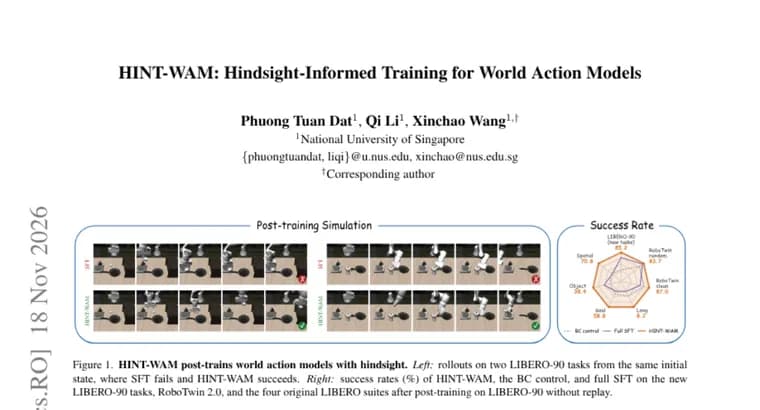
HINT-WAM is a post-training method for world action models (WAMs), which the paper's abstract describes as robot-manipulation models that couple action generation with predictions of future visual dynamics. The authors say WAMs have shown promising generalization and data efficiency, but that turning this into reliable task execution remains a challenge for existing post-training methods.
The abstract names two weaknesses in the usual options. Offline supervised fine-tuning gives dense supervision on expert trajectories, but its flow-matching action expert is trained only on noised demonstration actions. It never sees the intermediate states produced by its own sampler. The authors add that task-specific adaptation can also compromise pretrained capabilities. On-policy reinforcement learning does train on the policy's own behavior, but sparse task rewards make exploration and credit assignment difficult. Dense reward shaping still provides scalar evaluations rather than direct action targets.
HINT-WAM is presented as the first on-policy self-distillation framework that supervises the action expert on its own sampling trajectories. Its key ingredient is hindsight: the future video of the demonstration, used as privileged information available to the WAM itself. For each demonstration observation, the student generates an action through its own denoising trajectory. At the states along that trajectory, the same model acts as a teacher, conditioned additionally on the hindsight. This gives a conditional action distribution that serves as a dense training target. The student sees only deployment-time inputs, and the method needs no environmental rewards or simulator interaction.
To pass this supervision to a flow-matching action expert, HINT-WAM distills the teacher into the student with an energy score. This is a distribution-level objective that matches the teacher's action distribution from the student's own samples, rather than regressing its velocity field. The abstract points to a project web page at https://tuandattt.github.io/hintwam/.
Key facts
- HINT-WAM is described as the first on-policy self-distillation framework for world action models (WAMs) in robot manipulation.
- The teacher is the same model as the student, additionally conditioned on hindsight: the future video of the demonstration.
- The student sees only deployment-time inputs and needs no environmental rewards or simulator interaction.
- Supervision is transferred to the flow-matching action expert with an energy score, which matches the teacher's action distribution from the student's own samples instead of regressing its velocity field.
- The authors contrast it with offline supervised fine-tuning, which never trains on the sampler's intermediate states, and with on-policy RL, where sparse rewards make exploration and credit assignment hard.
Why it matters
The paper targets a specific gap in how WAMs are post-trained. Offline fine-tuning trains the action expert only on noised demonstration actions, not on the states its own sampler produces. On-policy reinforcement learning does use the policy's own behavior but depends on rewards that are sparse or only scalar. HINT-WAM aims to get on-policy training with dense, action-level targets and no reward signal, by letting the model see the demonstration's future as a teacher.
Who it affects
Robotics researchers working on manipulation policies built on world action models, particularly those who post-train flow-matching action experts. The abstract is about the training method, so it speaks to people building and adapting such models rather than to end users.
How to use it
The abstract points to a project web page at https://tuandattt.github.io/hintwam/. In outline, the recipe is this: for each demonstration observation, sample the student's own denoising trajectory; at the states along it, query the same model conditioned on the demonstration's future video to get a teacher action distribution; then train the student to match that distribution with an energy score. Only the teacher role uses the hindsight video.
How solid is it
This is a preprint abstract, and the claims are the authors' own, including the description of the method as the first of its kind. No quantitative results are given: no success rates, benchmark names, baselines or improvement figures. No authors or institutions are named in the abstract. No robot platforms, tasks, datasets or base WAM models are named.
Risks and caveats
Without reported results, it is not possible to say how much the method improves over supervised fine-tuning or reinforcement learning. The abstract does not claim real-world deployment or comparison against specific SFT or RL methods, and it states no compute cost or training time. The method also depends on demonstrations that include future video, since that is what the teacher conditions on.