HPSE teaches edited LLMs to reason over new facts, not just recall them
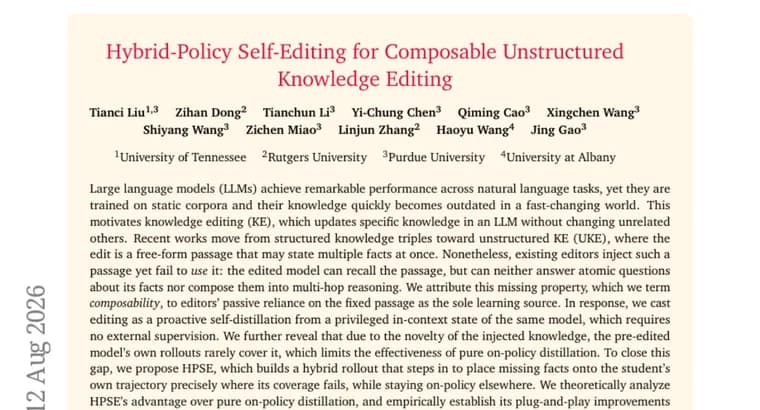
Tianci Liu and co-authors propose HPSE (Hybrid-Policy Self-Editing), a training method for knowledge editing (KE) in large language models. Knowledge editing lets engineers update specific facts inside a trained model without retraining it on the full corpus. Newer approaches, called unstructured knowledge editing (UKE), inject a free-form passage of text that can state several facts at once, closer to how a real update would arrive (a news item, a changed product spec, and so on) than the older method of editing structured subject-relation-object triples.
The authors report that existing UKE editors have a specific failure: the edited model can recall the injected passage almost verbatim, but it can neither answer straightforward questions about the individual facts inside that passage nor combine those facts into multi-hop reasoning. They name this missing property composability, and trace its cause to how these editors are trained: the model is taught only to reproduce the fixed passage, so the passage becomes something to memorize rather than material the model learns to reason over.
HPSE changes the training signal itself. It frames editing as self-distillation: the model is given a privileged, in-context version of itself, one that has the new passage placed directly in its context window and can therefore answer well about it. That privileged version acts as a teacher for the edited student model, which must eventually answer without the passage present in context. Because the teacher is the same model, this requires no external supervision such as hand-labeled question-answer pairs.
The authors identify a further obstacle for a pure version of this idea: because the injected knowledge is new to the model, the model's own self-generated, on-policy outputs rarely happen to touch on that knowledge, which limits how much a purely on-policy self-distillation setup can actually learn. HPSE's fix is a hybrid rollout: at the exact points where the student's own generated trajectory fails to cover a needed fact, HPSE inserts that missing fact directly into the trajectory; everywhere else, training continues on-policy, using the student's own output.
The authors say they back this design with a theoretical analysis of why the hybrid approach should outperform pure on-policy distillation, and with empirical tests combining HPSE with two existing KE editors across four different LLM backbones under a range of scenarios, describing the resulting improvements as plug-and-play.
Key facts
- Current unstructured knowledge editing (UKE) methods let a model recall an injected passage verbatim, but the model can't answer atomic questions about the facts inside it or chain them into multi-hop reasoning, a gap the authors call composability.
- HPSE (Hybrid-Policy Self-Editing) trains the edited model via self-distillation from a privileged, in-context version of the same model that already has the new passage in view, requiring no external supervision.
- Because injected knowledge is new to the model, its own on-policy rollouts rarely cover it; HPSE fixes this with a hybrid rollout that inserts missing facts onto the student's trajectory exactly where its own coverage fails, staying on-policy elsewhere.
- The authors provide a theoretical analysis of HPSE's advantage over pure on-policy distillation and report empirical, plug-and-play improvements across four LLM backbones and two existing KE editors.
- Tianci Liu and co-authors published the work via Hugging Face's paper feed; the abstract text does not name the four backbones or two editors tested, give specific benchmark numbers, or state a publication venue or date.
Why it matters
Knowledge editing is pitched as a cheap way to keep a large language model current without retraining it on the full corpus, but the authors show that current unstructured editors have a real blind spot: the edited model can recite an injected passage, yet it cannot answer basic questions about the facts inside it or combine them with other knowledge. That gap, which the authors call composability, means an edit that looks successful in a recall test can still fail the moment a user asks a real question about it. HPSE targets that gap directly by changing what the model is trained to do with the injected passage, not just whether it can repeat it.
Who it affects
The direct audience is researchers and engineers who build or apply knowledge editing methods for large language models, plus anyone maintaining an LLM-based system that needs to reflect new facts, product details or current events without a full retrain. HPSE is described as combinable with two existing KE editors, so teams already using those editors are the most direct beneficiaries; the paper does not describe an end-user product or a consumer-facing feature.
How to use it
HPSE is a training technique, not a released product: the authors report combining it with two existing knowledge editing (KE) editors across four LLM backbones and call the result plug-and-play, meaning it is meant to slot into those existing editors rather than replace them. The text does not name the specific backbones or editors tested, and it does not mention a code or dataset release.
How solid is it
The claim rests on two kinds of evidence: a theoretical analysis of why a hybrid rollout should beat pure on-policy self-distillation, and empirical tests across four LLM backbones and two KE editors under various scenarios. The abstract text available here does not include the actual accuracy, exact-match or other benchmark numbers behind the plug-and-play improvements, so the size of the reported gain cannot be checked from this text alone. No publication venue, conference or date is stated either.
Risks and caveats
This account is built from the paper's abstract as listed on Hugging Face's paper feed. The text does not name the paper's full author list or institutions beyond the one listed submitter, does not identify the four LLM backbones or two KE editors actually tested, and does not mention any code or dataset release. Readers who need the exact size of the improvement, or want to reproduce it, will need the full paper rather than this summary.