HybridAgents paper mixes latent reasoning with text tool use, claims 10.4% gain
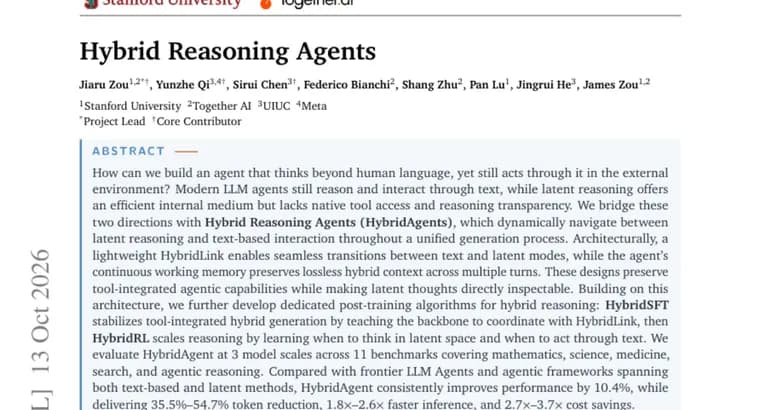
A paper on Hugging Face introduces Hybrid Reasoning Agents, or HybridAgents. It starts from a tension the authors describe: modern LLM agents reason and interact through text, while latent reasoning offers an efficient internal medium but lacks native tool access and reasoning transparency. Their question is how to build an agent that thinks beyond human language yet still acts through it in the external environment.
The proposed answer is an agent that dynamically navigates between latent reasoning and text-based interaction within a single, unified generation process. Architecturally, a lightweight component called HybridLink enables transitions between text and latent modes, and the agent's continuous working memory preserves lossless hybrid context across multiple turns. The authors say these designs keep tool-integrated agentic capabilities while making latent thoughts directly inspectable.
On top of this architecture the paper adds two post-training algorithms. HybridSFT stabilizes tool-integrated hybrid generation by teaching the backbone model to coordinate with HybridLink. HybridRL then scales reasoning by learning when to think in latent space and when to act through text.
The evaluation covers 3 model scales across 11 benchmarks in mathematics, science, medicine, search and agentic reasoning. Compared with frontier LLM agents and agentic frameworks, both text-based and latent, HybridAgent consistently improves performance by 10.4%, according to the abstract. It also reports 35.5%-54.7% token reduction, 1.8x-2.6x faster inference and 2.7x-3.7x cost savings. Code and data are available in a GitHub repository under the togethercomputer account.
Key facts
- HybridAgents switch between latent reasoning and text-based interaction within one unified generation process.
- A lightweight HybridLink handles transitions between modes, and continuous working memory keeps hybrid context across turns; latent thoughts stay inspectable.
- Training uses two stages: HybridSFT to coordinate the backbone with HybridLink, then HybridRL to learn when to think latently and when to act through text.
- Evaluated at 3 model scales on 11 benchmarks covering mathematics, science, medicine, search and agentic reasoning.
- Reported results: 10.4% performance improvement, 35.5%-54.7% token reduction, 1.8x-2.6x faster inference, 2.7x-3.7x cost savings; code and data are on GitHub.
Why it matters
Latent reasoning is attractive because it is an efficient internal medium, but the paper notes it lacks native tool access and reasoning transparency. Text-based agents have tools but reason through text. HybridAgents try to get both in one generation process: latent thinking where it is efficient, text where the agent must act on the outside world. If the reported numbers hold, the payoff is both better performance and lower cost per task.
Who it affects
Researchers and engineers building tool-using LLM agents are the direct audience, particularly those working on latent reasoning or on cutting token use and inference cost. The benchmark set spans mathematics, science, medicine, search and agentic reasoning, so the claimed gains are framed as broad rather than tied to one domain.
How to use it
The authors say code and data are available on GitHub at github.com/togethercomputer/HybridAgent. The abstract describes a training recipe in two stages, HybridSFT followed by HybridRL, applied to a backbone model together with the HybridLink component. No pricing or licence terms are given in the source.
How solid is it
The figures come from the paper's own abstract and are the authors' claims. The 10.4% improvement is described as consistent across comparisons with frontier LLM agents and agentic frameworks, both text-based and latent, over 11 benchmarks at 3 model scales. The source does not say whether the 10.4% is in percentage points or a relative gain, nor whether it is a mean, median or maximum. It does not name the backbone models, the benchmarks or the baselines individually, and it states no peer review or publication venue.
Risks and caveats
The abstract gives no per-benchmark results, limitations or failure cases, so it is hard to judge where the approach helps most or where it falls short. The baseline for the token reduction, speed-up and cost savings ranges is not specified. Treat the headline numbers as preliminary until the repository, data and full paper are checked against them.
“How can we build an agent that thinks beyond human language, yet still acts through it in the external environment?”
— HybridAgents paper abstract