Google Research launches Deep Review, an agentic AI reviewer for technical documents
On October 14, 2026, Rajesh Jayaram and Vincent Cohen-Addad of Google Research announced the public release of Deep Review, an agentic AI system built to give rigorous feedback and technical verification on complex documents. It was first designed to analyse computer science papers. The post says its reach now extends to other domains such as legal and finance, and to knowledge documents including Google Docs and presentations. Google describes two uses: an iterative improvement tool while drafting, and a tool for verifying claims and evaluation during review.
Deep Review is the successor of the Paper Assistant Tool (PAT), an experimental project meant to help researchers stress-test manuscripts before conference submission. Over the past year Google partnered with four flagship computer science conferences (STOC 2026, ICML 2026, NeurIPS 2026 and ICLR 2027) and gave private, pre-submission feedback to the authors of more than 16,000 manuscripts who opted in. During those pilots authors received feedback and analysis in the weeks before the submission deadline. The feedback was completely decoupled from the official conference review process, PAT did not collect any data for training, and papers were deleted from Google systems promptly after each program ended. The details are in a manuscript titled Towards Automating Scientific Review with Google's Paper Assistant Tool.
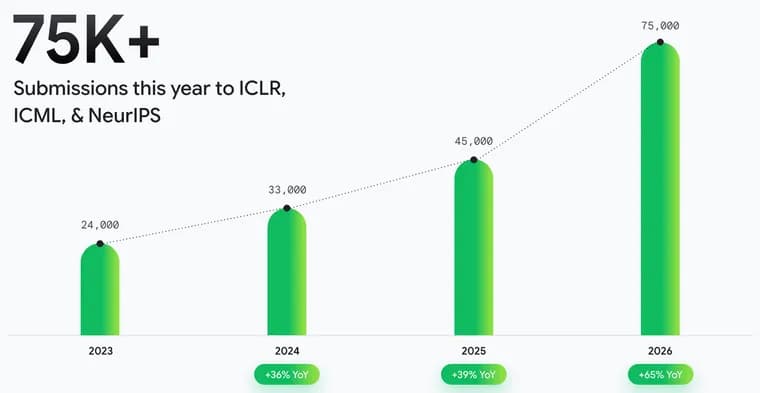
The motivation is what the post calls a validation bottleneck. AI speeds up writing papers, running code and drafting proposals, but human capacity to verify has stayed roughly fixed. Academic peer review shows it clearly: this year there were over 74,000 submissions to three major AI conferences (ICLR, NeurIPS and ICML), up from approximately 45,000 in 2025, 32,000 in 2024 and 23,000 in 2023. Each submission needs several high-quality reviews.
Deep Review checks logical consistency and mathematical statements, suggests improvements, grounds facts and compares a document with existing work. It takes on some of the most cognitively burdensome parts of review while leaving higher-level judgements to humans. The authors argue that single-prompt LLM calls often fail on long, complex documents because they exhaust their token reasoning budget, overlook cross-section dependencies in long context, or accept nuanced claims without scrutiny. Deep Review answers this with a four-stage agentic pipeline. The post says the same reasoning that checks whether a proof holds up in a paper can surface logical gaps in other documents where claims must be backed by evidence.
Two further items come with the launch. Gemini 4 Argon support has been added to Deep Review, which the post says raises the tool's capabilities beyond older PAT iterations. And Google introduces the Teamwork Deep Document Review Pattern, inspired by Deep Review and built into Antigravity on the Teamwork multi-agent orchestration framework. It uses a multi-agent hierarchy with self-correction and segment-based rubrics to evaluate research papers, manuscript drafts and technical proposals, and Antigravity users invoke it with the /teamwork-preview command. Multi-file support is described as coming soon, which would let users run the same consistency checks across sets of related documents, spreadsheets and exhibits at once. Deep Review is a collaborative effort across Google Research, Google DeepMind and Google Cloud.
Key facts
- Google Research released Deep Review publicly on October 14, 2026: an agentic AI system for rigorous feedback and technical verification of complex documents.
- It evolved from the experimental Paper Assistant Tool (PAT), piloted with STOC 2026, ICML 2026, NeurIPS 2026 and ICLR 2027, giving private feedback to authors of more than 16,000 opted-in manuscripts.
- It checks logical consistency and mathematical statements, suggests improvements, grounds facts and compares with existing work, leaving higher-level judgements to humans.
- It uses a four-stage agentic pipeline, now with Gemini 4 Argon support, and expands beyond papers to Google Docs, presentations, and domains such as legal and finance.
- A related Teamwork Deep Document Review Pattern is built into Antigravity and invoked with /teamwork-preview; multi-file support is coming soon.
Why it matters
The post frames a real imbalance: AI makes documents faster to produce, while human verification capacity has stayed largely fixed. Conference submissions illustrate it, with over 74,000 to ICLR, NeurIPS and ICML this year against about 45,000 in 2025 and 23,000 in 2023. Deep Review is Google's attempt to take the most tedious checking work off human reviewers, and it moves a tool tested on 16,000+ manuscripts from conference pilots to general availability.
Who it affects
Researchers preparing conference submissions are the first audience, since PAT was built for pre-submission stress-testing. Reviewers and program committees are the second: the authors say they expect such tools to play a significant role across peer review in the coming years. Beyond academia, Google names legal and finance documents, Google Docs and presentations, and calls out knowledge workers generally. Antigravity users also get the related Teamwork pattern.
How to use it
Google says Deep Review is now accessible worldwide and can be used as an iterative aid while drafting or as a verification aid during review. The access points and example document types are not given in the text available here, and no pricing or usage limits are stated. Antigravity users can invoke the Teamwork Deep Document Review Pattern with the /teamwork-preview command. Multi-file checks across sets of related documents, spreadsheets and exhibits are listed as coming soon, with no date.
How solid is it
This is a first-party announcement from Google Research, so the claims are the vendor's own. The deployment scale is concrete: four conference partnerships and more than 16,000 manuscripts. The performance evidence is thin. No accuracy, error-detection rate or benchmark figures for Deep Review or PAT are given, and the 'extremely positive' author reactions are not quantified. The four pipeline stages are not listed in the text available here. A manuscript on the PAT pilots is cited for further detail.
Risks and caveats
The tool leaves higher-level judgements to humans, so it is positioned as an aid rather than a replacement for reviewers. The pilot feedback was explicitly decoupled from official conference review, and the post does not say conferences adopted Deep Review in their review process. The privacy commitments quoted (no training data collected, papers deleted after each program) describe the PAT pilots. The claim that capabilities have further increased with Gemini 4 Argon is the authors' own statement and comes without measurements.
“Deep Review aims to help alleviate this expanding burden on human reviewers across technical fields.”
— Rajesh Jayaram and Vincent Cohen-Addad, Google Research