HyperDrone quadrotor simulator claims 20x speedup and millions of FPS
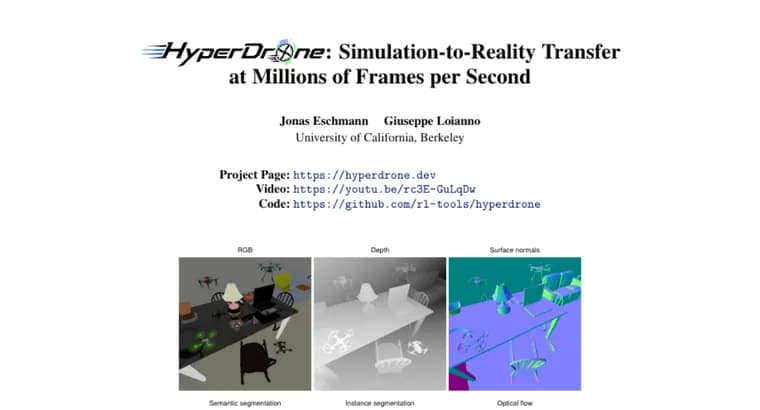
A new paper on Hugging Face presents HyperDrone, a quadrotor simulator built for high-performance batch rendering. The authors say it is more than 20x faster than existing state-of-the-art batch quadrotor simulators. The text does not name the baselines or say which settings the comparison used.
HyperDrone pairs highly optimized multirotor dynamics with HyperLux, a new ray-tracing engine. Both components run entirely on the GPU. HyperLux supports Nvidia OptiX, Vulkan, Apple Metal and WebGPU backends, and the authors say it takes full advantage of modern ray-tracing hardware.
HyperLux can render RGB, depth, semantic and instance segmentation, surface normals and optical flow observations. Fidelity is configurable and includes reflections, realistic lighting, motion blur, anti-aliasing and Physically Based Rendering (PBR). According to the authors, even at the highest-fidelity settings HyperLux reaches millions of frames per second on consumer-grade GPUs while rendering realistic 3D scenes. No exact figure or GPU model is given.
To show what the simulator is good for, the authors train a vision-based yaw-control policy purely in simulation. They then transfer it to a real small-scale quadrotor, a Crazyflie with a camera, where the policy runs completely onboard. No numbers on the real-world results, such as success rate or number of trials, are given.
Key facts
- HyperDrone is a quadrotor simulator for high-performance batch rendering, claimed to be more than 20x faster than existing state-of-the-art batch quadrotor simulators.
- It combines optimized multirotor dynamics with HyperLux, a new ray-tracing engine; both run entirely on the GPU.
- HyperLux supports Nvidia OptiX, Vulkan, Apple Metal and WebGPU, and renders RGB, depth, segmentation, surface normals and optical flow.
- The authors say HyperLux reaches millions of frames per second on consumer-grade GPUs even at the highest fidelity settings.
- A vision-based yaw-control policy trained purely in simulation was transferred to a real Crazyflie with a camera, running completely onboard.
Why it matters
Training vision-based drone policies needs huge numbers of rendered frames, so simulator speed limits how much can be learned. A batch simulator that puts both dynamics and ray-traced rendering on the GPU, and renders at configurable fidelity, targets that bottleneck. The claimed gain is more than 20x over existing state-of-the-art batch quadrotor simulators. The real-drone demo is meant to show the simulated training carries over to hardware.
Who it affects
Robotics and reinforcement-learning researchers who train vision-based quadrotor controllers in simulation are the obvious audience. The multi-backend support (Nvidia OptiX, Vulkan, Apple Metal, WebGPU) suggests it is meant to run on varied hardware, and the authors stress consumer-grade GPUs.
How to use it
The text gives no code release, licence or availability details, so there is nothing concrete to say about adopting it yet. What the paper describes: a simulator with configurable rendering fidelity, with RGB, depth, segmentation, surface normals and optical flow outputs, for training policies in simulation and deploying them onboard a small drone such as the Crazyflie.
How solid is it
This rests on the authors' own description of their work. The 20x figure is a relative claim with no named baselines, resolution or settings. "Millions of FPS" comes with no exact number, GPU model or hardware configuration. The real-world yaw-control demo is reported without quantitative results. The text names no authors or institutions.
Risks and caveats
Without named baselines or settings, the 20x speedup cannot be judged against any particular simulator. A yaw-control task is a narrow demonstration of sim-to-real transfer, and no success rate or trial count is given. High rendering speed does not by itself show that policies trained in the simulator transfer well to harder tasks.