IBM brings time-series models to Confluent Flink SQL, on CPUs
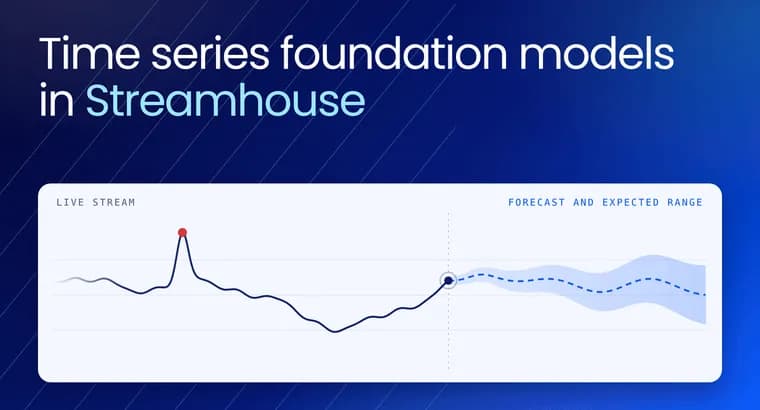
IBM Research, writing on the Hugging Face blog, announces that IBM's time-series foundation models now run natively inside Confluent as built-in functions, both in Confluent Cloud and on premises. The post says the models have more than 50 million downloads (the period is not stated) and come from a family of four models. With Apache Flink, teams can apply forecasting, anomaly detection and semantic intelligence to streaming data using SQL, and the results can go straight to the applications and people responsible for the next action.
The pitch starts from timing. A forecast delivered after a production run, a stockout or a payment authorization may be accurate but too late to matter. Time-series foundation models learn general patterns from diverse historical data and apply them to new series and tasks, so they can give teams a starting point without training a separate model for every series. Depending on the task and deployment, teams can also fine-tune a model or combine its outputs with other data and business logic.
On deployment: in Confluent Cloud the models are fully managed, with nothing to deploy. On premises, they can run within the customer's own infrastructure using Confluent Platform for Apache Flink. The models run on CPUs, without requiring GPUs.
The post places this inside what it calls a Streamhouse. Confluent's Data Streaming Platform brings together five capabilities (connect, stream, process, govern and query). Apache Flink transforms and enriches data as it flows, and Lightning Tables give low-latency access to the current state. Time-series models add predictive power on top: Flink prepares the data, invokes forecasting and anomaly detection, and publishes the results alongside the events that produced them. Large language models, statistical models and specialized machine learning systems can contribute where appropriate. The post lists four benefits: scaling model development with one pretrained starting point across many series; refreshing predictions as data changes, subject to the model's requirements and the pipeline's configuration; putting signals closer to decisions; and running compact models on CPUs next to the streaming pipeline, which can reduce the need for dedicated GPU infrastructure and simplify deployment.
The core of the article is six scenarios, framed as illustrations of how organizations could combine the models, streaming data and application logic.
-
Production optimization. On an ice cream line, a pretrained TTM model reads SCADA telemetry and QA measurements every 10 minutes and forecasts the share of tubs expected to be in spec four hours ahead, with a likely range. If the forecast drops below target, an optimization process scores combinations of freezer draw temperature and airflow, since the model takes those control variables as inputs. The operator approves the recommended setpoints, while routine adjustments can be automated within predefined guardrails. The post names less rework, lower energy use per tonne and more consistent quality as the outcome, and says the same approach fits ovens, dryers, kilns and mills.
-
Anomaly detection. A store operations team monitors sales for thousands of products across hundreds of stores. Fixed thresholds flag predictable weekend peaks and miss quieter drops. AI_DETECT_ANOMALIES gives each sales series an expected range based on its recent history, and each new reading is compared with it at a confidence level the team chooses, with no separate model per product and store. Out-of-range signals can be combined with inventory and store data to suggest a cause and a next step, such as checking the shelf or replenishing stock.
-
Supply chain planning. Traditional forecasts may be refreshed only once a week and tend to focus on top sellers. With AI_FORECAST, a pretrained model forecasts demand across products and stores; in the example it produces a 28-day forecast with a P10 to P90 range, refreshed as new sales data arrives. The planning application combines it with inventory, lead time and the planner's service level to compute a reorder point, and an agent can draft a purchase order for review when stock is projected to fall below it.
-
Fraud and security. Each payment is compared with an expected spending range based on that card's recent history. A transaction outside the range goes to the bank's existing fraud systems as an additional input, alongside other signals and business rules, and the bank can approve, request step-up authentication or investigate. The decision and its signals can be retained for review.
-
Trading. On each one-minute bar, PatchTST-FM forecasts trading volume for the next 30 minutes, with a P10 to P90 range. The execution algorithm uses it to pace a large order within the desk's participation limit, pausing and replanning after a news event or shrinking slices when trading is quieter than expected. The illustration uses a 100,000-share order, and forecasts and execution decisions can be kept in an audit trail.
-
Semantic search. TSPulse can produce representations of time-series windows that support similarity search. In a separately built application, they could be indexed so an engineer can look for shapes such as a spike and recovery, a gradual rise or a step change across equipment, then inspect maintenance records and operating conditions. That needs an embedding pipeline, an index and access to the relevant context, and the post stresses that similarity helps narrow an investigation but does not establish a root cause by itself.
The article then begins an industry section, saying the same building blocks can serve manufacturing, retail, banking and airlines. Its first example, industrial AI, describes SCADA, QA lab and energy meter streams being forecast as they arrive, with setpoints, work orders and alerts reaching the floor inside the cycle rather than at the next shift report.
Key facts
- IBM's time-series foundation models now run natively inside Confluent as built-in functions, in Confluent Cloud (fully managed) and on premises via Confluent Platform for Apache Flink.
- The models run on CPUs without requiring GPUs, and teams use them from Apache Flink through SQL for forecasting, anomaly detection and semantic intelligence.
- The post cites more than 50 million downloads for the IBM time-series models and a family of four models; the download period is not stated.
- Six illustrative scenarios cover production optimization (TTM, forecast four hours ahead), store sales anomalies, 28-day demand forecasts with AI_FORECAST, card fraud signals, trading volume with PatchTST-FM, and similarity search with TSPulse.
- The use cases are framed as what organizations 'could' build, not as reported deployments.
Why it matters
The argument is that predictions lose value when they arrive after the decision. By running pretrained time-series models inside the streaming platform, as functions called from Flink SQL, forecasts and anomaly flags can be produced next to the events that trigger them instead of in a separate batch system. It also removes the need to train a model per series: one pretrained model can be a common starting point across many products, stores or sensors. The post ties this to what it calls a Streamhouse, where current business context is served to applications, analytics and AI agents.
Who it affects
Teams already on Confluent Cloud or Confluent Platform for Apache Flink are the direct audience, along with data engineers who write Flink SQL. The post points to manufacturing, retail, banking and airlines, and to roles such as process engineers, store operations teams, category planners, fraud teams, execution desks and reliability engineers. Organizations without a GPU budget are also addressed, since the models run on CPUs.
How to use it
In Confluent Cloud the models are fully managed and nothing needs to be deployed. On premises, they run inside the customer's own infrastructure with Confluent Platform for Apache Flink. Usage is through SQL; the post names AI_FORECAST for demand forecasting and AI_DETECT_ANOMALIES for expected-range anomaly detection, where the team picks the confidence level. Both products link to documentation from the post. Semantic search with TSPulse is different: it needs a separately built application with an embedding pipeline and an index. Pricing and licensing of the built-in functions are not mentioned in the source.
How solid is it
This is a first-party post by IBM Research on the Hugging Face blog, announcing a product integration rather than reporting a research result. The core claim, that the models run natively in Confluent as built-in functions on CPUs, is stated plainly. The use cases are explicitly scenarios, and the source mentions no named customers or real deployments. It gives no benchmark, accuracy, latency or cost figures; outcomes such as less rework, lower energy use and more consistent quality are described qualitatively. The 50 million download figure has no stated time period. No release or general-availability date for the integration is given.
Risks and caveats
The post itself hedges several points. Running compact models on CPUs 'can' reduce the need for dedicated GPU infrastructure. Refreshing predictions as data changes is subject to the model's requirements and the pipeline's configuration. In the fraud example, the time-series signal is an additional input to the bank's existing fraud systems, not a replacement. In semantic search, similarity does not establish a root cause by itself. In the ice cream example, the operator approves recommended setpoints, and only routine adjustments are automated within predefined guardrails. Readers should treat the scenarios as design sketches, not evidence of results.
“The models run on CPUs, without requiring GPUs.”
— IBM Research, Hugging Face blog post