IBM releases Granite Time Series PatchTST-FM-r2, tops GIFT-Eval among permissively licensed models
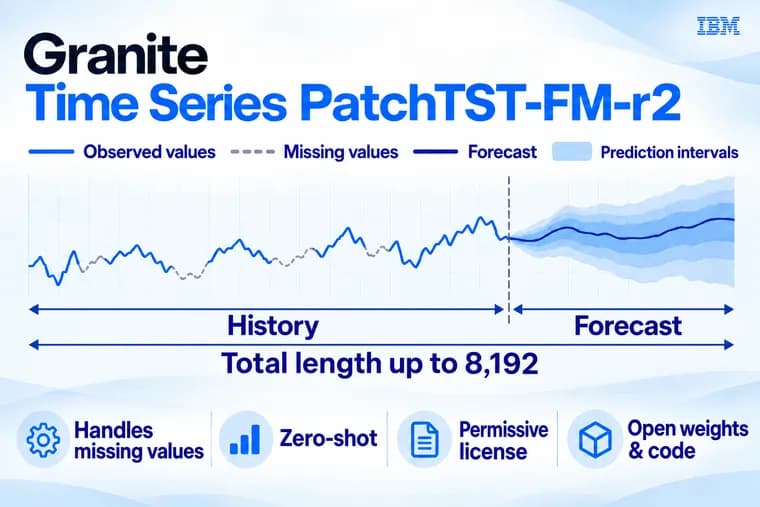
IBM has released Granite Time Series PatchTST-FM-r2, the newest model in its Granite time-series foundation model family and the successor to PatchTST-FM-r1. Time-series foundation models let one pretrained model forecast a new dataset zero-shot, instead of a separate model being trained and maintained for every dataset. Compared with r1, PatchTST-FM-r2 combines an updated architecture, a larger pretraining corpus, probabilistic forecasting, support for imputing missing values and strong zero-shot performance, in a model of about 385 million parameters. It supports context lengths up to 8,192 steps, flexible forecast lengths, and a 99-quantile prediction head that produces both point forecasts and quantile-based uncertainty intervals.
As of September 8, 2026, on the GIFT-Eval leaderboard, a benchmark for evaluating forecasting models across diverse scenarios, PatchTST-FM-r2 ranks second overall among models that are zero-shot, replicable and evaluated without test-set leakage. In that population it places second for both error measures: a geometric-mean CRPS of 0.467 and a geometric-mean MASE of 0.6846. The CRPS score puts it immediately behind TimesFM-3 overall. Among models in that population released under a permissive, commercial-friendly license, Apache 2.0 or the Linux Foundation's OpenMDW 1.0, either selectable, it is the top performer. GIFT-Eval also lists a separate, wider comparison that adds 'pretrained' models, which are allowed to include the training portions of GIFT-Eval's own evaluation datasets in their pretraining data. Counting those too, PatchTST-FM-r2 still ranks third for CRPS and fourth for MASE among replicable models, ahead of several pretrained models, including Chronos-2, Timer-S1 and Toto variants, despite some of those being considerably larger. The blog gives no absolute CRPS or MASE scores for any of the named competing models, only PatchTST-FM-r2's own scores and its relative rank.
Architecturally, PatchTST-FM-r2 replaces the standard transformer blocks of PatchTST-FM-r1 with conformer blocks, a design IBM says originates in speech processing. Each block places a temporal convolution layer alongside multi-head self-attention, sandwiched between two half-step feed-forward layers; the attention component is meant to capture long-range relationships between patches while the convolution captures shorter-range, local structure, an effect IBM illustrates by comparing attention patterns from the transformer and conformer versions on the ETTh1 dataset. The convolution kernels alternate between sizes 3 and 5 in a repeating {5, 5, 3, 3} pattern. The model also uses 50% overlapping patches with Hamming-window weighting and overlap-and-add forecasting to smooth predictions across patch boundaries, adds normalization for stability, and expands the backbone from 20 blocks in r1 to 30 blocks in r2.
The pretraining corpus draws on four documented sources: selected datasets from GiftEvalPretrain; custom synthetic data based on KernelSynth, with modified periodic kernels and limited augmentation; a TSMixup-style corpus built using the approach Chronos describes, but restricted to datasets outside the GIFT-Eval evaluation set; and about 500,000 synthetic CauKer sequences, each 4,096 steps long. IBM frames this documentation as useful for an enterprise's own model-governance and licensing review, while stating plainly that it does not eliminate the need for that review. The model, its weights, architecture, inference pipeline and the code needed to reproduce the GIFT-Eval results are dual-licensed under Apache 2.0 and OpenMDW 1.0, and the implementation, available through the Granite-TSFM repository, is backward-compatible with PatchTST-FM-r1 checkpoints.
To use the model, IBM's example installs the granite-tsfm package (version 0.3.9 or later), loads PatchTST-FM-r2 from the Hugging Face Hub with the tsfm_public package's PatchTSTFMForPrediction class, and runs it through a TimeSeriesForecastingPipeline, with no fine-tuning or task-specific fitting needed. The example forecasts an ETTh1 electricity-transformer series 64 steps ahead from a 512-step context window, at quantile levels 0.1, 0.5 and 0.9; IBM says the same pipeline applies to demand, sensor telemetry, CPU utilization, energy consumption, transaction volume, traffic or price data. Separately, IBM and Confluent recently made several Granite Time Series models available through an Early Access program on Confluent Cloud, bringing inference into streaming applications built on Apache Flink so forecasts and anomaly detection can run against live data rather than requiring a separate offline ML setup. The initial portfolio for that program lists PatchTST-FM-r1, FlowState-r1.1, TTM-r3 and TSPulse; PatchTST-FM-r2 is not yet included.
Key facts
- IBM released Granite Time Series PatchTST-FM-r2, a roughly 385-million-parameter zero-shot forecasting model and the successor to PatchTST-FM-r1.
- As of September 8, 2026, it ranks second overall among replicable, zero-shot models on the GIFT-Eval leaderboard (geometric-mean CRPS 0.467, MASE 0.6846), and first among those released under a permissive, commercial-friendly license.
- Counting a wider GIFT-Eval comparison that also includes pretrained models, it still ranks third for CRPS and fourth for MASE among replicable models, ahead of larger pretrained models such as Chronos-2, Timer-S1 and Toto variants.
- The architecture replaces standard transformer blocks with conformer blocks combining self-attention and temporal convolution (kernel sizes alternating in a {5, 5, 3, 3} pattern), and expands the backbone from 20 blocks in r1 to 30 in r2.
- The model, dual-licensed under Apache 2.0 and OpenMDW 1.0, supports context lengths up to 8,192 steps and a 99-quantile forecasting head; IBM and Confluent have separately made related Granite Time Series models, including PatchTST-FM-r1, available for streaming inference on Confluent Cloud.
Why it matters
Time-series foundation models are replacing the practice of training and maintaining a separate forecasting model for every dataset: one pretrained model can forecast a new series zero-shot. PatchTST-FM-r2 raises the bar for the subset of these models an enterprise can actually deploy without a restrictive license. On the GIFT-Eval leaderboard, a benchmark spanning diverse forecasting scenarios, it ranks second overall among replicable, zero-shot models, immediately behind TimesFM-3 on CRPS, and it is the top performer in that population among models released under a permissive, commercial-friendly license. IBM also publishes the weights, architecture, inference pipeline and the exact code used to reproduce the benchmark numbers, a level of transparency the post treats as part of the story, not just the score itself.
Who it affects
Teams building forecasting for demand, pricing, energy loads, traffic, telemetry or other regularly sampled time series, who currently train and maintain a separate model per dataset, are the direct audience. Enterprise adopters who need to audit what data a model was trained on before deploying it benefit from IBM's documented four-source pretraining corpus, though IBM says that documentation does not replace an organization's own governance and licensing review. Developers already using PatchTST-FM-r1 are affected too: PatchTST-FM-r2 is backward-compatible with r1 checkpoints. Separately, companies running streaming pipelines on Confluent Cloud gain early access to inference for several Granite Time Series models via Apache Flink, though that initial portfolio lists PatchTST-FM-r1, FlowState-r1.1, TTM-r3 and TSPulse, not PatchTST-FM-r2 itself.
How to use it
PatchTST-FM-r2 is dual-licensed under Apache 2.0 and OpenMDW 1.0, a licensing framework the Linux Foundation built specifically for AI models; users choose whichever license suits them, and IBM says neither restricts use. To run it, install the granite-tsfm package (version 0.3.9 or later), load PatchTST-FM-r2 from the Hugging Face Hub with the tsfm_public package's PatchTSTFMForPrediction class, and pass data through a TimeSeriesForecastingPipeline; IBM's own example forecasts an ETTh1 electricity-transformer series 64 steps ahead from a 512-step context window at quantile levels 0.1, 0.5 and 0.9, with no fine-tuning or task-specific fitting needed. IBM says the same pipeline applies to demand, sensor telemetry, CPU utilization, energy consumption, transaction volume, traffic or price series. The weights, architecture, inference pipeline and the code to reproduce the GIFT-Eval benchmark are all published, and the implementation is backward-compatible with PatchTST-FM-r1 checkpoints.
How solid is it
The GIFT-Eval ranking that IBM highlights is restricted to models it describes as zero-shot, replicable and evaluated without test-set leakage; within that population, PatchTST-FM-r2 ranks second overall, second on CRPS (geometric mean 0.467) and second on MASE (geometric mean 0.6846), immediately behind TimesFM-3 on CRPS. IBM backs the claim with the code needed to reproduce those benchmark numbers, published alongside the model. A separate, wider GIFT-Eval comparison folds in 'pretrained' models that are allowed to include GIFT-Eval's own training splits in their pretraining data; in that comparison PatchTST-FM-r2 still places third for CRPS and fourth for MASE among replicable models, ahead of pretrained models such as Chronos-2, Timer-S1 and Toto variants despite some being considerably larger. The post gives no absolute CRPS or MASE scores for any of those named competitors, only PatchTST-FM-r2's own scores and its relative rank, so the size and margin of its lead over specific rivals cannot be checked from this post alone.
Risks and caveats
IBM states plainly that documenting the pretraining corpus does not eliminate an organization's need for its own model-governance and licensing review, only that it gives more information to run one than an opaque corpus would. The post names competing models, Chronos-2, Timer-S1 and Toto variants, as 'considerably larger' without giving their parameter counts, so that comparison cannot be verified independently from what IBM states here. No individual author or spokesperson is named; every claim in the post is made in IBM's collective voice. The Confluent Cloud integration remains an Early Access program, IBM gives no pricing, region availability or general-availability date for it, and PatchTST-FM-r2 itself is not yet part of that program's initial portfolio.