IBM Research shows an Indic voice agent built on CUGA
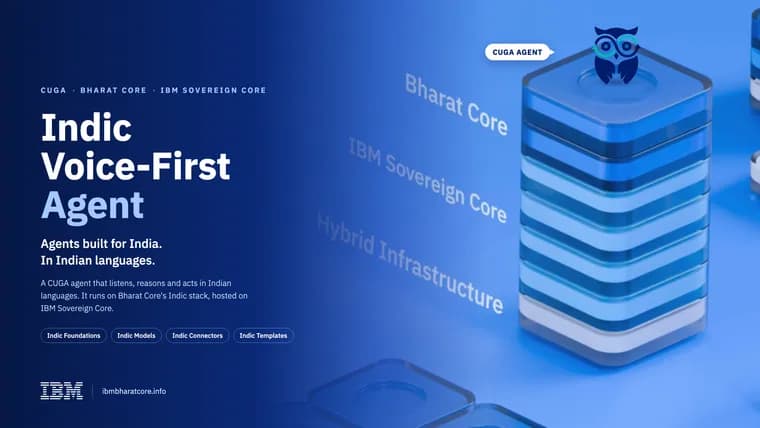
A post on the Hugging Face blog describes a small voice agent that uses CUGA (ConfigUrable Generalist Agent), IBM Research's open-source agent harness. The problem it targets: most useful knowledge is written and digitized in English, while most of the people who need it speak and think in regional languages such as Hindi, Tamil, Telugu, Gujarati and Marathi, and many would rather talk than type. In the example use case, a farmer asks aloud, in their own language, how to tell good seed from bad. If someone asks about cricket or coding, the agent politely steers them back to farming instead of making something up.
CUGA handles model wiring, tool management, state and guardrails, so developers write tools and a prompt instead of the agent loop. Here it runs as an embedded SDK inside a small web app. The core design choice is that CUGA works purely on text, with voice added as two thin layers around it. Audio goes through speech-to-text, then a knowledge search, then a grounded answer from CUGA, then text-to-speech. That means the agent can be built and tested in plain text first, and speech providers can be swapped without touching it. Two options are supported: Sarvam AI's cloud speech APIs, called directly from the user's browser, and open-source models on your own server (SraVaani for speech-to-text, Svara for text-to-speech).
The post says adding speech was easy and cross-lingual retrieval was hard, because a Hindi question has to find an English paragraph. CUGA's default embedding model is English-only and turns Hindi into vectors that carry almost no meaning. A Hindi or Tamil question still retrieves five passages, but the wrong ones. The model, told to answer only from what it was given, then replies that the handbook doesn't cover the question. Every layer behaves correctly, so no error or warning appears.
The fix was a multilingual embedding model, intfloat/multilingual-e5-large, so that the same meaning lands in the same place in any language. Wiring it into CUGA took a small workaround, shown in the tutorial. After that, one English document serves every language with no translated copies. The authors advise asking the agent a non-English question and checking that it finds the right pages before tuning any prompt. For off-topic questions, marked OFF_TOPIC, the app swaps in a polite redirect without a second LLM call, which keeps the voice path fast.
A demo is available in CUGA Apps on Hugging Face Spaces, and a step-by-step tutorial, Build an Indic Voice Agent with CUGA, starts from an empty folder. The post says nothing in the approach is specific to agriculture, and connects it to IBM Bharat Core, an AI stack built on IBM Sovereign Core for running Indic AI workloads on local infrastructure.
Key facts
- The demo voice agent answers spoken farming questions and uses CUGA, IBM Research's open-source agent harness, as an embedded SDK in a small web app.
- CUGA handles only text; speech sits in two thin layers, using either Sarvam AI's cloud APIs or the open-source SraVaani and Svara models on your own server.
- With the default English-only embedding model, Hindi or Tamil questions retrieve five wrong passages and raise no error or warning.
- Switching to intfloat/multilingual-e5-large, with a small workaround, lets one English document serve every language without translated copies.
- A demo runs in CUGA Apps on Hugging Face Spaces, and a step-by-step tutorial shows how to build the agent from an empty folder.
Why it matters
The post's starting point is a language gap: knowledge mostly sits in English, while many who need it speak regional languages and would rather talk than type. The authors argue that voice-first, multilingual assistants can reach people poorly served by English-only text screens, and that an open, auditable harness with answers tied to checkable sources is how such services earn trust.
The most practical lesson concerns retrieval. An English-only embedding model can break a multilingual assistant while the system appears to work normally.
Who it affects
The direct audience is developers building voice or multilingual assistants, especially for India. The example end user is a farmer asking about seed quality. The authors say the handbook could be swapped for scheme documents, health advisories or legal guides to make a different assistant.
The post also addresses teams scaling a prototype into a secure enterprise application, such as a vernacular KYC system or a multilingual government bot, where control over data sovereignty matters more.
How to use it
You can try the agent without any setup in CUGA Apps on Hugging Face Spaces by asking a farming question in your language and listening to the answer. To build your own, follow the tutorial Build an Indic Voice Agent with CUGA, which adds one layer at a time.
Start with plain text, then add speech. Use a multilingual embedding model (the authors use intfloat/multilingual-e5-large), and check retrieval with a non-English question before tuning prompts. Pick the speech provider to match deployment: the post gives cloud for speed or on-premises for data sovereignty as examples.
How solid is it
This is a first-party account of a small demo that uses IBM Research's own harness, and it closes by pointing readers to IBM Bharat Core. No accuracy, retrieval quality, latency or cost figures are given for the voice agent, and no field trials or real farmer deployments are reported. The farmer scenario describes the use case.
The LLM that generates the answers is not named. The page header calls CUGA a leader in the AppWorld Benchmark, but no score or ranking date is given. The live demo offers a way to check the behaviour yourself.
Risks and caveats
The failure the authors describe is silent: wrong passages come back, the model says the handbook doesn't cover the question, and nothing flags a fault. Anyone keeping the default English-only embedding model for non-English questions should expect this problem. The fix is simple in concept but needed a workaround to wire into CUGA.
The statement that pairing CUGA with Bharat Core's Indic connectors and fine-tuned models lets developers build fully compliant, sovereign AI solutions is the authors' own claim. The post does not say the demo agent itself runs on Bharat Core.
“Adding speech is the easy part. The hard part is cross-lingual retrieval: a Hindi question has to find an English paragraph.”
— Hugging Face blog post on the CUGA voice agent