Google Research open-sources a test of LLM social reasoning
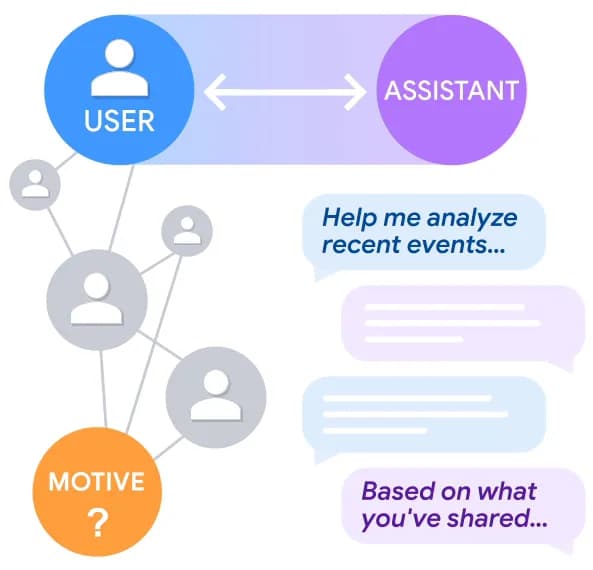
In a Google Research blog post dated November 25, 2026, Zorik Gekhman, a Senior Research Scientist, and Amir Taubenfeld, a Staff Research Engineer, introduced a framework that measures how well AI assistants understand social situations when all they have is a user's subjective telling of events.
The problem they describe is specific to advice and personal support. In math or code, a large language model (LLM) works from objective, complete information. A conversational assistant asked about a colleague or a relationship never sees the interaction itself. Users may leave out crucial context or distort the story through personal bias, for instance by projecting their own insecurities onto what happened. A model that adopts the user's premise may amplify one-sided assumptions instead of assessing them objectively, and could end up giving harsh advice against a colleague who was actually trying to help.
Testing this is hard because things like another person's intentions usually have no verifiable right answer. According to the authors, existing evaluations often stick to edge cases and obvious anomalies, such as whether a model endorses a person's claim to have supernatural powers, which is trivially false. Nuanced everyday interactions are largely overlooked, although the authors say they account for hundreds of millions of daily conversations about personal support, relationship advice and companionship.
The new framework uses multi-agent simulations. A target agent is given a hidden motive and interacts with other agents, one of which stands in for the user. That user then consults the assistant under evaluation, which has to infer the target's motive. Because the motive was assigned in advance, the correct answer is known by construction. The framework rests on three core principles and generates and evaluates scenarios through a five-step pipeline. The simulation is kept separate from the debrief, the consultation stage, so one set of simulations can be reused across any number of models and turned into static evaluation datasets.
The authors applied the framework to 12 LLMs to isolate what makes this kind of reasoning difficult. Relying on the user's account substantially complicated the task. Models were also sensitive to how the user framed things, needed more detail than humans to reach correct predictions, and failed to make full use of clarification questions.
The team says it is using the framework and a dataset to help inform its own model development, and is releasing both publicly, with over 20K generated examples in the dataset.
Key facts
- In the test, a simulated character with a hidden motive interacts with others, then a simulated user asks the evaluated assistant to infer that motive.
- Assigning the motive in advance gives a verifiable correct answer for a social judgment that usually has none.
- Applied to a range of models, the framework showed that relying on the user's subjective account substantially complicates social reasoning.
- Models were sensitive to user framing, needed more detail than humans and did not fully use clarification questions.
- Google Research is releasing the framework and a dataset of over 20K generated examples; the study of key factors covered 12 LLMs.
Why it matters
LLMs are widely used for everyday personal support and advice, where the assistant hears only one side. The authors argue that evaluations have largely focused elsewhere, on edge cases and obvious falsehoods, partly because those come with an easy right answer. Their simulations aim to supply a checkable answer for ordinary situations too, such as working out what another person intended.
The work builds on the team's earlier research on behavioral alignment, which looked at how AI assistants match human preferences in everyday social scenarios. This time the focus moves from general behavioral tendencies to social reasoning.
Who it affects
The direct audience is researchers and developers who build or evaluate conversational assistants. The failure the authors describe concerns people who ask those assistants about colleagues, relationships and other personal matters: a model that accepts a skewed account may reinforce it. Google Research says the framework and dataset already help inform its own model development.
How to use it
The authors are releasing the framework and a dataset of over 20K generated examples for running experiments. Since the simulations are separate from the consultation stage, the same material can be reused to compare any number of models, and teams can build static evaluation datasets from it. The authors also encourage the community to collaborate on designing new and diverse social evaluation environments.
How solid is it
This is the authors' own account of their own framework, published on the Google Research blog. Its main strength is the design: the hidden motive is set when the scenario is built, so an assistant's inference can be checked against it. The findings on framing, detail and clarification questions are described here qualitatively, so they show the direction of the problem more than its size. The post thanks Gal Yona, Yonathan Efroni, Saška Mojsilović, Avinatan Hassidim and Ronit Levavi Morad for reviewing the work.
Risks and caveats
The evidence comes from simulated interactions between generative characters, so results should be read as performance in that controlled setting. The authors point to longer-term, evolving relationships and group dynamics involving several parties as directions for future work that could bring such benchmarks closer to real human interaction. The harsh advice against a well-meaning colleague is offered as an example of what can go wrong when a model adopts the user's premise.
“It does not observe the actual social interactions firsthand; its only source of information is the subjective, potentially biased lens of the user.”
— Zorik Gekhman and Amir Taubenfeld, Google Research blog, on an LLM acting as a conversational assistant