Import AI 477: Anthropic co-founder tells IMF the singularity has begun
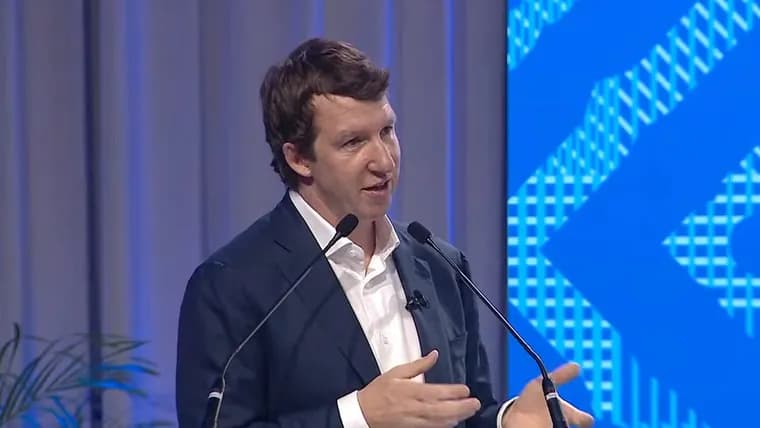
Import AI 477 reprints a speech its author gave on Saturday 17 October at the IMF meeting in Bangkok, as the Per Jacobsson lecture. The author says it was inspired by a trend covered in the newsletter this year: AI beginning to operate at the frontier of human science, sometimes autonomously. The aim was to tell an audience of economists, bankers and policymakers that they should expect significant, rapid change. The speech focuses on how humanity can share in the benefits of AI if it shows foresight and restraint; the author says the stakes of the singularity and the risks will be covered in coming issues. The author also notes that some of the speech was ad libbed and is not captured in the text.
The speaker is identified by a career path rather than a name in the text: a journalist focused on data centers for about two decades, who left journalism in 2016 to work at OpenAI and then co-founded Anthropic a few years later. For years, the speaker says, the aim was to convince people that AI might one day alter national security, change the economic trajectory of the planet and eventually build itself. The speaker's claim now is that this has arrived: AI is changing national security, altering the world's economic trajectory and contributing to its own development.
The central argument is that the singularity has begun. Vernor Vinge forecast it in 1993, writing that "When greater-than-human intelligence drives progress, that progress will be much more rapid," and describing the singularity as "a point where our models must be discarded and a new reality rules." The speaker says this year has brought convincing evidence that it has started, and that the main implication is simple: in the coming years the pace of progress, in science as a whole and not just in AI, should be expected to speed up. This will feel confusing and disorienting, and bring great wealth and potentially great peril.
The case starts with software. The speaker says that for half a century most countries have seen falling research productivity even as researcher headcount grows, so ideas appear to be getting harder to find. Now AI systems augment, extend and automate parts of human labor. In software development, the speaker says, AI systems are more capable and efficient than the vast majority of the world's software engineers, and one person can write software that once took whole teams. Inside Anthropic, researchers now produce almost 10 times the code they did in the company's first four years. The same coding gains made AI much better at both cyberdefense and cyberattacks, which the speaker offers as a taste of progress bringing new capabilities and new challenges together. The speaker expects the same pattern in science and robotics.
For evidence that AI may be capable of frontier science, the speaker gives three examples from 2026. In mathematics, AI systems have been used to propose solutions to longstanding problems, including the Navier-Stokes Millennium Prize problem, the Jacobian Conjecture and several open Erdos problems, and in many cases were responsible for core insights. In biology, researchers have used AI to design viruses from scratch and to identify drug candidates, and drugs largely designed by AI are already in trials. In robotics, AI systems increasingly operate laboratory equipment remotely, which could speed up work on batteries and fuel cells. The speaker stresses that most of these cases rest on the same single underlying frontier model, and that systems like Claude, ChatGPT or Gemini can work at the frontier of several scientific disciplines.
Benchmarks, the speaker says, show the same pattern. Humanity's Last Exam launched in January 2025 with top AI scores of 8%; as of the week of the speech the top system is Claude Opus 5.5 at 67.7%. FrontierMath, released in November 2024 and built from hundreds of hard problems curated by professional mathematicians, saw the best systems score 2% at launch and now score 94%.
The closing story is TheoPhysEval, a paper published the week before the speech that tests AI on unpublished theoretical physics problems. Its 50 questions were compiled by physicists around the world. The speaker quotes Indian physicist Suvrat Raju, who wrote a post on the results: he knows of no individual who can solve any significant fraction of the problems without AI help. The initial evaluation put GPT-6-Astra's score in the late eighties, followed closely by Opus 5.5. When the team examined the models' supposed mistakes, the models, especially Astra, insisted the expert-supplied answers were wrong. Going back to the experts, "in multiple instances" they found subtle errors deep inside their calculations. As the answers were revised, Astra's score rose to 98% (49/50). The speaker likens this to the film trope where the teacher becomes the student.
The speaker's reason for caring is that frontier science implicitly tests creativity, one of the last frontiers of AI capability. In the speaker's view, success at creative problem solving in science should signal an ability to generalize across many domains, including AI research itself, which could have an explosive effect on innovation. Hence, the speaker says, nations can make decisions today to benefit from the trend. The available text ends partway into the next section, which begins on science.
Key facts
- In a Per Jacobsson lecture at the IMF meeting in Bangkok on 17 October, an Anthropic co-founder argued that the singularity has begun and that science as a whole will speed up in the coming years.
- Cited benchmarks: Humanity's Last Exam top score went from 8% at its January 2025 launch to 67.7% (Claude Opus 5.5); FrontierMath from 2% at launch to 94%.
- The TheoPhysEval paper (50 physics questions) saw GPT-6-Astra start in the late eighties and reach 98% (49/50) after experts corrected subtle errors in their own answers, per physicist Suvrat Raju.
- The speaker says Anthropic researchers now produce almost 10 times the code they did in the company's first four years, and that coding gains also sharpened both cyberdefense and cyberattacks.
- The speech concentrates on the benefits of rapid AI progress and how to share them; the risks are deferred to later issues of the newsletter.
Why it matters
The speech is a senior AI-lab insider telling economists and policymakers that rapid change is coming, and it ties that claim to specific evidence: AI contributing to frontier science, benchmark scores rising steeply, and a physics test where the model caught errors in expert answers. The speaker's reasoning is that frontier science tests creativity, so success there would hint at broad generalization, including into AI research, which "could" have an explosive effect on innovation. The speaker frames the practical point as one of preparation: decisions made now could set nations up to benefit.
Who it affects
The intended audience was the economists, bankers and policymakers at the IMF meeting. The speaker says the effects reach every aspect of life: national security, the pace of innovation, how countries plan infrastructure, health, and software engineers, whose work is already changing. Defenders and attackers in cybersecurity are named as affected by the same coding gains.
How to use it
This is a speech, not a product or tool. For readers, the practical takeaway the speaker offers is to expect the pace of scientific progress to speed up in the coming years and to make decisions now that position people and nations to share in the benefits. The speaker also says the newsletter will expand on the stakes and risks in coming issues.
How solid is it
The central claim is the speaker's own belief, stated in the first person, and the headline evidence is a mix of benchmark figures and examples without sources in the text. The speaker says AI was used to "propose" solutions to Navier-Stokes, the Jacobian Conjecture and open Erdos problems; the text does not say whether any were verified. The text does not say which drugs are in trials. The benchmark figures are given as of "this week" and "now" without a named source or date. The speaker is a co-founder of Anthropic and cites Anthropic's own Claude Opus 5.5 as the top Humanity's Last Exam scorer. The TheoPhysEval account rests on a quote from Suvrat Raju, as relayed by the speaker. The text available ends partway through the speech.
Risks and caveats
The speaker says the coming change "will feel confusing and disorienting" and brings "great wealth and potentially great peril." Within the speech, the one concrete risk is cybersecurity: AI systems got much better at both cyberdefense and cyberattacks, with bad actors racing to use them for hacks. The speaker also notes that AI-designed viruses are among the biology examples. The full risk discussion is not part of this speech's focus and is promised for later issues. The speaker also describes the role as a narrator of what is happening in AI, a principal agent behind it and a translator between communities, and says the aim is to be truthful about the speaker's own culpability.
“I believe that this year we have gained convincing evidence that it has now begun.”
— The speaker, Per Jacobsson lecture reprinted in Import AI 477