Inside vLLM: anatomy of a high-throughput inference engine
A blog post titled "Inside vLLM: Anatomy of a High-Throughput LLM Inference System" breaks down how the vLLM engine works, moving from the LLM engine and engine core (scheduling, paged attention, continuous batching) through advanced features, multi-GPU scaling, the serving layer, and benchmarking. It is the first post in a planned series, published August 29, 2025, with the analysis based on a specific vLLM commit (42172ad, dated August 9, 2025). The post focuses on the V1 engine rather than the now-deprecated V0.
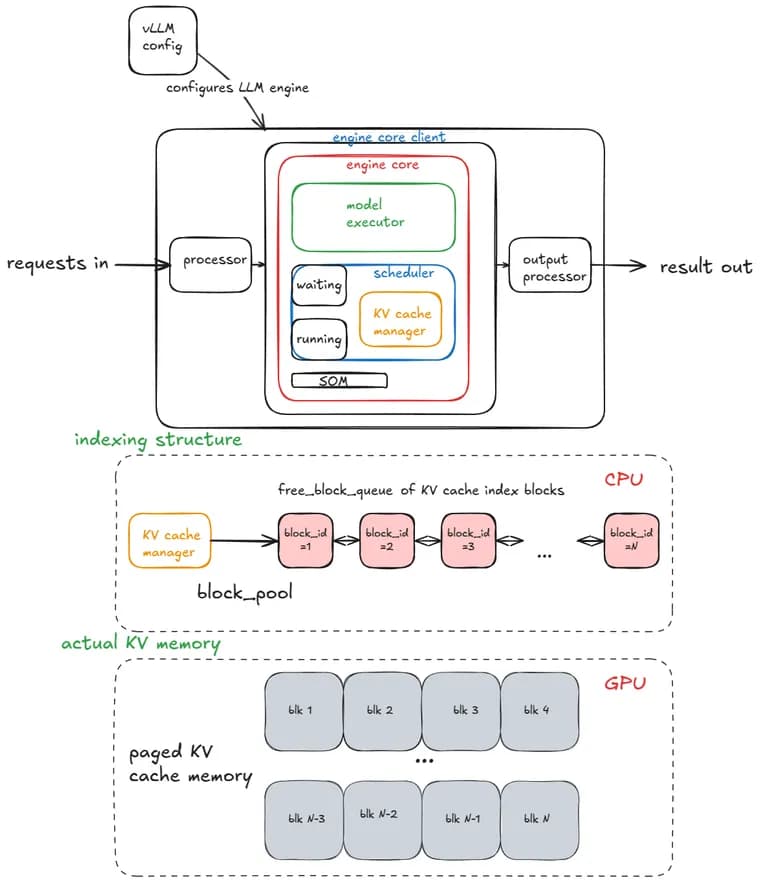
Starting from a minimal offline, single-GPU, synchronous example, the author walks through the LLM engine constructor: the vLLM config, a processor that turns raw prompts into EngineCoreRequests, an engine core client, and an output processor that converts raw outputs into what the user sees. The engine core itself contains a model executor, a structured output manager for guided decoding, and a scheduler with waiting and running queues plus a KV-cache manager. During worker setup, the engine assigns a CUDA device, checks available VRAM against a configurable gpu_memory_utilization setting (an example value of 0.8 is shown reserving 80% of total VRAM), loads the model and its weights, and initializes the KV cache by profiling GPU memory to determine how many cache blocks fit, then optionally captures CUDA graphs to cut kernel launch overhead.
The scheduler is described as the component that decides which requests run in a given step. It prioritizes decode requests already in the running queue, then pulls new ones from the waiting queue, calling an allocate_slots function each time to reserve KV-cache blocks. The post gives a concrete example: KV-cache blocks store 16 tokens by default, so a prefill request carrying 17 new tokens needs ceil(17/16) = 2 blocks. If the pool runs short, the engine can evict lower-priority requests to free blocks rather than fail outright. A key architectural claim is that the V1 scheduler can mix prefill and decode requests within the same engine step, which the V0 engine could not do, since V0 could only process one type of request at a time.
Each engine step is described as three stages: scheduling which requests run, a forward pass that runs the model and samples tokens, and postprocessing that appends sampled tokens, detokenizes them, and checks stop conditions (length limits, EOS tokens, stop-token IDs, or stop strings). During the forward pass, all sequences in a batch are flattened into one long sequence, with position indices and attention masks keeping each sequence isolated to its own tokens, which is what allows continuous batching without padding sequences to a common length. The retrieved text of the post cuts off partway through the forward-pass description, before the promised sections on advanced features, multi-GPU scaling, the serving layer, and the benchmarking and auto-tuning results are reached.
Key facts
- The post walks through vLLM's V1 engine architecture end to end: engine core, advanced features, multi-GPU scaling, the serving layer, and benchmarking; it is the first of a planned series, published August 29, 2025, based on vLLM commit 42172ad from August 9, 2025.
- KV-cache blocks store 16 tokens by default; a worked example shows a prefill request with 17 new tokens needing ceil(17/16) = 2 blocks.
- An example gpu_memory_utilization setting of 0.8 is shown reserving 80% of total VRAM for the engine.
- The V1 scheduler can mix prefill and decode requests within a single step; the V0 engine could only run one type at a time.
- Each engine step runs three stages on every call: schedule, forward pass, and postprocess, the last of which appends tokens, detokenizes, and checks stop conditions.
Why it matters
Inference-serving engines like vLLM sit underneath most production LLM deployments, and how they schedule requests and manage GPU memory directly sets throughput and cost. This post makes those internal mechanics explicit, mapping the constructor, the scheduler, and the KV-cache manager to the actual code paths rather than describing the system at a marketing level.
Who it affects
The audience is engineers who run, tune, or contribute to LLM inference engines such as vLLM or SGLang, and teams trying to understand or reduce the GPU cost of serving models. It is not written for end users of an LLM product and assumes familiarity with terms like prefill, decode, and KV cache.
How to use it
The post is a free, openly published blog article, the first in a series that promises deeper dives into specific subsystems. It includes a runnable offline inference snippet as a starting example, so a reader can follow along against a real vLLM installation rather than reading description alone.
How solid is it
The analysis is pinned to one specific vLLM commit (42172ad, August 9, 2025), so some described internals may already have shifted in newer releases. It is an independent engineer's reading of the vLLM V1 source rather than an announcement or documentation from the vLLM project itself.
Risks and caveats
The retrieved text cuts off mid-sentence during the forward-pass description, before the sections on advanced features, multi-GPU scaling, the serving layer, and the benchmarking and auto-tuning results, so none of those specifics can be reported here. No release version number or star count for the vLLM project is given in the source.
“The V1 scheduler can mix both types of requests in the same step, thanks to smarter design choices. In contrast, the V0 engine could only process either prefill or decode at once.”
— the post's author