J-Zero outperforms baselines by 4.2 to 8.0 points on AI tasks
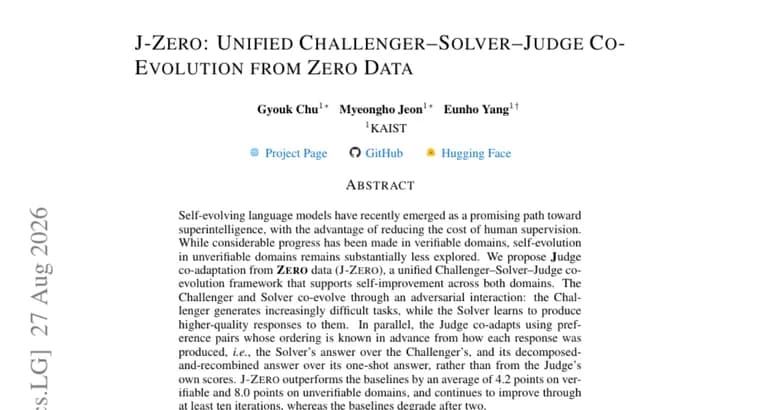
Researchers propose J-Zero, short for Judge co-adaptation from Zero data, a training framework built around three components that evolve together: a Challenger, a Solver and a Judge. The aim is self-improvement in language models across both verifiable domains, where an answer can be checked against a ground truth, and unverifiable domains, where it cannot. The authors say the unverifiable case has been far less explored, even as self-evolving models are increasingly seen as a path toward superintelligence because they cut the cost of human supervision.
In the framework, the Challenger and the Solver train against each other adversarially: the Challenger keeps generating harder tasks, and the Solver keeps learning to produce better responses to them. The Judge co-adapts in parallel, on pairs of responses whose correct ordering is already known from how each pair was produced, rather than from scores the Judge assigns itself. Specifically, the Solver's answer is treated as preferable to the Challenger's own answer, and a response the Solver builds by decomposing a problem and recombining the pieces is treated as preferable to a one-shot answer to the same problem.
Against baseline methods, J-Zero shows an average improvement of 4.2 points on verifiable domains and 8.0 points on unverifiable domains. The authors also report that J-Zero keeps improving through at least ten training iterations, while the baseline methods start to degrade after only two.
Key facts
- J-Zero is a Challenger-Solver-Judge co-evolution framework for self-improving language models in both verifiable and unverifiable domains.
- The Challenger generates increasingly difficult tasks while the Solver learns to answer them better, in an adversarial loop.
- The Judge trains on preference pairs whose ordering is known in advance from how each response was produced, not from the Judge's own scores.
- J-Zero outperforms baselines by an average of 4.2 points on verifiable domains and 8.0 points on unverifiable domains.
- J-Zero keeps improving through at least ten iterations, while the baseline methods degrade after two.
Why it matters
Self-evolving language models are being pitched as a way to cut the cost of human supervision, but most progress so far has been in verifiable domains, where a solution can be checked automatically against a known answer. J-Zero is presented as a way to extend that kind of self-improvement to unverifiable domains, where there is no ground truth to check against, by building the Judge's training signal into the structure of the pipeline instead of requiring human-labeled preference data.
Who it affects
The framework is aimed at researchers building self-evolving or self-improving language model pipelines, and anyone working on preference or reward modeling. Because the Judge's training signal comes from how the data was generated rather than from human-labeled rankings, teams that currently depend on human annotators to compare model outputs, especially in domains where correctness cannot be checked automatically, are the ones most directly affected.
How to use it
The method has three moving parts trained together: a Challenger that proposes increasingly difficult tasks, a Solver that answers them, and a Judge that ranks pairs of answers. Instead of collecting human preference labels for the Judge, the framework relies on an ordering that is already known from how each pair of answers was generated: the Solver's answer is preferred over the Challenger's own answer, and an answer the Solver builds by decomposing a problem and recombining the pieces is preferred over a one-shot answer to the same problem. The abstract does not specify model sizes, architectures or training compute, so what is described here is the training method itself rather than a released tool.
How solid is it
The claims rest on a single reported comparison: J-Zero outperforms unnamed baseline methods by an average of 4.2 points on verifiable domains and 8.0 points on unverifiable domains, and it keeps improving through at least ten training iterations while those baselines degrade after two. The abstract does not name the baselines, define what the 'points' metric measures, or identify which benchmarks make up the verifiable and unverifiable domain tests, which limits how much can be judged from the text alone.
Risks and caveats
Without a defined scoring metric or named baselines, the size of the reported gains is hard to compare against other published self-evolution methods. Model scale and training cost are not disclosed, so how the approach behaves at larger scale, or whether the improvement trend continues past ten iterations, is unclear. No author names, institutional affiliations or publication venue are given in the abstract, which limits independent verification of the claims at this stage.
“J-Zero outperforms the baselines by an average of 4.2 points on verifiable and 8.0 points on unverifiable domains, and continues to improve through at least ten iterations, whereas the baselines degrade after two.”
— the paper's abstract