It takes five cloud services to hear a doorbell ring
The author, Vivek, installed a cheap Blink video doorbell after a burglary in his apartment building in winter 2024. The doorbell worked, but it introduced a regression: instead of knocking, visitors now rang the doorbell, which sent a phone notification and played a sound outside the door, inaudible from inside. His wife did not keep her phone on her constantly, so she stopped noticing visitors, and told him directly that the doorbell had made it harder, not easier, to answer the door.
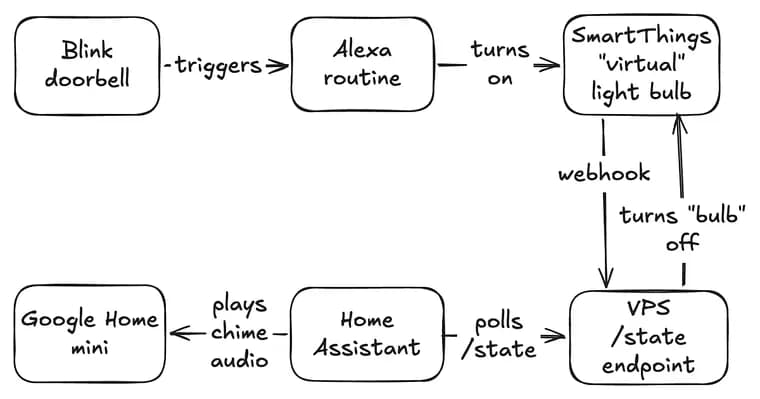
To fix this, Vivek wanted the doorbell ring to play a sound on the Google Home minis already in the house. He set two constraints: no paid subscriptions, and no exposing his home mini PC directly to the internet. After several days of research, including asking GPT-4o without success, he built a chain of five services. The Blink doorbell triggers an Alexa routine. That routine flips a virtual light bulb on the Samsung SmartThings platform, used purely as a single bit of cloud state. SmartThings sends a webhook whenever that virtual bulb's state changes. A VPS runs a small server that listens for the webhook, exposes an endpoint reporting the bulb's on/off status, and then resets it to off. Finally, a Home Assistant routine on his home mini PC polls that endpoint, and when it sees the status flip from off to on, plays an audio file on a Google Home mini.
The setup has been running for about 18 months and works reliably, though Vivek calls it over-engineered. The one new problem: Samsung recently announced that personal SmartThings API access, which the whole chain depends on to store a single boolean, will start costing $4.99 a month. He now has to find another way to keep the contraption running. He sums up the project as upgrading his front door from depending on zero cloud services to depending on five.
Key facts
- A 2024 burglary near the author's apartment prompted him to install a Blink video doorbell.
- The doorbell's own notification sound played outside the door, so his wife often missed visitors entirely.
- He built a five-step chain (Blink to Alexa routine to a Samsung SmartThings virtual bulb to a VPS webhook listener to a Home Assistant poll) to play the doorbell sound on a Google Home mini, avoiding subscriptions and avoiding exposing his home mini PC to the internet.
- The chain has worked for about 18 months, replacing a front door that previously depended on zero cloud services with one that now depends on five.
- Samsung's new $4.99 a month charge for personal SmartThings API access, the piece of the chain that stores a single boolean, now threatens to break the whole setup.
Why it matters
The story is a concrete illustration of smart home fragmentation: no device in the chain, from a $30 video doorbell to a major platform like SmartThings, speaks directly to any other, so a single working notification requires stitching together five separate cloud services with a VPS and a home server in between. It is a small, personal case of a larger pattern in consumer IoT, where interoperability between vendors is achieved, if at all, through workarounds like this rather than a shared standard.
Who it affects
Anyone running a mixed-vendor smart home setup, here Blink, Amazon Alexa, Samsung SmartThings, a self-hosted VPS, and Home Assistant on a home mini PC, and specifically hobbyists who want to avoid both paying for subscriptions and exposing home devices directly to the internet. It also affects non-technical household members: the original problem was that the author's wife, who does not carry her phone constantly, could not hear or see the doorbell notification at all.
How to use it
The chain works by using a Samsung SmartThings virtual light bulb purely as one bit of cloud state: an Alexa routine flips it, SmartThings fires a webhook on the change, a VPS server exposes that state over an endpoint and resets it, and a Home Assistant routine at home polls the endpoint to trigger a sound on a Google Home mini. Replicating it costs no subscription today, but that is changing: Samsung has announced personal SmartThings API access, which this setup relies on, will cost $4.99 a month, so anyone copying this exact approach should expect that fee going forward.
How solid is it
This is a first-person account from the person who built and has run the system, with a published flowchart diagram and a stated 18-month operating history, not a third-party report or a study. It is credible as a single, specific case, but it describes one household's setup rather than a general or measured claim about smart home reliability.
Risks and caveats
The setup depends on five separate third-party services staying available, compatible, and, as the SmartThings change shows, free or affordably priced; a pricing or API change at any one link can break the whole chain, as is already happening. It is also not a beginner project: it requires comfort with Alexa routines, the SmartThings platform, running a VPS server, and Home Assistant, and the source does not say whether the author has already found or built a replacement for the newly paid SmartThings step.
“This is really stupid, Vivek. Adding a doorbell has made it harder to open the door for guests.”
— the author's wife, quoted in the post