JEV teacher lifts Qwen2.5-1.5B agent over GRPO on ALFWorld and WebShop
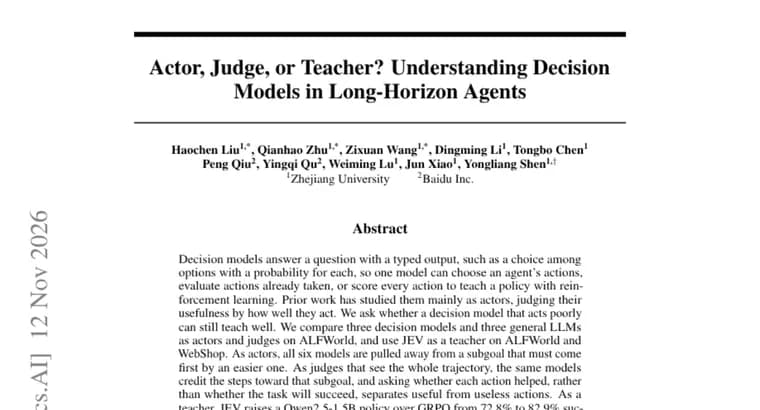
A paper on Hugging Face Papers looks at decision models in long-horizon agents. A decision model answers a question with a typed output, such as a choice among options with a probability for each. That lets one model do three jobs: choose an agent's actions, evaluate actions already taken, or score every action to teach a policy with reinforcement learning.
The authors say prior work has studied these models mainly as actors, judging their usefulness by how well they act. Their question is different: can a decision model that acts poorly still teach well?
To test it, they compare three decision models and three general LLMs as actors and judges on ALFWorld. They also use JEV as a teacher on ALFWorld and WebShop.
The actor results are uniform. All six models are pulled away from a subgoal that must come first by an easier one. The judge results look different. When the same models see the whole trajectory, they credit the steps toward that subgoal. The paper adds that asking whether each action helped, rather than whether the task will succeed, separates useful from useless actions.
As a teacher, JEV raises a Qwen2.5-1.5B policy over GRPO from 72.8% to 82.9% success on ALFWorld, and from 56.8% to 71.4% on WebShop. Those are absolute success rates. The gains are 10.1 percentage points on ALFWorld and 14.6 points on WebShop.
The authors conclude that the results suggest a poor actor can still teach well, because judging an action after the episode ends reveals the consequences that acting must anticipate. Code is available on GitHub at ZJU-REAL/decision-agents.
Key facts
- The paper tests whether a decision model that acts poorly can still teach well, compared with prior work that judged these models mainly as actors.
- Three decision models and three general LLMs were compared as actors and judges on ALFWorld; as actors, all six are pulled away from a subgoal that must come first by an easier one.
- As judges that see the whole trajectory, the same models credit the steps toward that subgoal, and asking whether each action helped separates useful from useless actions.
- With JEV as teacher, a Qwen2.5-1.5B policy rises over GRPO from 72.8% to 82.9% success on ALFWorld and from 56.8% to 71.4% on WebShop.
- Code is public at github.com/ZJU-REAL/decision-agents.
Why it matters
Agents are often judged by how well they act, and the same yardstick has been applied to the models that might train them. This paper separates the two roles. It reports that models which fail as actors still give useful signal as judges, so a model's score as an agent may not show how good a teacher it would be. The gains on a small 1.5B policy, 10.1 points on ALFWorld and 14.6 points on WebShop, are the evidence the authors offer.
Who it affects
Researchers training long-horizon agents with reinforcement learning, especially those choosing a model to score actions during GRPO-style training. It also bears on anyone who evaluates decision models only by running them as actors.
How to use it
The code is on GitHub at ZJU-REAL/decision-agents. The practical idea in the abstract is to ask a judge whether each action helped, after seeing the whole trajectory, rather than asking whether the task will succeed. The abstract gives no setup details beyond that, so the repository is the place to look for how JEV is used as a teacher.
How solid is it
This is an abstract-level account of a preprint, and the numbers are the authors' own. The reported success rates are absolute figures on two benchmarks, ALFWorld and WebShop, for one policy size, Qwen2.5-1.5B. The authors word their central conclusion as "these results suggest", not as a proven result. No number of runs, seeds, confidence intervals or statistical significance is given. The abstract does not define what JEV stands for or how it works, and it does not name the three decision models or the three general LLMs.
Risks and caveats
Results are limited to ALFWorld and WebShop and a single policy size, and no claim about other models or benchmarks is made. No results are given for the actor and judge experiments beyond qualitative statements. Training cost, compute and timescale are not given. The abstract does not state explicitly that 72.8% and 56.8% are the GRPO baseline scores; it says JEV raises the policy over GRPO from those figures to the higher ones.
“a poor actor can still teach well, because judging an action after the episode ends reveals the consequences that acting must anticipate”
— Paper abstract, Hugging Face Papers