JevSpawn paper proposes parallel action spawning for LLM agents
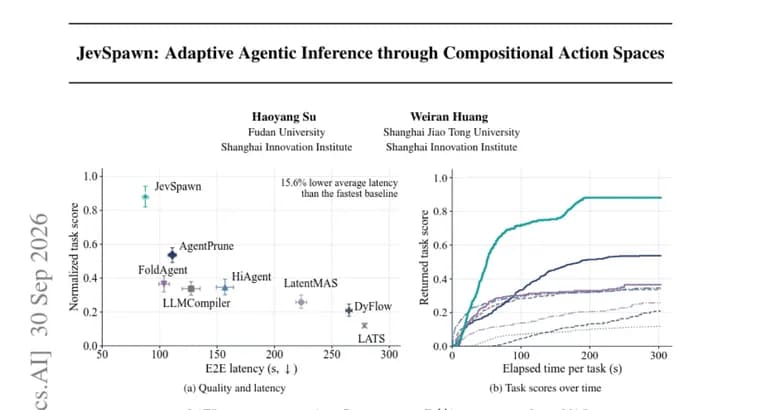
The paper starts from a familiar complaint about LLM agents: they generate intermediate reasoning and actions token by token, which makes extended interactions slow and computationally expensive. The authors point to Jev-style models as one alternative. These models offer fast probabilistic predictions over finite fields, but they require those fields to be specified in advance.
That requirement is the problem the paper targets. In autonomous task solving, the available actions have to be derived from natural language instructions and adapted through interaction, so a fixed, pre-specified field does not fit.
The proposed answer is JevSpawn, described as a compositional policy that connects natural language task specifications to finite probabilistic exploration. Its mechanism has several parts that work together: parallel action spawning is coupled with feedback driven branch selection, representation revision, and recovery from retained alternatives. In plain terms, the agent spawns several candidate actions at once, uses feedback to choose among the branches, revises its representation as it goes, and can fall back to alternatives it kept.
On cost, the authors say that shared action structure and model prefixes reduce repeated generation and context computation, and that this works without additional training.
For evidence, the paper reports evaluations on eight benchmark tasks against seven agent baselines and a TypeSafe Jev variant. The authors say these evaluations establish JevSpawn as a promising approach to structured agentic inference, with improved task performance and faster navigation.
Key facts
- JevSpawn is a compositional policy that connects natural language task specifications to finite probabilistic exploration, so Jev-style models no longer need their finite fields specified in advance.
- Parallel action spawning is coupled with feedback driven branch selection, representation revision, and recovery from retained alternatives.
- Shared action structure and model prefixes reduce repeated generation and context computation, without additional training.
- Evaluation covers eight benchmark tasks, seven agent baselines and a TypeSafe Jev variant.
- The authors report improved task performance and faster navigation, and call the approach promising.
Why it matters
Token-by-token generation of reasoning and actions makes long agent interactions slow and computationally expensive, according to the paper. JevSpawn aims at that cost by spawning actions in parallel and reusing shared action structure and model prefixes, which the authors say cuts repeated generation and context computation. It also tries to remove a limit of Jev-style models: the need to specify finite fields in advance, which holds back autonomous task solving.
Who it affects
The work is aimed at people building LLM agents that must work out their available actions from natural language instructions and adapt them as they interact. It is also relevant to anyone using Jev-style models, which the paper says are fast but depend on pre-specified fields.
How to use it
The abstract describes the method as working without additional training. No code release, dataset release or date is mentioned. Anyone wanting to try it will need to go to the full paper for implementation details.
How solid is it
The claim rests on evaluations on eight benchmark tasks against seven agent baselines and a TypeSafe Jev variant. The authors themselves use the word "promising" rather than claiming a settled result. No numeric results are given: no accuracy, success rate, speedup factor or token or compute savings. The eight benchmark tasks, the seven agent baselines and the TypeSafe Jev variant are not named.
Risks and caveats
No size of the improvement in task performance or in faster navigation is quantified, so the practical gain is unclear from the abstract. It does not say which underlying LLM or Jev-style model is used, and it does not define what "Jev" stands for or what "finite fields" means beyond the phrase used. No authors or institutions are named in the abstract.
“Parallel action spawning is coupled with feedback driven branch selection, representation revision, and recovery from retained alternatives.”
— JevSpawn paper abstract