LaLa-World: language-conditioned latent world model plans with 6x less training cost
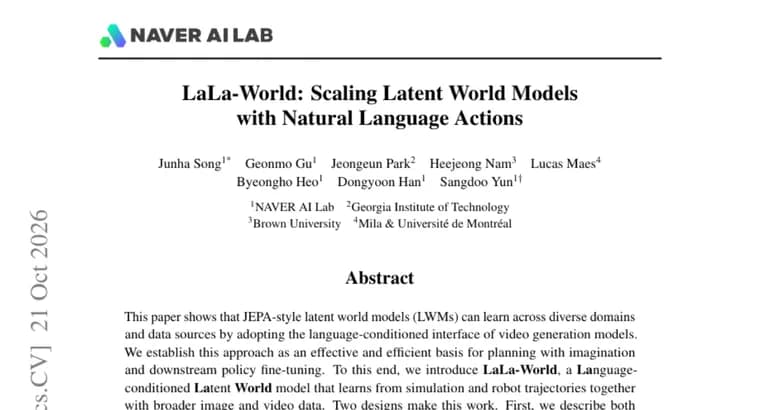
A paper on Hugging Face Papers, titled "LaLa-World: Scaling Latent World Models with Natural Language Actions", argues that JEPA-style latent world models (LWMs) can learn across diverse domains and data sources if they adopt the language-conditioned interface used by video generation models. The authors present this as an effective and efficient basis for planning with imagination and for downstream policy fine-tuning.
The model they introduce is LaLa-World, a Language-conditioned Latent World model. It learns from simulation and robot trajectories together with broader image and video data. Two design choices make this work, according to the authors. First, both numerical actions and visual changes are described in language, which allows a single future predictor to be trained jointly across heterogeneous datasets. Second, the predictor is built on a language model, so it can interpret language conditions while predicting future latent states.
The reported results are comparative. The resulting predictor achieves higher average MPC planning performance than existing LWMs trained separately for each domain or task. Adding image and video data improves average planning performance further, and also improves robustness to how actions are phrased.
The efficiency claim comes from a matched comparison with an RAEv2-based video generation model baseline. There, LaLa-World reaches comparable planning performance (not higher) with 6x less training cost and 13.9x faster planning.
The pretrained LaLa-World also serves as the initialization for LaLa-Policy, a policy that jointly predicts actions and future visual representations. On the LIBERO and RoboCasa benchmarks, LaLa-Policy performs competitively with Cosmos Policy, with up to 5.5x faster inference.
The text available gives no absolute benchmark scores, model sizes, base language model, dataset sizes or code release details.
Key facts
- LaLa-World is a language-conditioned JEPA-style latent world model trained jointly on simulation, robot trajectories and broader image and video data.
- Actions and visual changes are both described in language, so one future predictor can be trained across heterogeneous datasets; the predictor is built on a language model.
- It achieves higher average MPC planning performance than existing latent world models trained separately per domain or task.
- Against an RAEv2-based video generation baseline, it reaches comparable planning performance with 6x less training cost and 13.9x faster planning.
- LaLa-Policy, initialized from LaLa-World, performs competitively with Cosmos Policy on LIBERO and RoboCasa, with up to 5.5x faster inference.
Why it matters
Latent world models usually get trained separately for each domain or task. This paper argues that describing actions and visual changes in language lets one predictor learn across simulation, robot trajectories, images and video. If the claims hold, that points to a cheaper route to planning with imagination than generating video: the reported figures are 6x less training cost and 13.9x faster planning against an RAEv2-based video generation baseline at comparable planning performance.
Who it affects
The work is aimed at researchers building world models and robot policies, particularly those working on planning with imagination and policy fine-tuning. The benchmarks named for the policy are LIBERO and RoboCasa, so robotics-learning groups using those suites are the most direct audience.
How to use it
The source gives no information about released code, weights or data, so there is nothing to run from this text alone. The practical takeaway is the recipe: express numerical actions and visual changes as language, train a single language-model-based future predictor on mixed datasets, then reuse the pretrained model to initialize a policy such as LaLa-Policy.
How solid is it
This is a paper listed on Hugging Face Papers, and the claims are the authors' own. The efficiency gains come from one matched comparison, where planning performance is described as comparable, not better. LaLa-Policy is described as competitive with Cosmos Policy, not more accurate. The 5.5x inference speedup is only an upper bound ("up to").
Risks and caveats
No absolute scores are given for LaLa-World, LaLa-Policy or any baseline, so the size of the planning gains cannot be judged from the text. The source does not say what the 6x and 13.9x figures are measured in. It names only LIBERO and RoboCasa for the policy and mentions no real-robot results. No limitations or failure cases are stated.