Language models write EEG and ECG network weights without gradient descent, paper reports
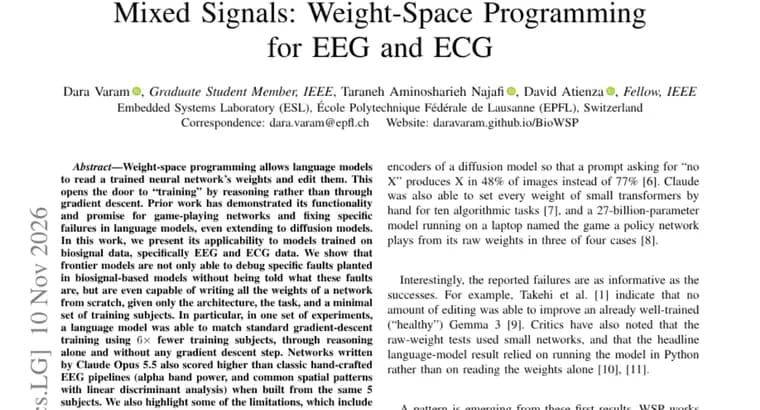
A paper titled "Mixed Signals: Weight-Space Programming for EEG and ECG" applies an idea called weight-space programming to biosignal data. In weight-space programming, a language model reads a trained neural network's weights and edits them, which the authors say opens the door to "training" by reasoning rather than through gradient descent. Earlier work, they note, showed the approach for game-playing networks and for fixing specific failures in language models, and even extended it to diffusion models. This paper tests it on models trained on EEG and ECG data.
The authors report two main results. First, frontier models can debug specific faults planted in biosignal-based models without being told what the faults are. Second, they can write all the weights of a network from scratch, given only the architecture, the task, and a minimal set of training subjects.
Two figures stand out. In one set of experiments, a language model matched standard gradient-descent training while using 6 times fewer training subjects, through reasoning alone and without any gradient descent step. And networks written by Claude Opus 5.5 scored higher than classic hand-crafted EEG pipelines, namely alpha band power and common spatial patterns with linear discriminant analysis, when built from the same 5 subjects.
The authors also list limitations. Language models cannot improve already well-trained classification models, and they cannot reliably recognise, from the weights alone, the task a network was trained on. Their overall conclusion is that weight-space programming can be useful for small networks, such as those deployed on edge devices and wearables, but that the concept still needs further investigation before it can be used in practice.
Key facts
- Weight-space programming means a language model reads and edits a trained network's weights, aiming at "training" by reasoning instead of gradient descent; this paper applies it to EEG and ECG models.
- Frontier models debugged specific faults planted in biosignal-based models without being told what the faults were, and wrote all of a network's weights from scratch given the architecture, the task and a minimal set of training subjects.
- In one set of experiments a language model matched standard gradient-descent training with 6 times fewer training subjects, with no gradient descent step.
- Networks written by Claude Opus 5.5 scored higher than classic hand-crafted EEG pipelines (alpha band power; common spatial patterns with linear discriminant analysis) when built from the same 5 subjects.
- Limitations: language models cannot improve already well-trained classifiers or reliably identify a network's task from its weights alone.
Why it matters
The paper pushes a different way of building models: instead of running gradient descent, a language model reasons about what the weights should be and writes or edits them directly. Prior work covered game-playing networks, fixing failures in language models and diffusion models. Biosignals are a new domain for the idea. The headline claim is data efficiency: in one set of experiments, a language model matched gradient-descent training with 6 times fewer training subjects. That matters most where training subjects are scarce, as with the 5-subject comparison against hand-crafted EEG pipelines.
Who it affects
The authors point to small networks, such as those deployed on edge devices and wearables, as the place where weight-space programming could be useful. That makes it relevant to people building EEG and ECG models with little training data, and to researchers following language models as tools that act on other models' weights. The authors state no direct effect beyond that.
How to use it
This is a research result, not a product. The setup the authors describe gives a language model the network architecture, the task and a minimal set of training subjects, and has it write all the weights; or it gives the model a trained network with planted faults to find and fix. No code, release or availability information is given in the source. The authors say the concept still needs further investigation before it can be used in practice.
How solid is it
The only source is the paper's abstract, which reports results without scores: no accuracy, AUC or other values for any model or baseline are given. The abstract does not say which datasets, tasks or architectures were used, which models other than Claude Opus 5.5 were tested, or how many training subjects the gradient-descent baseline used in the 6 times comparison. It also does not say whether that 6 times result applies to EEG, ECG or both. The comparison with hand-crafted EEG pipelines rests on 5 subjects. The claims are the authors' own.
Risks and caveats
The authors name two limitations: language models cannot improve already well-trained classification models, and they cannot reliably recognise, from the weights alone, the task a network was trained on. They conclude the approach may suit small networks and still needs more study before practical use. The size of the "small networks" is not specified, and the 6 times figure comes from one set of experiments, so it should not be read as a general result.
“weight-space programming can be useful for small networks, such as those deployed on edge devices and wearables, but the concept still requires further investigation before it can be used in practice”
— From the paper's abstract