LARC lets unified multimodal models reason in continuous space, claims GenEval lead over BAGEL
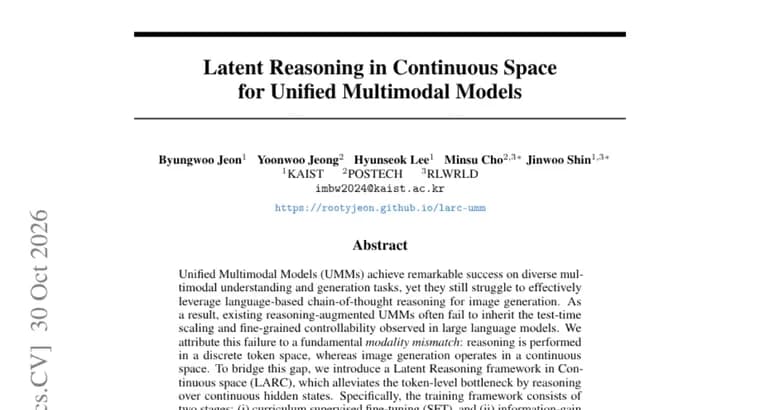
A paper on Hugging Face introduces LARC, short for Latent Reasoning framework in Continuous space, a method for Unified Multimodal Models (UMMs). These are models that handle both understanding and generation across modalities. The authors start from a problem: UMMs do well on many multimodal tasks, yet they still struggle to use language-based chain-of-thought reasoning when generating images. As a result, existing reasoning-augmented UMMs often fail to inherit the test-time scaling and fine-grained controllability seen in large language models.
The authors attribute this to a modality mismatch. Reasoning happens in a discrete token space, while image generation operates in a continuous space. LARC is meant to bridge that gap. It alleviates the token-level bottleneck by reasoning over continuous hidden states rather than over text tokens.
Training has two stages. First comes curriculum supervised fine-tuning (SFT), which gradually converts token-level reasoning into latent reasoning. Second comes information-gain reinforcement learning (RL), which self-evolves the latent reasoning without ground truth supervision.
Across diverse text-to-image benchmarks, the authors say LARC consistently improves generation quality, prompt following, and compositional fidelity. They report state-of-the-art performance on GenEval, with a 7 percentage point gain over BAGEL. They also say LARC shows clear test-time scaling behavior, outperforming token-based generation under both parallel and sequential test-time scaling strategies.
Key facts
- LARC (Latent Reasoning framework in Continuous space) has unified multimodal models reason over continuous hidden states instead of discrete text tokens before generating an image.
- The authors blame a modality mismatch: reasoning runs in a discrete token space, while image generation operates in a continuous one.
- Training has two stages: curriculum SFT that gradually converts token-level reasoning into latent reasoning, then information-gain RL that self-evolves it without ground truth supervision.
- The authors report state-of-the-art GenEval performance, a 7 percentage point gain over BAGEL.
- They also report clear test-time scaling, beating token-based generation under both parallel and sequential strategies.
Why it matters
Chain-of-thought reasoning has helped language models scale at test time, but the authors say reasoning-augmented unified multimodal models often fail to inherit that benefit for image generation. LARC targets the cause they identify: reasoning in discrete tokens feeding a generator that works in continuous space. If the approach holds up, reasoning before drawing could scale with extra test-time compute the way it does in text models.
Who it affects
Mainly researchers building unified multimodal models and text-to-image systems, particularly those working on reasoning-augmented generation, test-time scaling, or reinforcement learning for latent reasoning. BAGEL is the baseline named for the comparison.
How to use it
The abstract describes a recipe rather than a product. Start with curriculum SFT to move token-level reasoning gradually into latent reasoning, then apply information-gain RL, which needs no ground truth supervision. Practitioners would need the full paper for implementation details.
How solid is it
These are the authors' own claims, from an abstract-level account of a preprint. The only quantified result is the 7 percentage point GenEval gain over BAGEL, an absolute difference rather than a relative one. No absolute GenEval scores are given, the BAGEL variant is not specified, and the test-time scaling gains are not quantified. No independent replication is mentioned.
Risks and caveats
The benchmark leadership is self-reported, and a single GenEval number is the main evidence cited. The other text-to-image benchmarks are not named, and the abstract gives no model size, training data, or compute cost. No code, weights, or release plans are mentioned, so reproducing the results may be hard until more is published.