LatentStream moves streaming video memory from retrieval to internalization
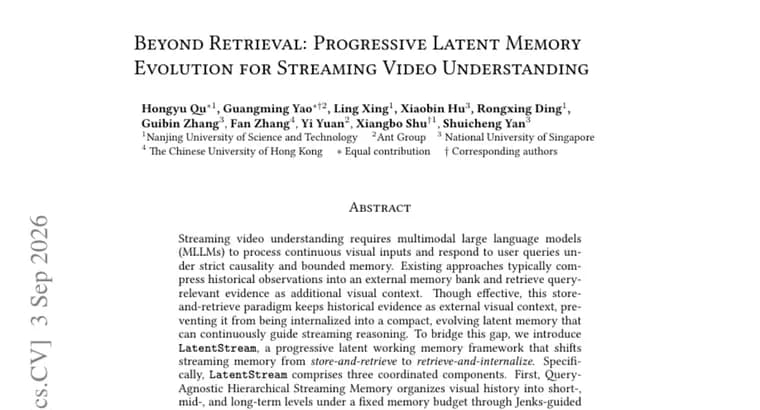
Researchers have introduced LatentStream, a framework that changes how multimodal large language models (MLLMs) handle memory while watching streaming video. Streaming video understanding forces an MLLM to process a continuous feed and answer questions about it under strict causality (it cannot look ahead) and a bounded memory budget. The dominant approach today compresses what the model has seen into an external memory bank and retrieves query-relevant pieces of that bank as extra visual context when a question arrives. The authors argue this store-and-retrieve design works but has a structural limit: it keeps historical evidence sitting outside the model as external context, so that evidence never gets folded into a compact, evolving internal memory that could keep guiding the model's reasoning as the stream continues. LatentStream is built to close that gap by shifting the process from store-and-retrieve to what the authors call retrieve-and-internalize. It has three coordinated parts. The first, Query-agnostic Hierarchical Streaming Memory, organizes the visual history into short-term, mid-term and long-term levels under a fixed memory budget, using a technique the authors call Jenks-guided adaptive consolidation to decide what gets kept at each level. The second part, Hierarchical Latent Memory Evolution, activates once a user query arrives: groups of latent memory tokens are given progressively wider memory receptive fields, letting them iteratively pull historical evidence from their assigned scope and fold it into a compact, fixed-length latent memory rather than leaving it as separate retrieved context. The third part, Progressive Confidence-guided Latent Memory Optimization, builds a hierarchical reward signal from group-wise predictive entropy and uses it to jointly refine both the latent memory tokens and the evidence retrieved for them, pushing the model toward increasingly confident answers as the stream goes on. The authors report that extensive experiments show LatentStream reaching new state-of-the-art results on existing online and offline video benchmarks, though the text made available does not name the specific benchmarks, baseline systems, or any accuracy figures behind that claim, nor does it mention author affiliations or a code, model or dataset release.
Key facts
- LatentStream reframes streaming video memory in MLLMs as retrieve-and-internalize instead of the standard store-and-retrieve approach.
- Query-agnostic Hierarchical Streaming Memory splits visual history into short-, mid- and long-term levels under a fixed memory budget via Jenks-guided adaptive consolidation.
- Hierarchical Latent Memory Evolution uses latent memory tokens with progressively expanding memory receptive fields to internalize retrieved evidence into a compact, fixed-length memory once a query arrives.
- Progressive Confidence-guided Latent Memory Optimization refines the latent tokens and retrieved evidence using a reward built from group-wise predictive entropy.
- The authors report new state-of-the-art results on existing online and offline video benchmarks, without naming specific benchmarks or figures in the available text.
Why it matters
Streaming video is a harder setting for MLLMs than a single clip or image: the model must answer questions in real time about a feed it is still receiving, without revisiting the future and without unbounded memory. The prevailing fix, an external memory bank that gets searched at query time, treats the past as a separate store rather than as something the model actually carries forward. LatentStream's pitch is that folding evidence into an evolving latent memory, rather than just retrieving it on demand, lets the model's internal state keep tracking a stream instead of repeatedly re-fetching context from outside itself.
Who it affects
The direct audience is researchers and engineers building MLLMs for continuous video applications, such as live monitoring, assistive systems, or any tool that has to answer questions about video as it arrives rather than after the fact. The paper does not name authors, affiliations, or any product built on the method, so its immediate reach is the video-understanding research community rather than a shipped tool.
How to use it
The text made available does not mention a code, model or dataset release, licensing terms, or pricing, so there is nothing here to install or license yet. What is described is the architecture: a fixed memory budget managed through hierarchical, query-agnostic consolidation, paired with query-time latent memory tokens whose receptive fields expand progressively and are optimized through a confidence-based reward.
How solid is it
The claim of new state-of-the-art results rests on what the authors describe as extensive experiments on existing online and offline video benchmarks, but the available text does not name those benchmarks, list baseline methods, or give any accuracy or score figures, so the strength of the result cannot be independently sized from this material alone.
Risks and caveats
Because no benchmarks, baselines, or numbers are given in the text, the state-of-the-art claim currently rests on the authors' own description rather than a checkable figure. There is also no stated memory size, token count, or computational cost for the fixed budget or the fixed-length latent memory, so the practical overhead of the approach relative to the store-and-retrieve methods it replaces is not established here.