Layer dropout cuts LLM training FLOPs by up to 25%, study finds
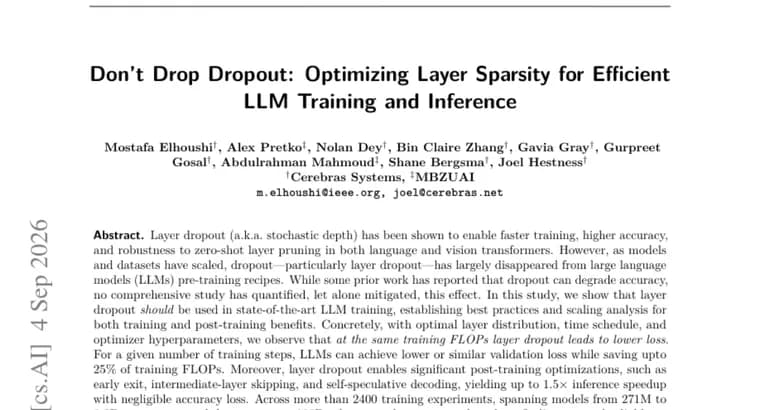
Layer dropout, also known as stochastic depth, is a technique that randomly skips entire transformer layers during training. It had already been shown to speed up training and make models more robust to having layers pruned after the fact, but as language models and their training datasets grew larger, the technique largely disappeared from LLM pretraining recipes. The authors say prior work had reported that dropout can hurt accuracy, yet no comprehensive study had actually measured that effect, let alone found a way around it. This study sets out to fix that gap and argues that layer dropout should be used in state-of-the-art LLM training. With the right layer distribution, a tuned schedule for when dropout is applied during training, and matched optimizer hyperparameters, the authors report that at the same training compute, layer dropout produces lower loss than training without it. Put differently, for a fixed number of training steps, models trained with layer dropout reach validation loss that is lower than or similar to a standard run while using up to 25% less training FLOPs. Beyond pretraining, the technique also opens the door to post-training optimizations that lean on the same layer-skipping idea, including early exit, skipping intermediate layers, and self-speculative decoding, which together yield inference speedups of up to 1.5x with what the authors describe as negligible accuracy loss. To back these claims, the team ran more than 2400 training experiments, covering models from 271 million to 8.2 billion parameters and datasets of up to 160 billion tokens, and report that the FLOP-savings and speedup findings hold reliably as scale increases. All pretraining experiments were run on Cerebras CS-3 systems. The abstract does not name the paper's authors, their institutions, a specific model architecture family beyond "transformers," or a publication venue and date.
Key facts
- With optimal layer distribution, dropout schedule, and optimizer hyperparameters, layer dropout produces lower validation loss than standard training at the same training FLOPs.
- For a fixed number of training steps, layer dropout reaches lower or similar validation loss while cutting training FLOPs by up to 25%.
- Post-training techniques it enables, including early exit, intermediate-layer skipping, and self-speculative decoding, deliver up to 1.5x inference speedup with negligible accuracy loss.
- The findings come from more than 2400 training experiments on models from 271M to 8.2B parameters and datasets up to 160B tokens, all pretrained on Cerebras CS-3 systems.
- Layer dropout had largely disappeared from LLM pretraining recipes as models and datasets scaled, despite earlier evidence that it can speed training and improve robustness to layer pruning.
Why it matters
Layer dropout used to be a known way to speed up transformer training and make models more robust when layers are later pruned, but it fell out of use as LLMs and their training sets grew, partly on reports that it could hurt accuracy. No comprehensive study had actually quantified that tradeoff, let alone tried to fix it. This work argues the technique deserves a place back in state-of-the-art pretraining: with the right layer distribution, dropout schedule, and optimizer hyperparameters, it reaches lower loss than standard training at matched compute, rather than merely matching it.
Who it affects
Anyone running large-scale LLM pretraining stands to gain compute savings, since the method lowers or matches validation loss while cutting training FLOPs by up to 25% for a given number of steps. It also matters to teams focused on inference cost, since layer dropout is what makes post-training tricks like early exit, intermediate-layer skipping, and self-speculative decoding effective, together worth up to 1.5x faster inference with reportedly negligible accuracy loss.
How to use it
The gains depend on getting three things right during pretraining: how dropout probability is distributed across layers, the schedule for when and how much dropout is applied over training, and optimizer hyperparameters tuned to match. Get those right and a model reaches the same or lower validation loss for up to 25% less training compute at a fixed number of steps, and becomes a candidate for early exit, intermediate-layer skipping, or self-speculative decoding afterward for faster inference. The source does not state licensing, pricing, or release details for any code or checkpoints.
How solid is it
The claims rest on a large empirical base: more than 2400 training experiments across models from 271M to 8.2B parameters and datasets up to 160B tokens, with results said to hold reliably as scale increases. All pretraining runs were done on Cerebras CS-3 systems, a specific and traceable hardware setup. What is missing from the source is any statement of who the authors are, their institutions, the exact model architecture family used beyond "transformers," or where and when the work was published, which limits independent verification of provenance.
Risks and caveats
Both headline figures are upper bounds, up to 25% FLOP savings and up to 1.5x inference speedup, not guaranteed outcomes for every configuration, and "negligible accuracy loss" is not pinned to a specific number in the source. The abstract also does not name a specific model architecture beyond "transformers" or state a publication venue, so the work's peer-review status and generality beyond the tested setups cannot be confirmed from the text alone.