LG releases K-EXAONE 2.0, a 750B-parameter open-weight MoE model
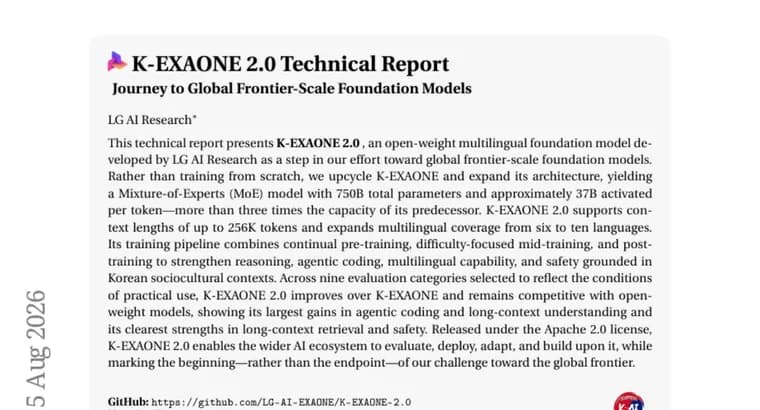
LG AI Research has released K-EXAONE 2.0, an open-weight multilingual foundation model the company describes as a step toward global frontier-scale foundation models. Rather than training from scratch, LG upcycled its earlier K-EXAONE model and expanded its architecture into a Mixture-of-Experts (MoE) design with 750B total parameters and approximately 37B activated per token, more than three times the activated-parameter capacity of its predecessor. The model supports context lengths of up to 256K tokens and expands multilingual coverage from six to ten languages.
The training pipeline combines continual pre-training, difficulty-focused mid-training and post-training, aimed at strengthening reasoning, agentic coding, multilingual capability and safety grounded in Korean sociocultural contexts. LG evaluated K-EXAONE 2.0 across nine evaluation categories chosen to reflect practical use conditions; the report states the model improves over the original K-EXAONE and remains competitive with other open-weight models, with its largest gains in agentic coding and long-context understanding, and its clearest strengths in long-context retrieval and safety. The report does not give specific benchmark scores for these categories, nor does it name which open-weight models K-EXAONE 2.0 was compared against.
K-EXAONE 2.0 is released under the Apache 2.0 license, which LG says lets the wider AI ecosystem evaluate, deploy, adapt and build on the model. The report frames the release as the beginning of LG's push toward the frontier rather than an endpoint. No individual paper authors or research team members, and no release date, are given in the available text.
Key facts
- K-EXAONE 2.0 is a Mixture-of-Experts model with 750B total parameters and about 37B activated per token, more than three times the activated capacity of the original K-EXAONE.
- It supports context lengths of up to 256K tokens and expands language coverage from six to ten languages.
- Training combined continual pre-training, difficulty-focused mid-training and post-training, targeting reasoning, agentic coding, multilingual capability and safety grounded in Korean sociocultural contexts.
- Across nine evaluation categories, LG reports the largest gains in agentic coding and long-context understanding, and the clearest strengths in long-context retrieval and safety, versus the original K-EXAONE and other open-weight models.
- The model is released under the Apache 2.0 license.
Why it matters
K-EXAONE 2.0 is a large jump in scale over its predecessor, built by upcycling rather than training from scratch, an approach that lets LG expand into a 750B-parameter MoE architecture with roughly triple the activated-parameter capacity while reusing existing model weights as a starting point. Releasing it open-weight under Apache 2.0 adds another large-scale MoE model to the open ecosystem, alongside its expansion from six to ten supported languages and a 256K token context window.
Who it affects
Developers and researchers who build on open-weight foundation models gain a new large-scale option with an unrestrictive Apache 2.0 license. The multilingual expansion and safety work grounded in Korean sociocultural contexts particularly target users and applications operating in or serving Korean-language and broader multilingual contexts.
How to use it
K-EXAONE 2.0 is released under the Apache 2.0 license, which LG AI Research says allows the wider AI ecosystem to evaluate, deploy, adapt and build upon the model. No pricing or hosting terms are given in the available text; the license itself is the access mechanism.
How solid is it
The claims come from LG AI Research's own technical report. The report describes gains across nine evaluation categories selected to reflect practical use, with the largest gains in agentic coding and long-context understanding and the clearest strengths in long-context retrieval and safety, but the available text gives no specific benchmark scores and does not name the open-weight models used for comparison, so the size of the improvement cannot be independently checked from what is stated.
Risks and caveats
The report does not identify individual paper authors or research team members, nor does it give a release or publication date. Without specific numeric results or named comparison models, the performance claims rest on LG's own qualitative summary rather than independently verifiable benchmark data.