LimiX-2 debuts contextual mechanism networks for tabular data
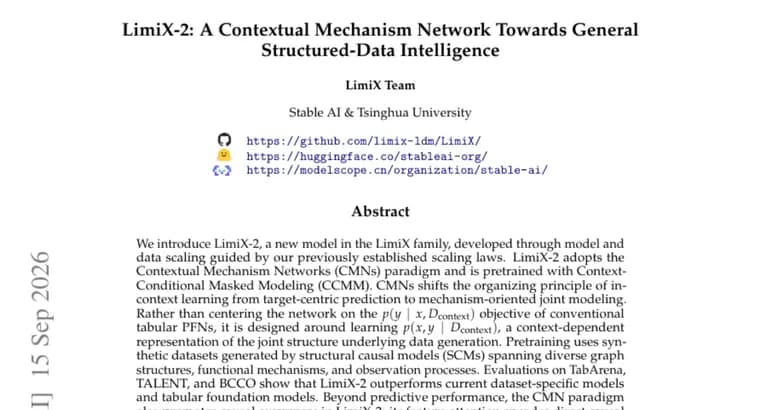
The authors introduce LimiX-2, the latest model in their LimiX family, built by scaling up model size and training data according to scaling laws they established in earlier work. LimiX-2 is pretrained using a new scheme called Context-Conditional Masked Modeling (CCMM) inside a paradigm the authors name Contextual Mechanism Networks, or CMNs. The stated idea is a shift in what in-context learning optimizes for: conventional tabular prior-fitted networks center on predicting a target from inputs and context, written as p(y given x, context); CMNs instead learn the joint structure of inputs and targets together, p(x, y given context), which the authors describe as a context-dependent representation of how the data itself was generated. To pretrain the model this way, they generate synthetic training data from structural causal models covering a range of graph structures, functional mechanisms, and observation processes, rather than relying only on real tabular datasets.
On the evaluation side, the authors report that LimiX-2 outperforms both dataset-specific models and other tabular foundation models across three benchmark suites: TabArena, TALENT, and BCCO. The source does not give the actual scores or margins, nor does it name which specific rival models were beaten. Beyond raw predictive accuracy, the authors argue the CMN design has a side effect: because the model's feature attention captures direct causal relationships between variables, LimiX-2 can recover the causal skeleton of a dataset, meaning it can identify which variables causally influence which others, with the paper reporting this recovery is accurate.
The source text does not name any authors, institutions, or affiliations, does not state a release date, model size, or parameter count, and does not say whether weights, code, or a license are or will be made available. The specific prior scaling-law work the authors reference is not described further either.
Key facts
- LimiX-2 is a new model in the LimiX family, produced by scaling up model and data size according to the authors' previously established scaling laws.
- It is pretrained with Context-Conditional Masked Modeling (CCMM) under a new paradigm the authors call Contextual Mechanism Networks (CMNs).
- CMNs shift the learning objective from predicting a target given inputs and context, p(y given x, context), to modeling the full joint distribution p(x, y given context).
- Pretraining data comes from synthetic datasets generated by structural causal models spanning varied graph structures, functional mechanisms, and observation processes.
- The authors report LimiX-2 outperforms both dataset-specific models and other tabular foundation models on the TabArena, TALENT, and BCCO benchmarks, though no scores or margins are given.
Why it matters
LimiX-2's pitch is a change in what a tabular model is trained to optimize for. Instead of the usual approach of predicting a target column from the rest of a table plus context, the Contextual Mechanism Networks paradigm trains the model to represent the joint structure of inputs and targets together, framed as learning how the data was generated rather than only how to predict from it. That framing is what the authors say lets the model also recover causal relationships between variables as a byproduct of ordinary training, rather than requiring a separate causal-discovery step.
Who it affects
The work is aimed at people building or using tabular machine learning systems: models trained on spreadsheet-like structured data rather than text or images. A model that both predicts well and surfaces causal structure between variables would be relevant to anyone using tabular models for decision-relevant predictions, where knowing which features causally drive an outcome matters as much as the prediction itself.
How to use it
The source text gives no release date, model size, parameter count, or information on whether weights, code, or a license will be made available. There is nothing in the material to say how or whether LimiX-2 can currently be obtained or run.
How solid is it
The evidence offered is evaluation on three established tabular benchmark suites, TabArena, TALENT, and BCCO, where the authors say LimiX-2 beats both models built for specific datasets and other general-purpose tabular foundation models. The claim rests on the authors' own reporting: no concrete scores, margins, or the identities of the specific models it outperformed are given in the source, so the size of the improvement cannot be judged from this text alone.
Risks and caveats
This is a self-reported result from the paper's own authors, and the source text names no authors, institutions, or affiliations, which makes it impossible to independently place the work or check for conflicts of interest. Without published numbers or named baselines, the outperformance claim cannot be verified or sized here, and the causal-skeleton-recovery claim likewise has no accuracy figures attached in this text.
“CMNs shifts the organizing principle of in-context learning from target-centric prediction to mechanism-oriented joint modeling.”
— LimiX-2 paper abstract